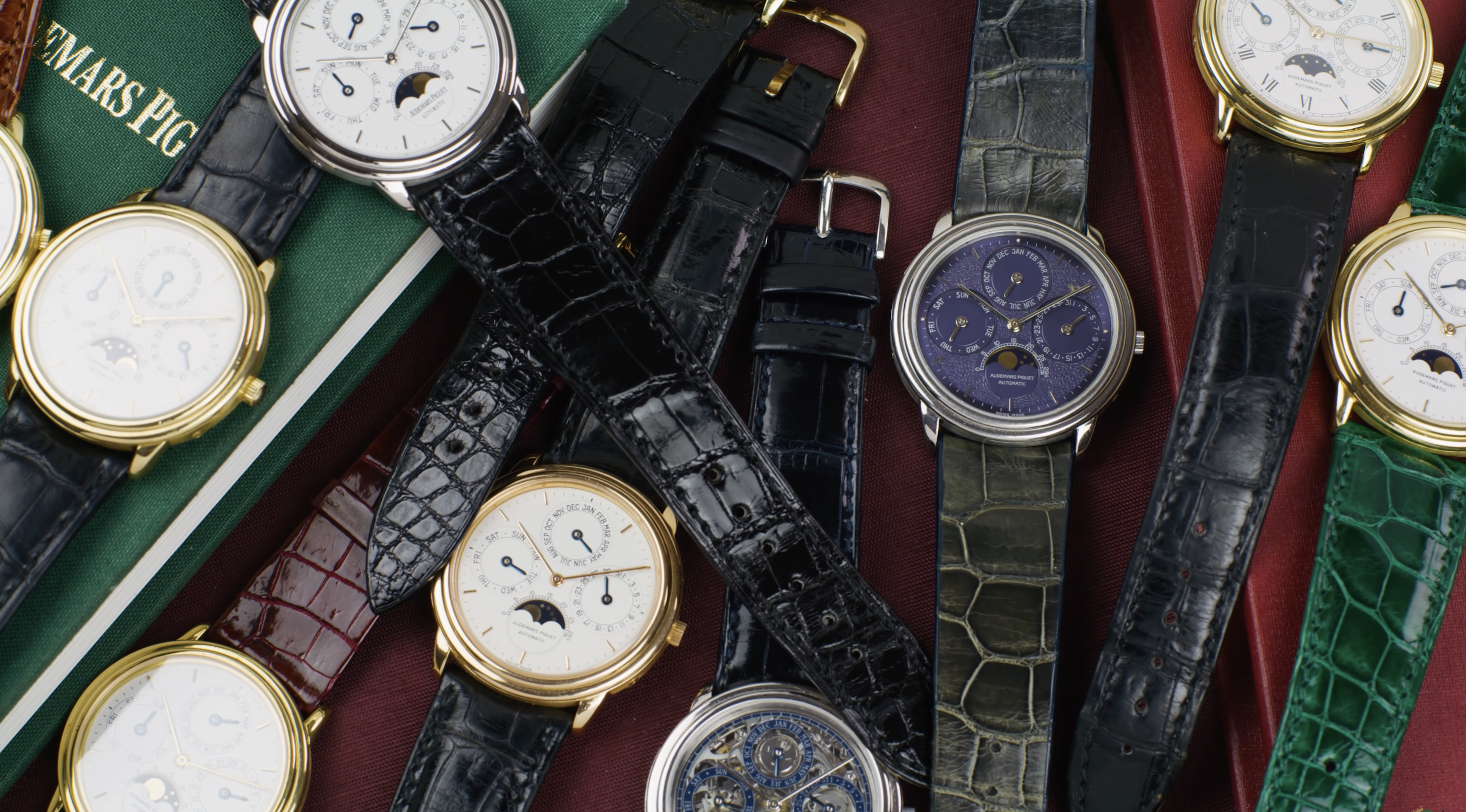
Audemars Piguet Quantième Perpétuel Classique
Gérald Genta and his Royal Oak are often credited with saving Audemars Piguet during the Quartz Crisis. Whilst the Royal Oak certainly played its part, three other men deserve at least as much credit: Wilfred Berney, Jean-Daniel Golay and Michael Rochat. The trio, respectively an after-sales manager, head of the technical department and a watchmaker, worked in secret on a rather ballsy project. What they eventually presented did not only mark an important chapter in the history of Audemars Piguet, but arguably helped secure the manufacture’s future for many more years to come.
History
The story starts in the 1970s. As most watch lovers know, this was perhaps the most difficult decade the traditional Swiss watch industry had ever faced. The market was changing drastically and demand for mechanical watches was falling rapidly, let alone for expensive and complicated mechanical marvels. Against this backdrop, the trio began developing something that made very little commercial sense at the time: an ultra-thin automatic perpetual calendar.
George Golay, CEO of Audemars Piguet, immediately understood what they had created. The result was calibre 2120/2800, and in 1978 Audemars Piguet introduced the first watches powered by it. The initial batch was immediately received with great enthusiasm. The Quantième Perpétuel Classique would become one of the backbones of the Audemars Piguet collection for the following decade and a half. And, as we are used to with AP during this period, production remained relatively small while the number of different executions was enormous.
That is exactly what makes these watches so interesting to study today. We have had the pleasure of handling quite a few of them over the years, so we will put several references and executions side by side and look at the differences, similarities and occasional oddities.

Case
First and foremost, we have to talk about thickness. After all, being exceptionally thin was one of the main reasons this watch was so important in the first place. Despite housing an automatic perpetual calendar, the case measures only around 7mm thick. Depending on the reference and execution, some versions can measure roughly a millimetre more.
There are numerous case designs within the QP family, including the so-called “Clover” or “Juggernaut”, octagonal cases and even twelve-sided examples. The classical round cases, however, generally measure around 36mm in diameter: my absolute sweet spot.
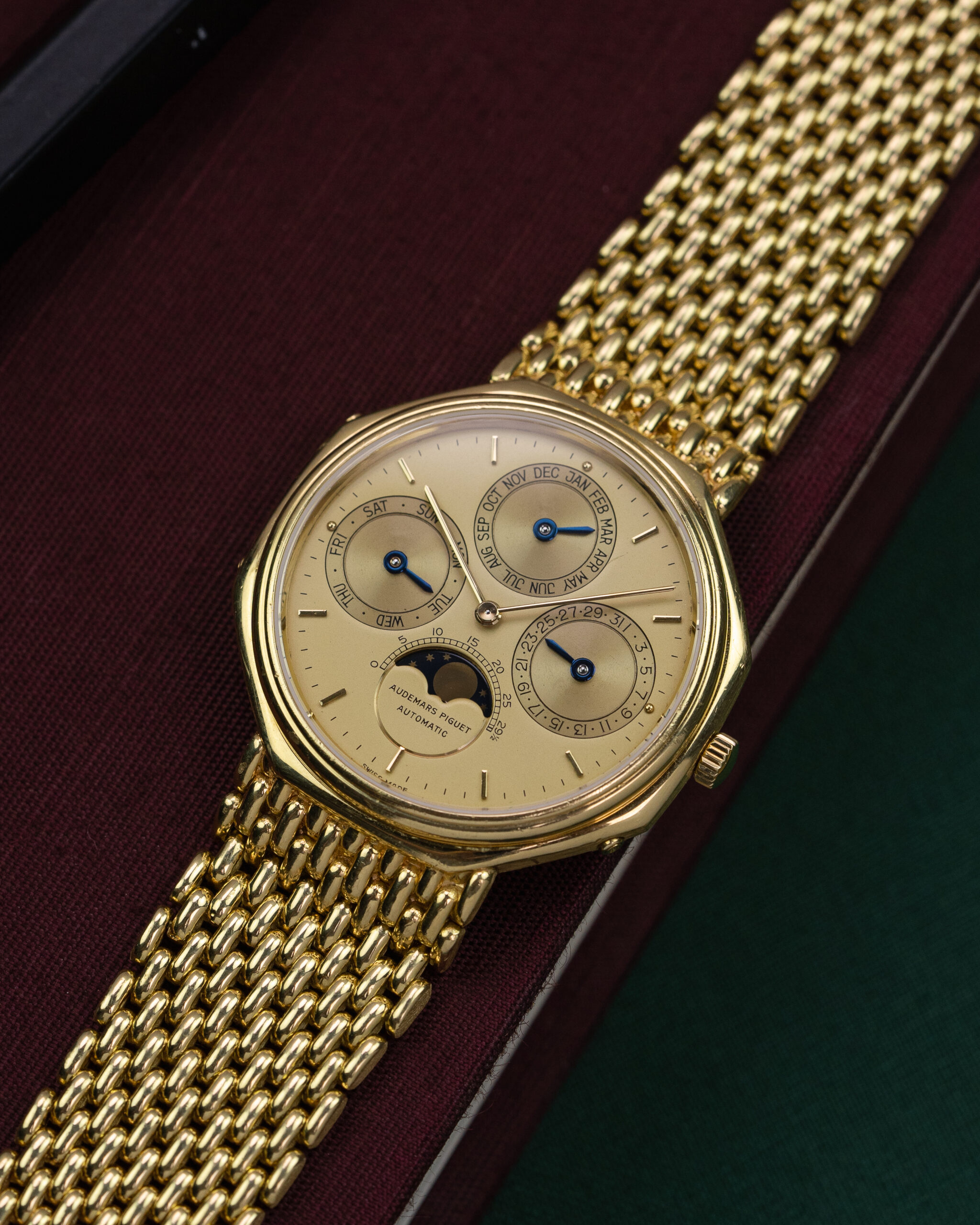
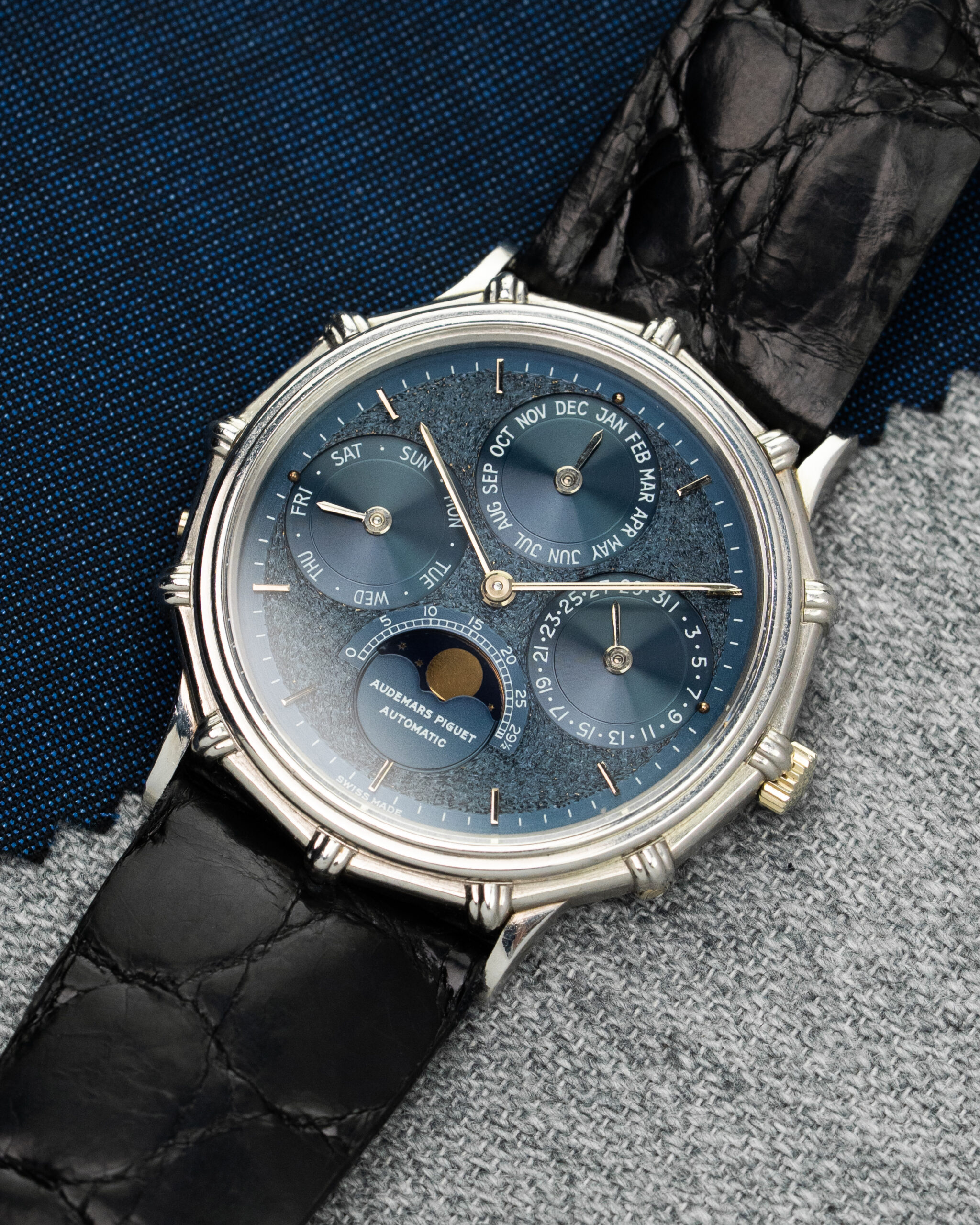
Within these seemingly similar cases there are plenty of differences. Audemars Piguet used two main constructions, gradually updating the case back, correctors and bezel to improve water resistance. The second generation began appearing around the mid-1980s.
Earlier cases generally have softer, more rounded lugs that flow closely into the bezel. The bezel itself is also noticeably higher than on later examples. Later cases received a differently shaped case back, sloping towards the edge rather than being heavily rounded. The correctors became less exposed as well, sitting deeper and enjoying greater protection from the case.
On rarer occasions, Audemars Piguet fitted these watches with a sapphire display back. Reference 25661 is a good example. In most respects it is closely related to the 25657, but the sapphire case back makes it considerably rarer, with only 342 examples produced.
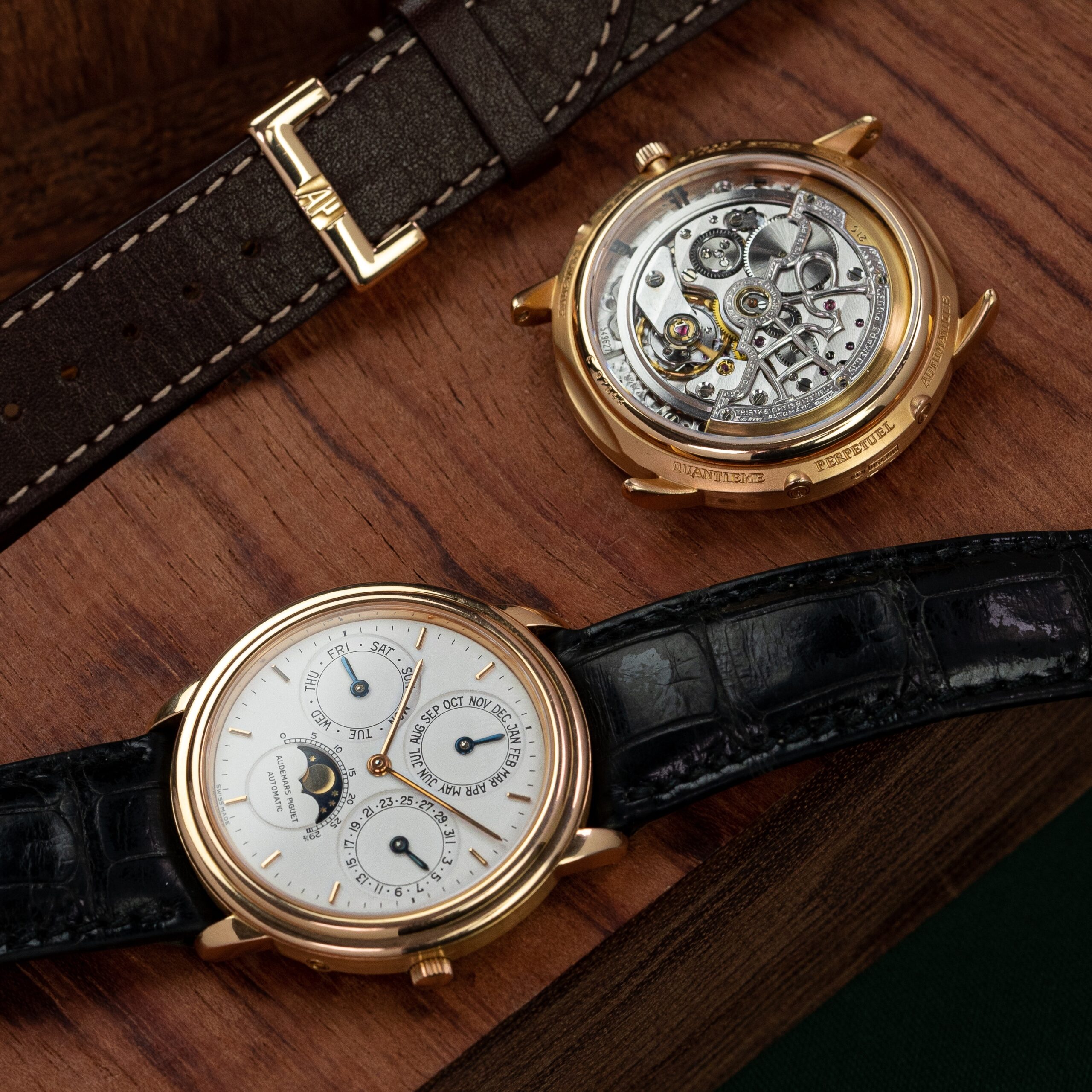
Case-back engravings also evolved throughout production, with differences in font, size and positioning depending on the period. The same applies to the hallmarks, making the case itself an interesting area of study.
Of the more than 5,000 Classique QPs produced, the majority were made in yellow gold, followed by pink gold and platinum. White-gold and bicolour examples are considerably rarer. According to production records, Audemars Piguet even experimented with steel on only a handful of occasions. Unfortunately, the current whereabouts of those watches remain unknown.

Crown
As per usual we also highlight the crown but we will keep it brief as there are many interesting features on this watch, yet the crown isn’t necessarily one of them. Straightforward plain crown without a logo, but ribbed for practical reasons.
Bracelet & Clasp
This watch either came on an integrated bracelet in matching metal to the case, or with a leather strap between the lugs with a width of 20mm. In case of the last-mentioned; due to the short lugs the strap is very close to the case, that therefore uses a recess to properly fit it. Whilst it is harder to adjust it to the right size, the integrated bracelet plays an exciting role on some models and shouldn’t be considered less valuable, as is the case with some other dress watches with such bracelets.

Dial & hands
Now onto the most interesting part in my humble opinion, at least the part that plays the biggest role in the value of the QP: the dial. The brand name can be found underneath the moon phase at the 6 o’clock position and above “Automatic”. Up top we can find the month indication. On the right side of the dial the date and on the opposite side the day. Please note there is no leap year indication even though the movement features this complication. Usually rather short applied stick markers are used that are as thin as the handset that displays merely the hour and minutes, no second hand.


Before highlighting some rare and extraordinary examples, we will dig into the regular opaline white dials in chronological order. All started with the ref 5548, this model is signed only with “Swiss” at the bottom up until 1982 when they changed it in “Swiss made”. The sub-dial above that, is an open semi-circle until 1984 when a faint outline of a full circle is added.
We can distinguish 3 different sub-dial constructions. Besides fully recessed or totally flat, there is a variety in-between, where only the center of the subs are lowered. Further differences in details are seen in the graphics & font. More or less serifs, possibly a hooked 7 and closed or open 9’s. Late dials have the capitalized A and P in the brand name.


Now over to the more exotic dials. Part of the fun in collecting this highly important model, lies within the many different dial variations: some in very small quantities or even unique examples. A subtle variation can be in the markers; instead of the usual applied sticks one can occasionally expect painted Arabic or Roman Numerals. Gem-set indices are most commonly found in a diamond adorned case. Another popular configuration has the “Open worked dial”, consisting of a sapphire crystal dial; often combined with the display case back.
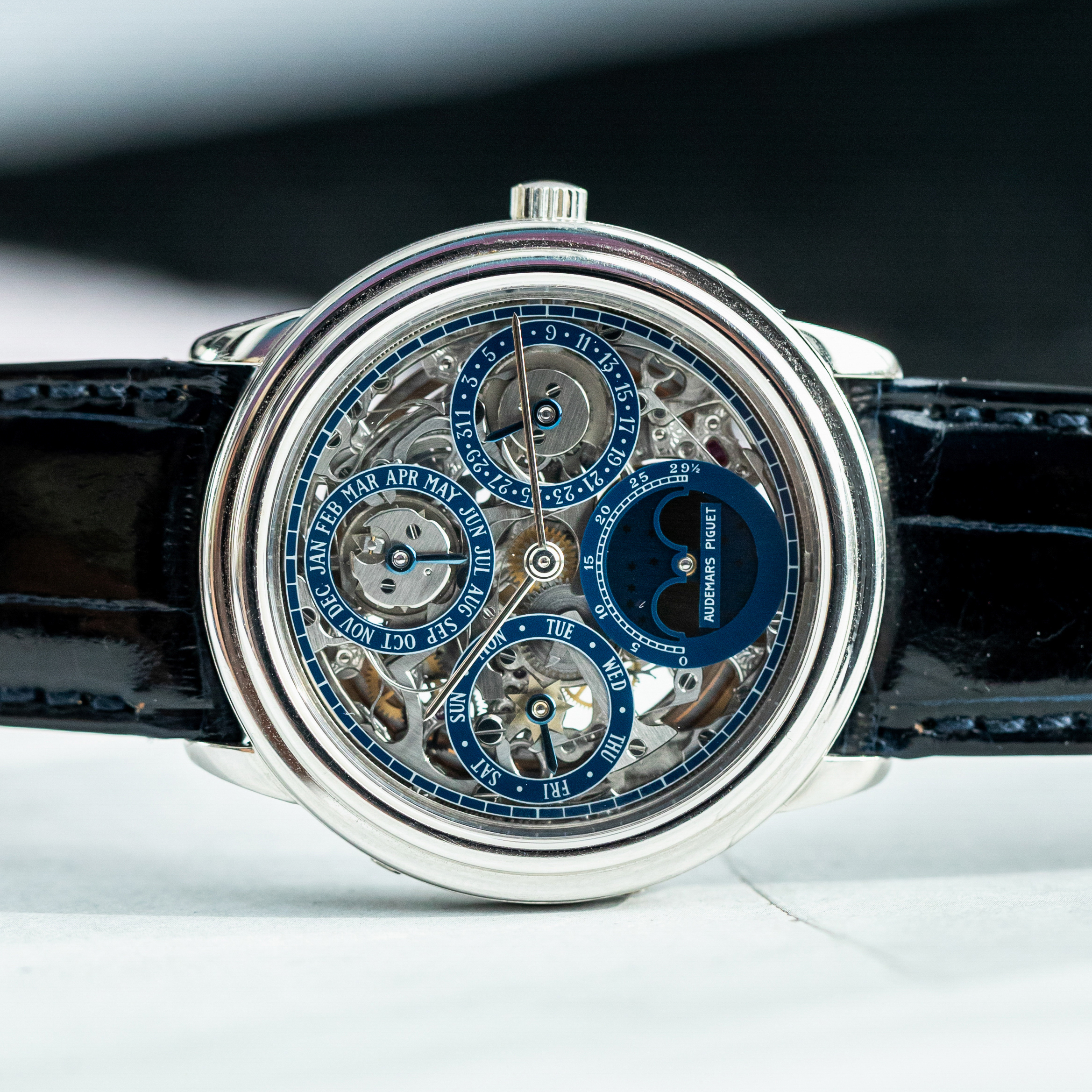

Different colors other than the white ones are rare too, like champagne, grey or Salmon or how about a dial made out of Mother-of-Pearl. Blue is popular too and are especially stunning when “Tuscan”. This motif is applied onto the surface of the dial and can be seen in some QP Royal Oaks as well. This is not the only decoration in relief used; some pieces have the pleasure to feature the art of guilloche or engine turning in different patterns.


Movement
Last but definitely not least is the movement. It is easy to forget what is the engine of this project with so many other aspects to enjoy, but once again: the thinnest automatic perpetual calendar ever. Cal. 2800 was born out of the 2120, which is the no-date version of the 2121 indeed; that time-only movement also utilized in the first Royal Oaks (ref. 5402). But it already saw light in some dressier pieces after Jaeger-LeCoultre completed production in the late 60’s.
Cal. 2800 has a free-sprung Gyromax balance wheel, a rotor supported by a circular rail and a suspended mainspring barrel. The degree of finishing and decorating depends on the period, reference, material and if it has a see-through case back.
Make no mistake, they weren’t unique in choosing this movement for an ultra-thin perpetual calendar, don’t forget about Vacheron Constantin’s counterparts for example.

Conclusion
It is my intention to emphasize the historical importance of this model. Golay understood the significance straight away when he immediately launched 159 of these QP’s, about as much calendar-wristwatches as AP produced in the previous half a century combined; In the midst of the quartz-crisis nonetheless! And it came at a hefty price tag of 15.500CHF, for reference, that was around quadruple the price of a steel Royal Oak. In 15 years of production they created 70 different models of the QP. Within these models there are close to 200 variations, designed by Jacqueline Dimier. Even though possessing a different style, some even dubbed her as the female Gerald Genta. Whatsoever, all these varieties are one of the reasons it is so fun to explore and why they’re gaining momentum with collectors.