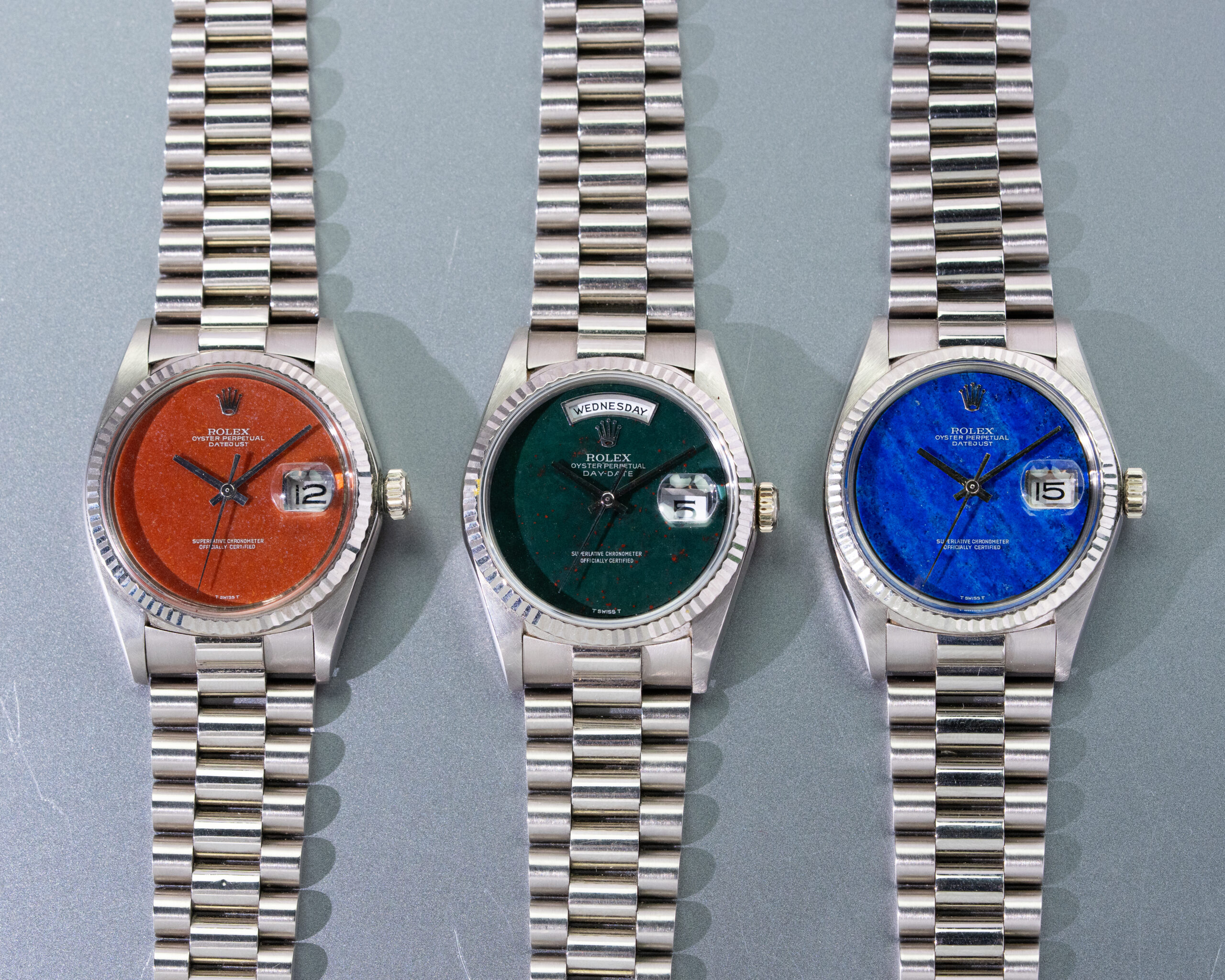
Rolex Stone Dials
Introduction:
If I told you that Rolex produced thousands of truly unique watches, you might think I was misusing the word “unique”. After all, how can something produced in such considerable numbers still be a one-off? With stone dials, however, that is quite literally the case. Every dial was created with the help of Mother Nature. No two pieces have exactly the same structure, colour, inclusions or pattern. That is part of what makes Rolex stone dials so fascinating to collect. Here some excerpts from master catalogues, already teasing some variety.
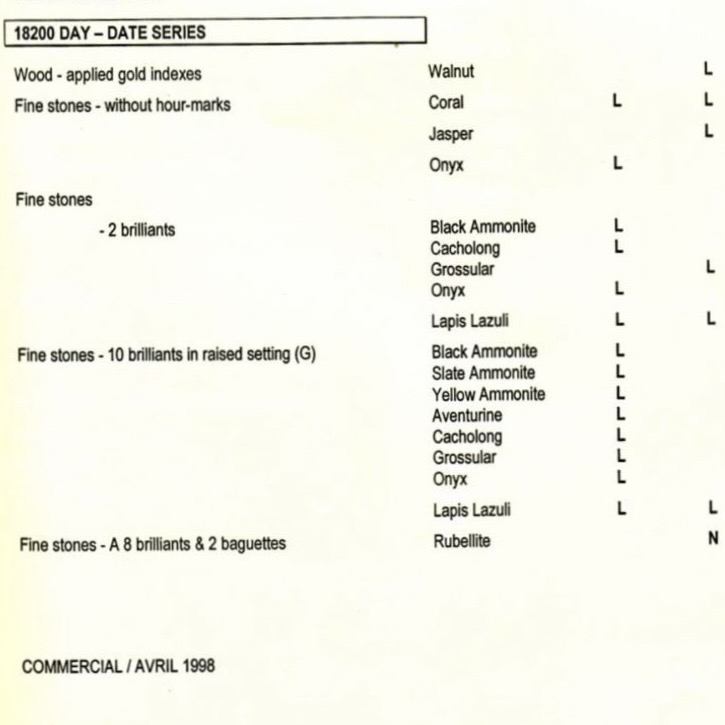
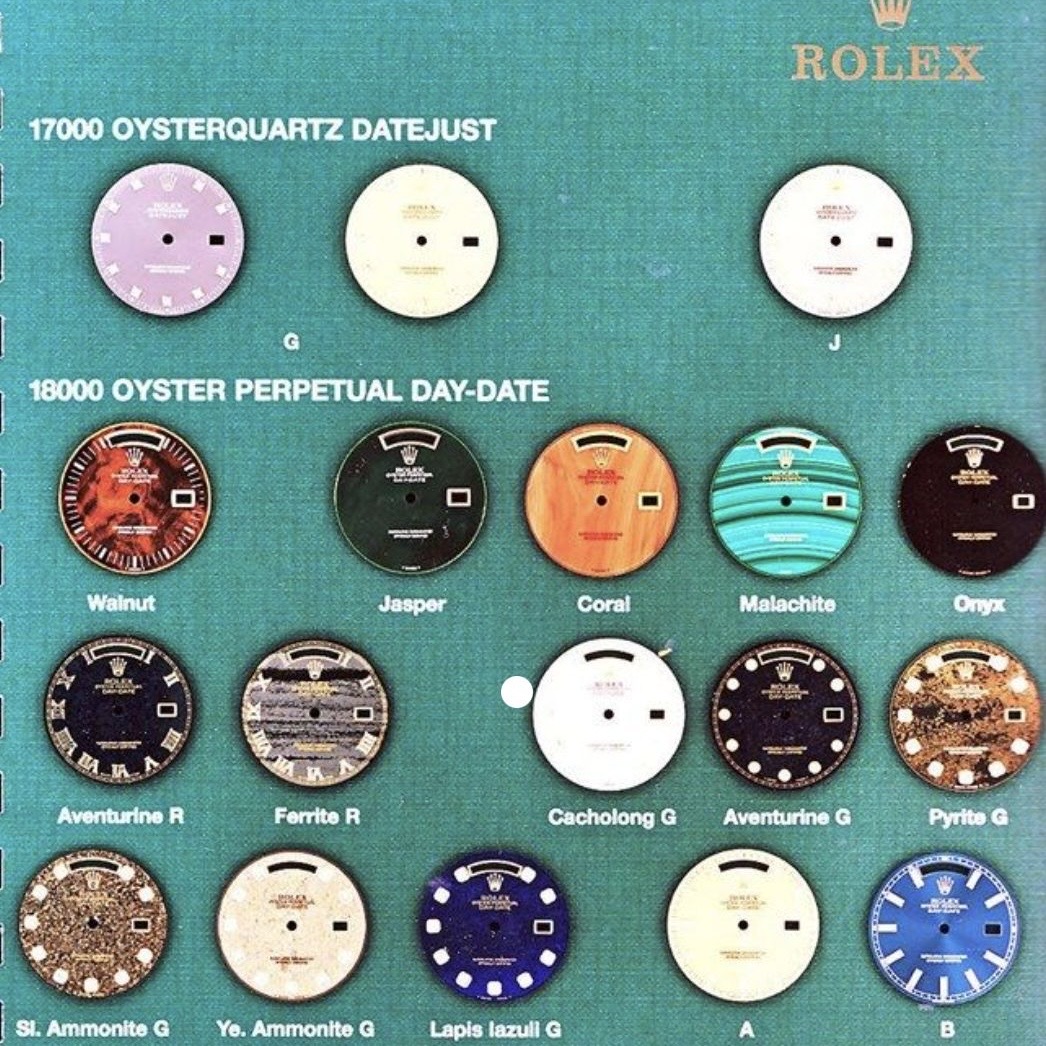
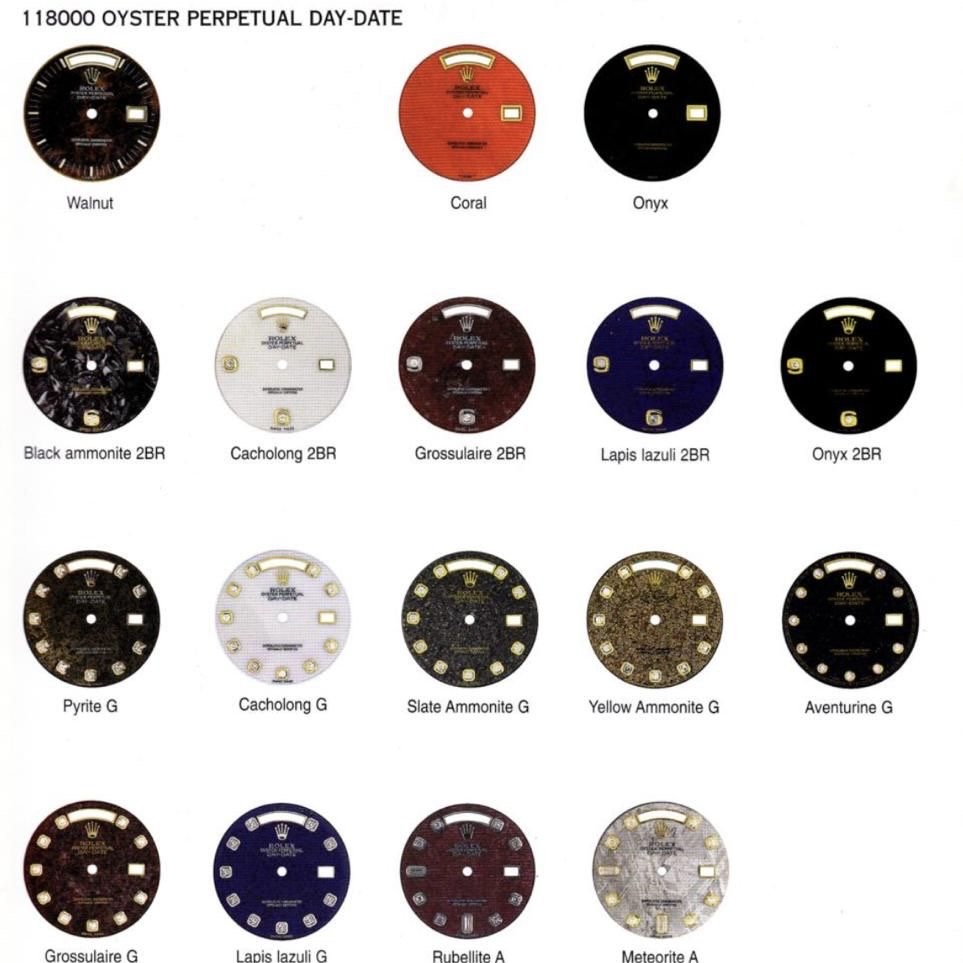
In this guide, we are going to dive into the world of Rolex stone dials: how they were made, the different generations and, of course, the variety of minerals Rolex used over the years.
The Basics:
As you probably know, I am absolutely obsessed with watches, but much of my formal education lies in gemmology. After graduating, that background turned out to be surprisingly useful in my profession as a vintage watch dealer, particularly when examining the originality and quality of gem-set watches. Precious stones can occasionally be found almost everywhere on a watch: on the case, bracelet, bezel, crown, dial and, in some exceptional cases, even the hands. But there is something particularly fascinating about a watch whose entire dial is cut from stone.
I started collecting and studying Rolex stone dials about a decade ago. Rolex was certainly not the only manufacturer to experiment with natural materials, but the sheer variety of its production, combined with the collectability of the watches themselves, has made Rolex stone dials a category of their own.
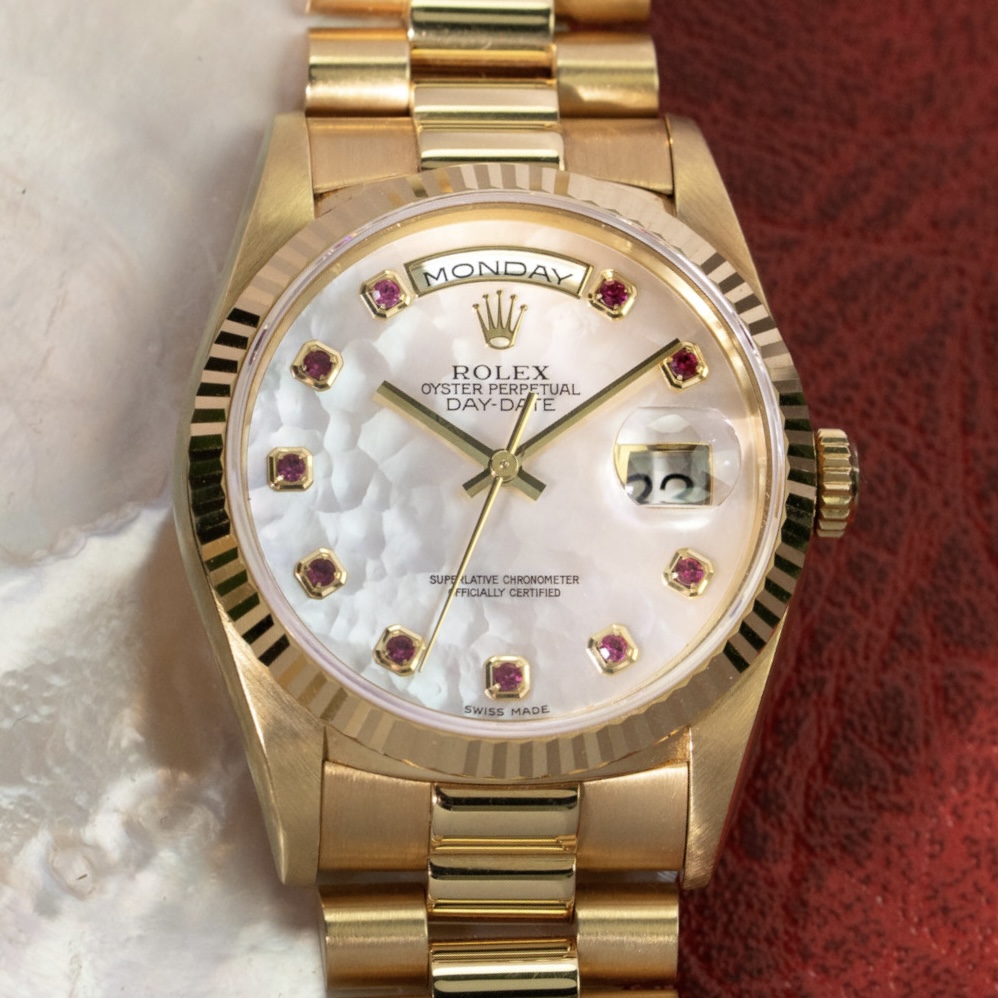
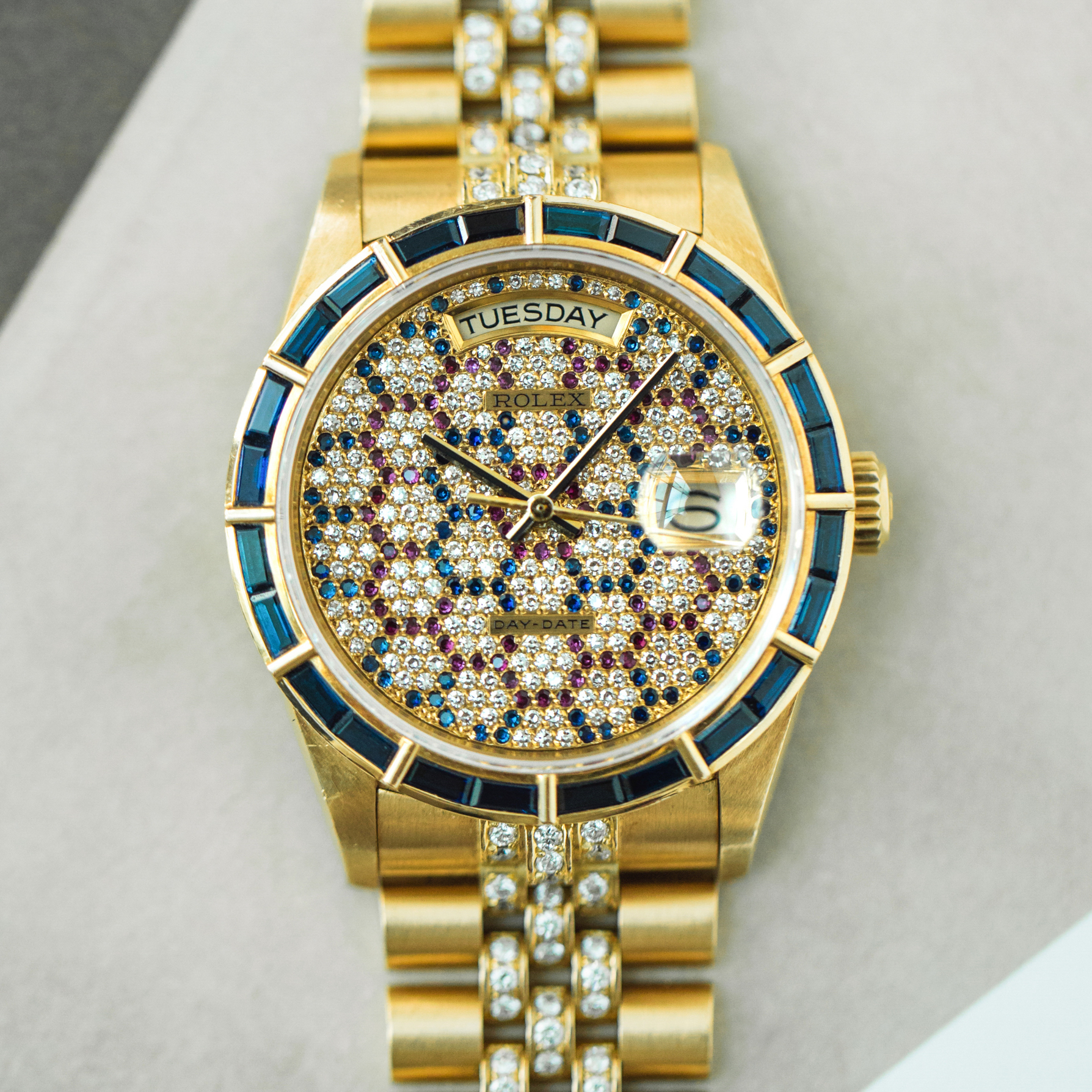
So what exactly do we mean by a “stone dial”? Not every naturally occurring or organic material qualifies. Mother-of-pearl, probably the most encountered natural-material dial, does not fall within the category. Neither does wood. For the purpose of this guide, we are talking primarily about dials made from crystalline materials. It is also important to distinguish a stone dial from a dial that is merely set with precious stones. A diamond-set pavé dial, for example, is not considered to be a stone dial. The dial surface itself needs to be made from mineral material. We will look at the individual varieties in greater detail later.
Models:
Rolex began using stone dials in its regular production towards the end of the 1960s. Until approximately 1978, they were exclusively available on precious-metal Datejust models. They initially appeared on the 36mm four-digit Datejust references, with stone dials later becoming available for smaller Lady-Datejust models as well.
Producing these dials was exceptionally difficult. A thin slice of mineral had to be cut and finished to extremely tight tolerances, while the date aperture created an obvious weak point. Unlike a conventional brass dial, stone does not flex when put under stress. It cracks. This may also help explain why the Day-Date had to wait considerably longer before receiving stone dials. A Day-Date requires not one but two apertures to be cut into the material: the date window at three o’clock and the considerably larger day aperture at twelve.
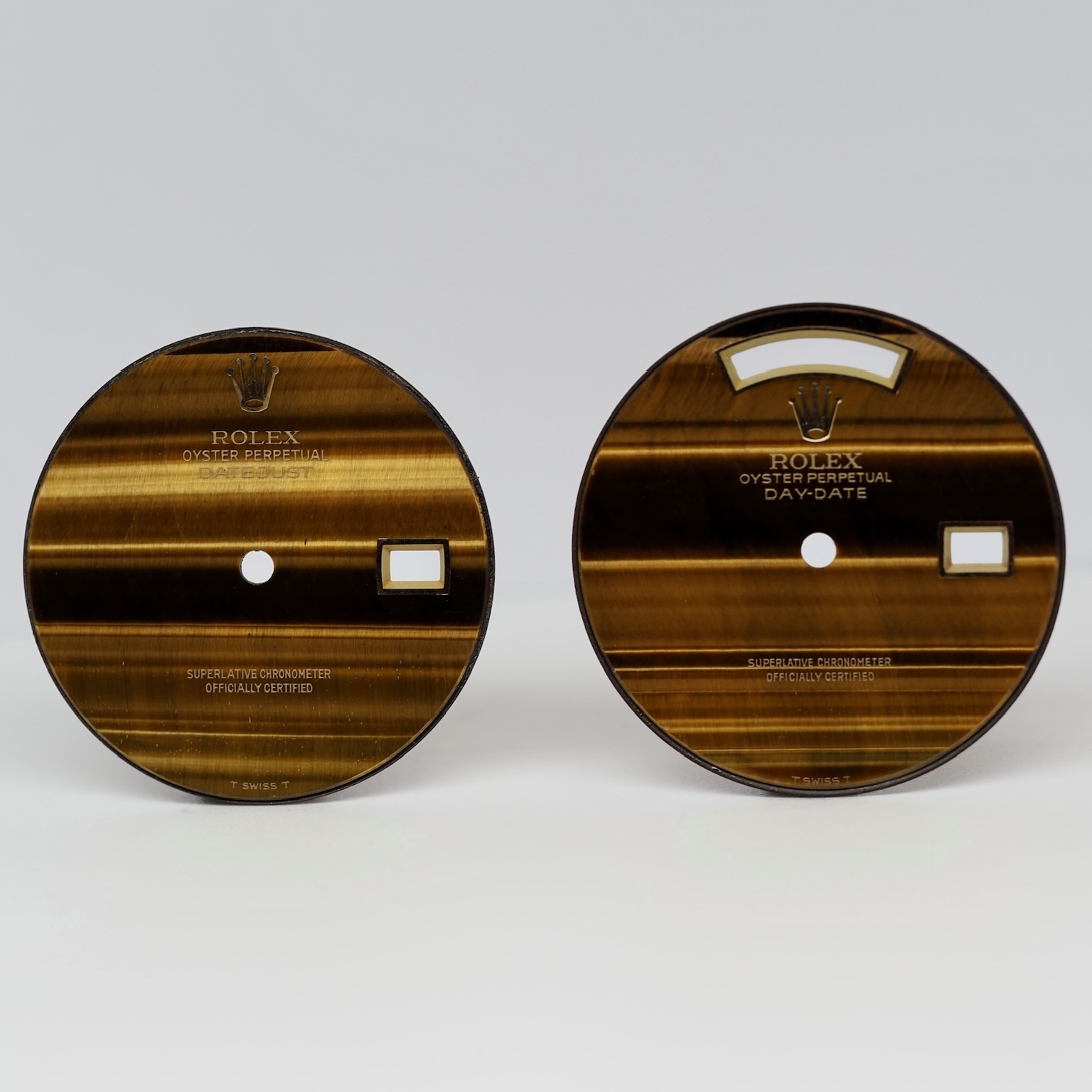
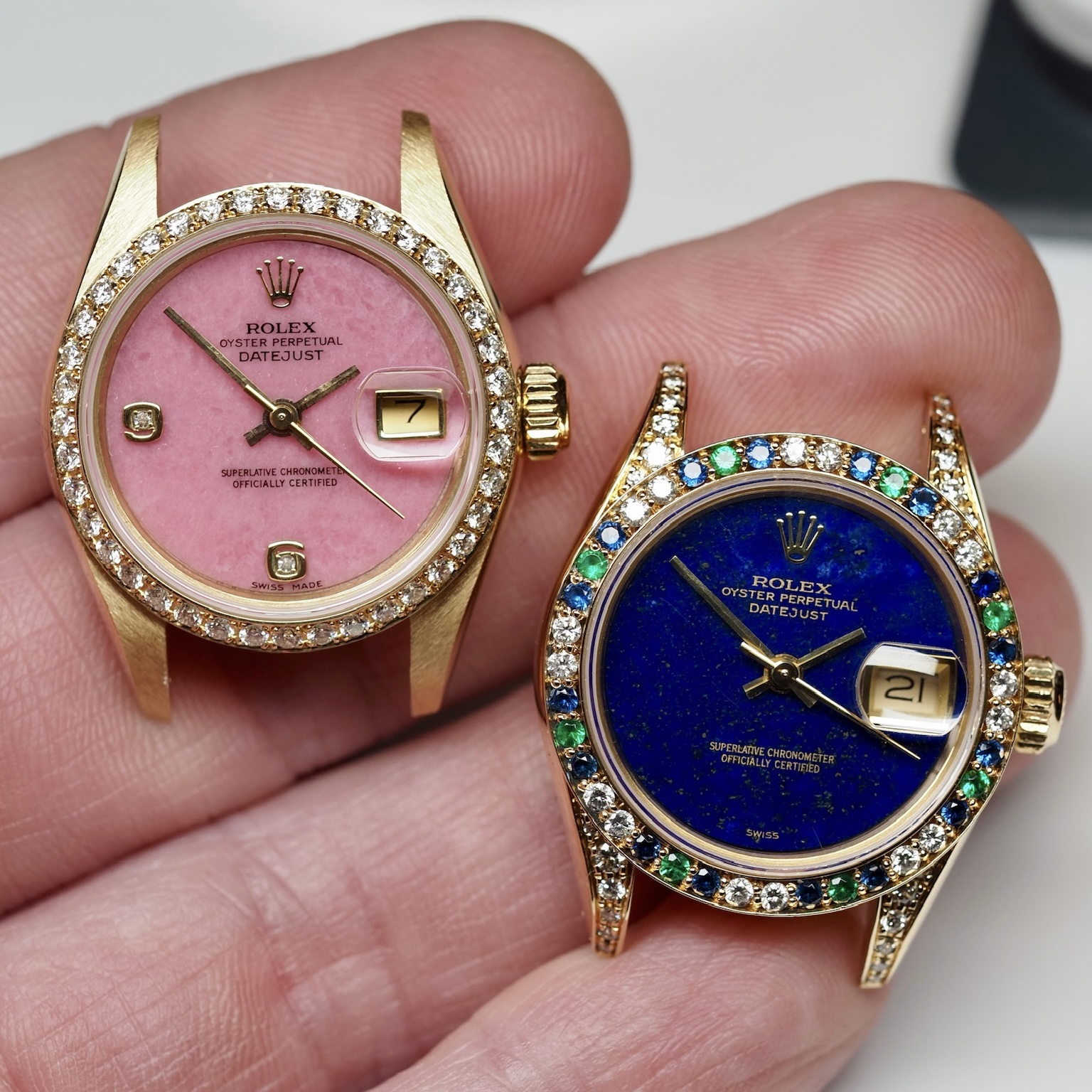
The Lady-Datejust stone-dial models generally remain less valuable because the collector market for the smaller watches is more limited. The 36mm versions, however, have become extremely sought-after and have seen a dramatic increase in demand over the past several years. The same applies to vintage stone-dial Day-Dates.
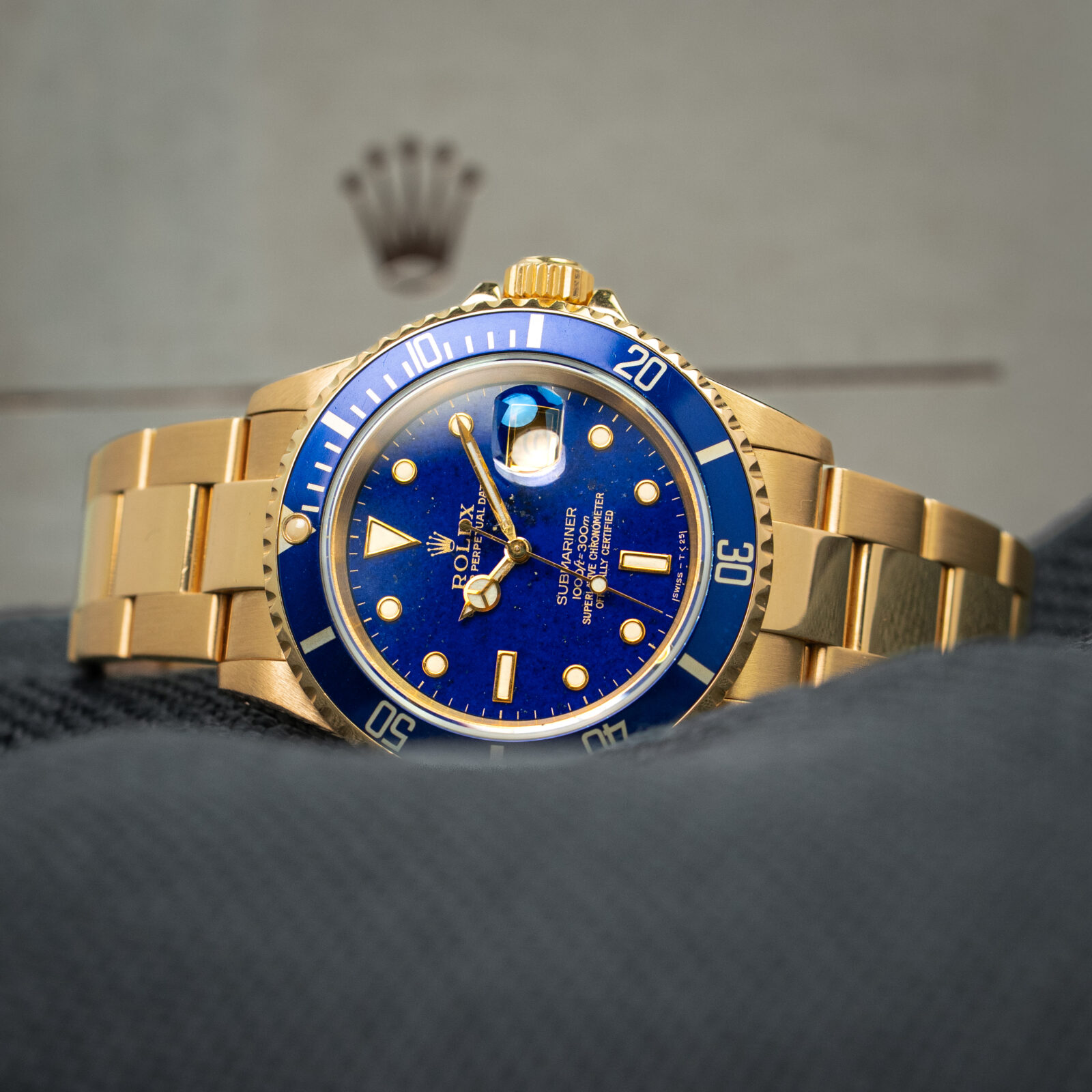
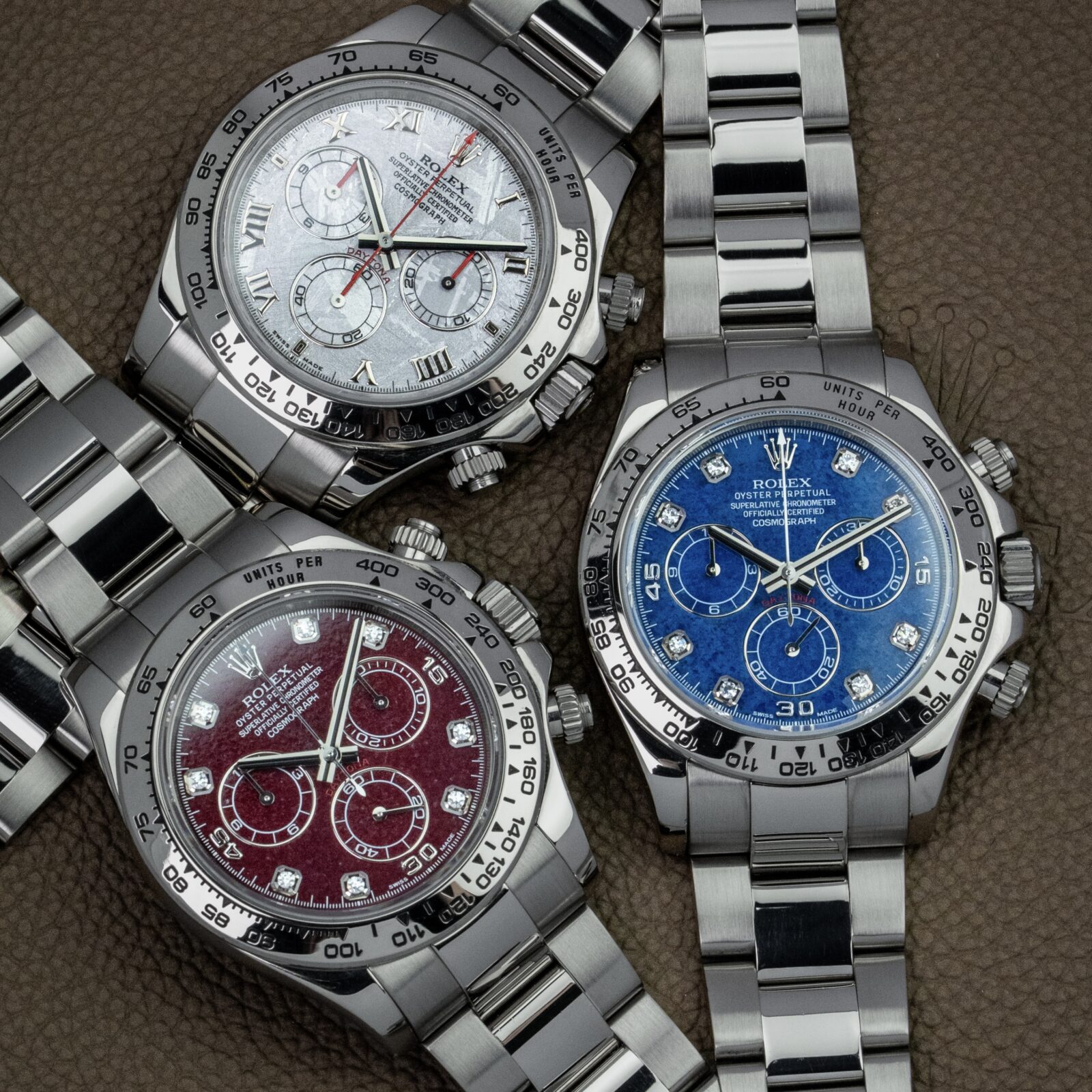
Perhaps that renewed interest also helps explain why Rolex has revisited natural stone in its modern collection, introducing materials such as eisenkiesel, aventurine, carnelian and turquoise for their current Day-Dates. Additionally they provided a stone dial option for a sportswatch: The Yacht-Master with a Falcon’s Eye dial. Yet, not the first professional model with such an option. The yellow-gold Submariner reference 16618, for example, was available with both onyx and lapis lazuli dials. The Daytona has also been produced with several spectacular stone-dial configurations. There are also many non-Oyster Rolex models fitted with mineral dials. For the sake of keeping this guide somewhat manageable, however, we will concentrate primarily on the vintage 36mm Datejust and Day-Date.
Generations:
Let’s look at the different generations in chronological order, beginning with the earliest dials signed “T SWISS T”. As most collectors know, the two Ts refer to tritium. This sometimes causes confusion with stone dials because they have no luminous material on the dial whatsoever and are often paired with non-luminous hands. However, the cliché used for these dials followed Rolex’s generic lay-out. The application of luminous material was the final stage in production. Consequently, just as we see on certain regular Rolex dials without lume, the presence of “T SWISS T” does not necessarily mean that luminous material was applied to that particular dial.
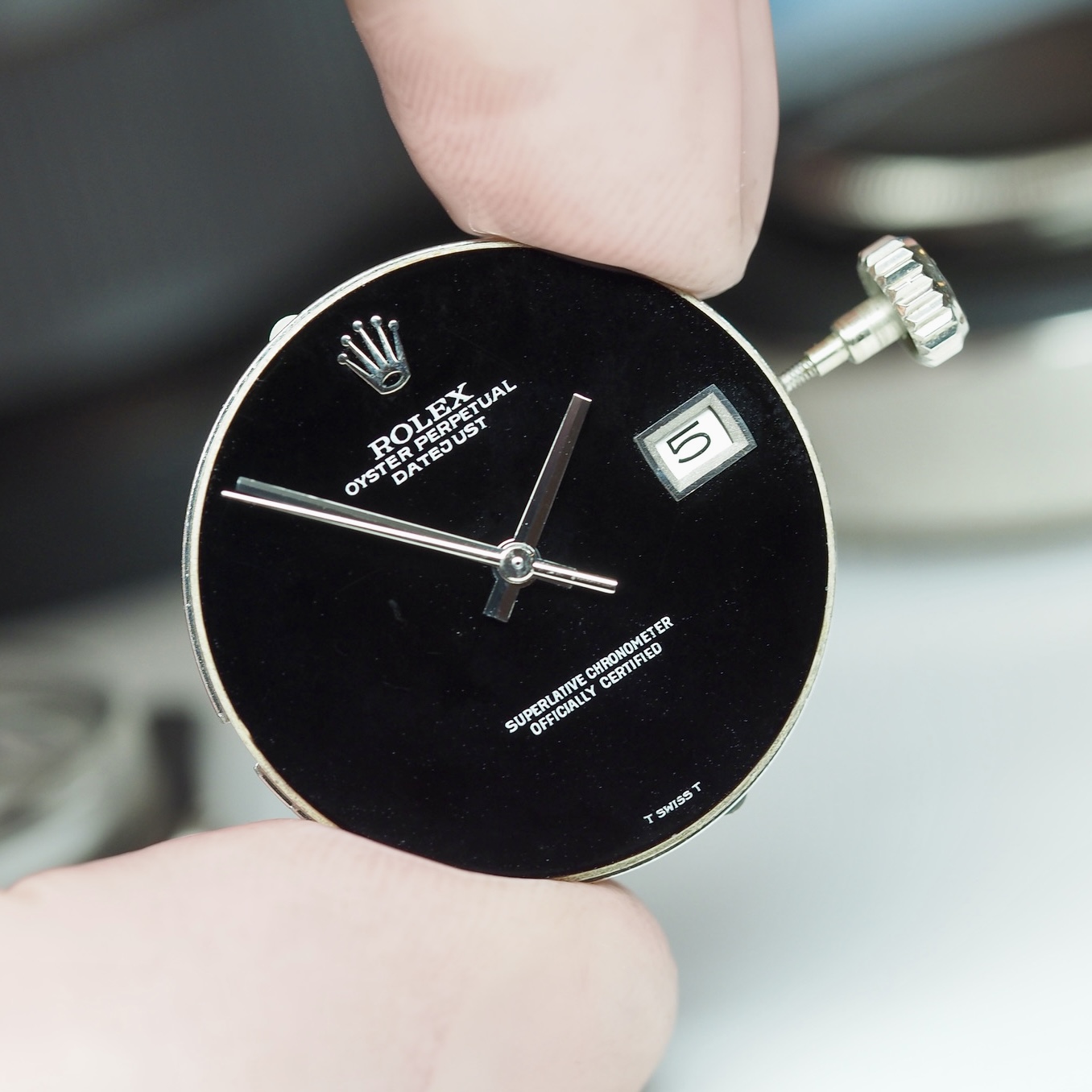
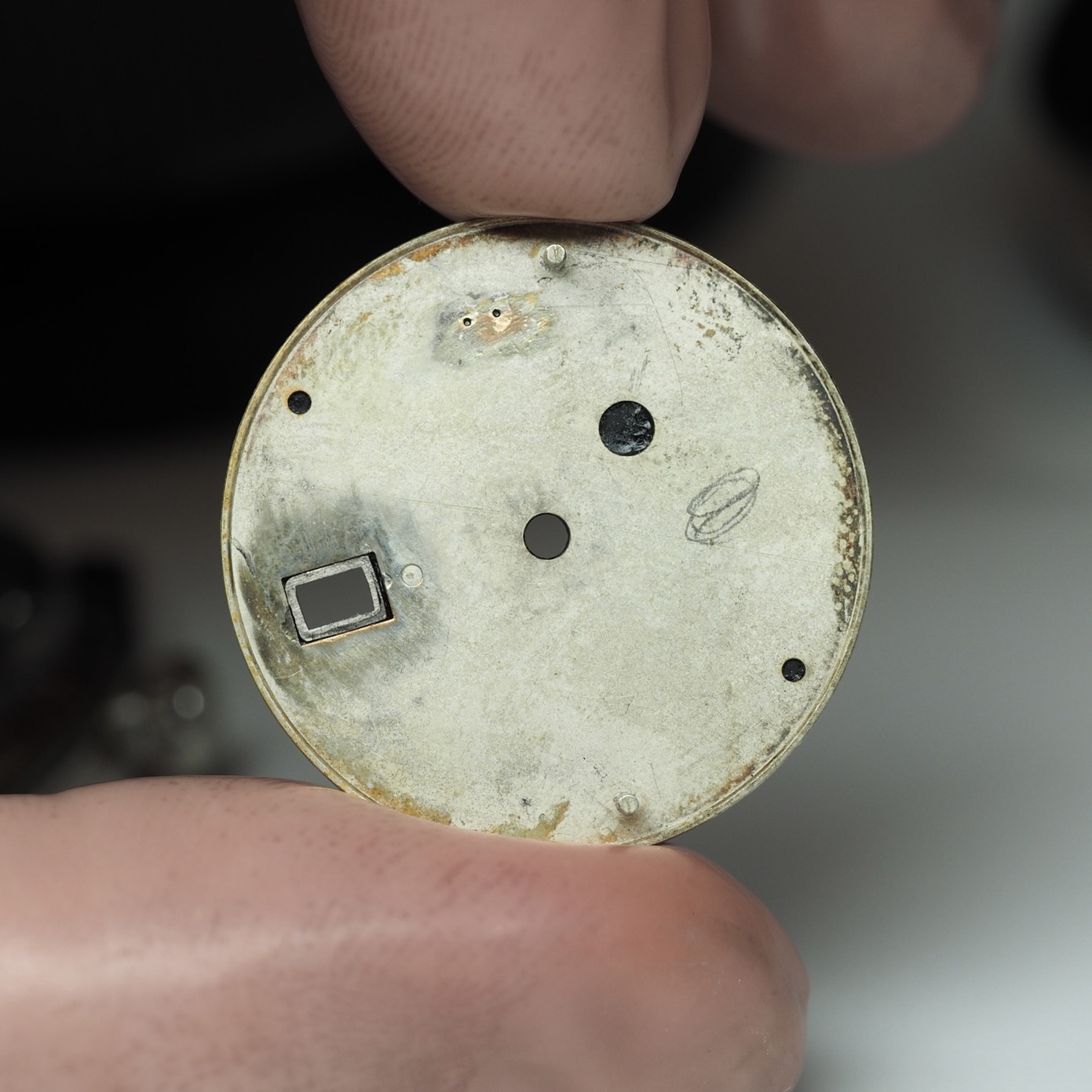
On the plexiglass generation, stone dials were available only for precious-metal Datejust models. Their construction is also different from the conventional 4-digit Datejust dials. The stone dials are mounted using dial feet rather than fitting over the movement in the same manner as a “pie-pan” dial would. Importantly, the position of these feet differs between the four-digit 16xx references and the later five-digit 16xxx generation. The dials are therefore not simply interchangeable between the two.
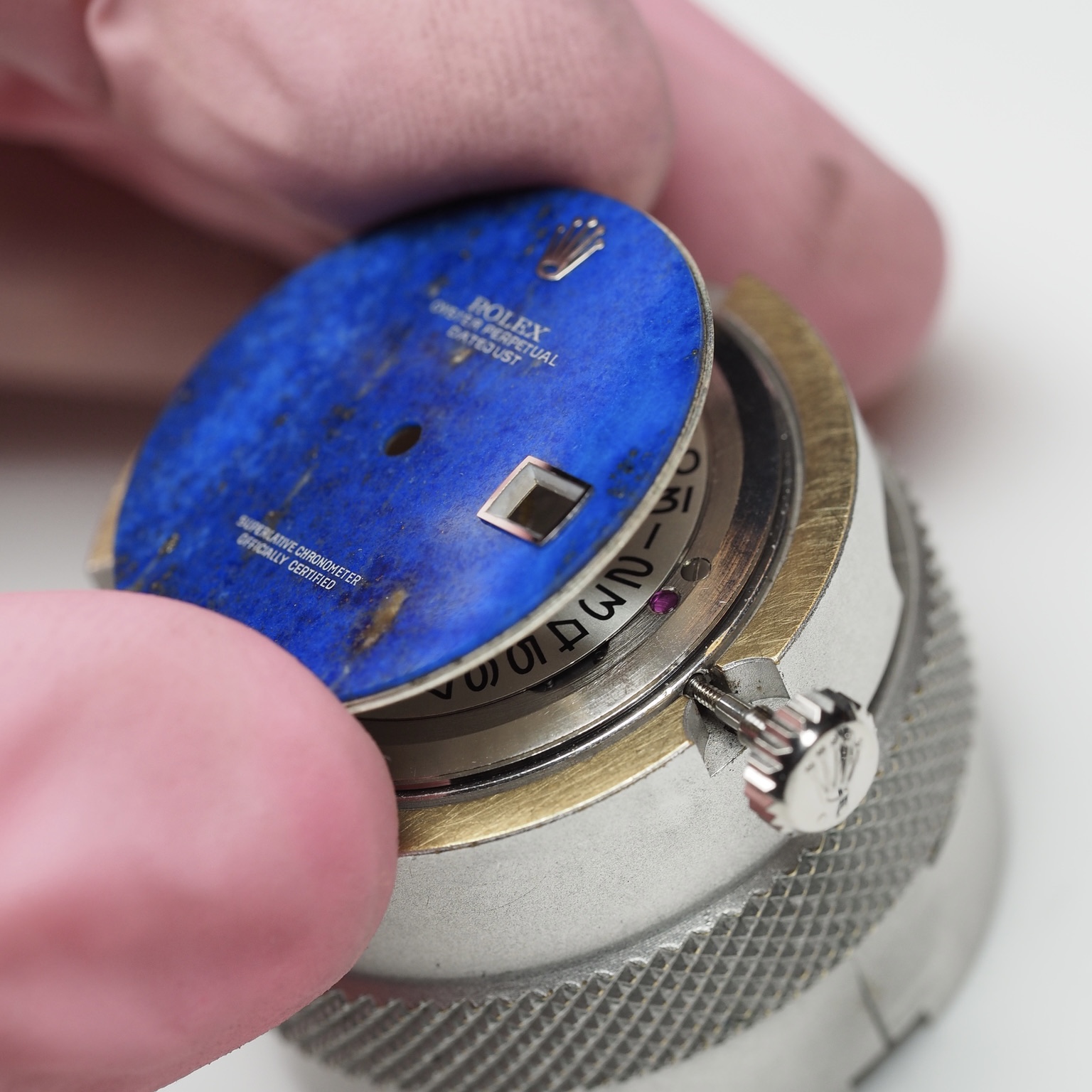
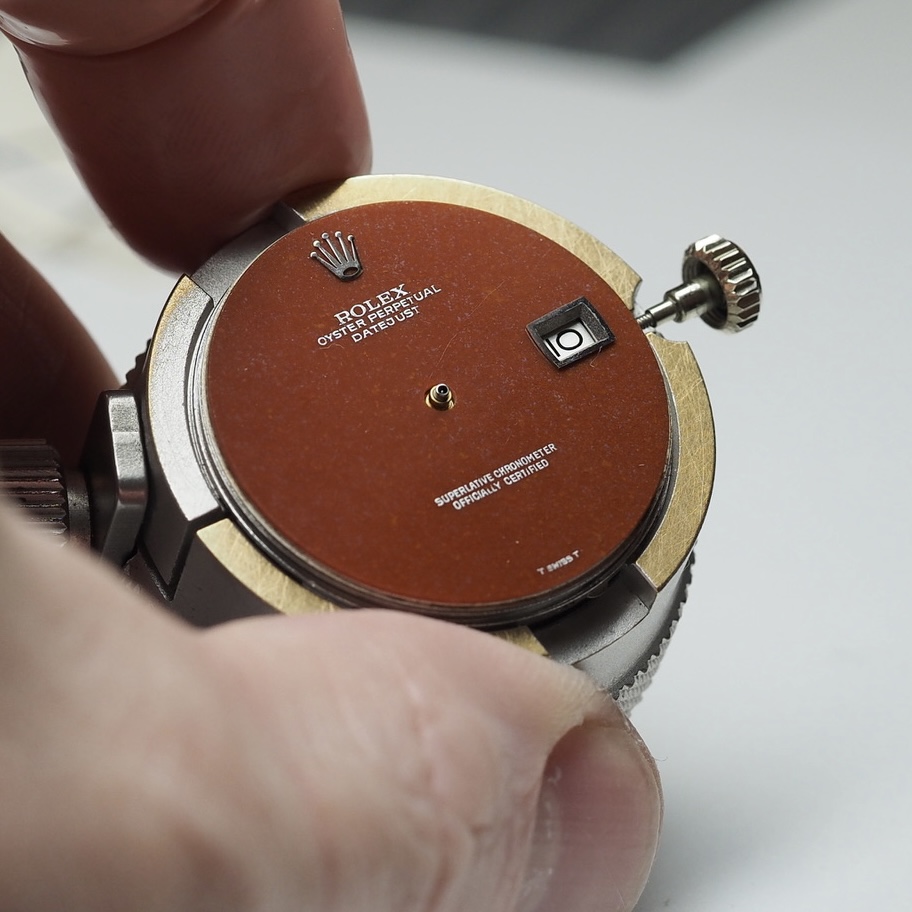
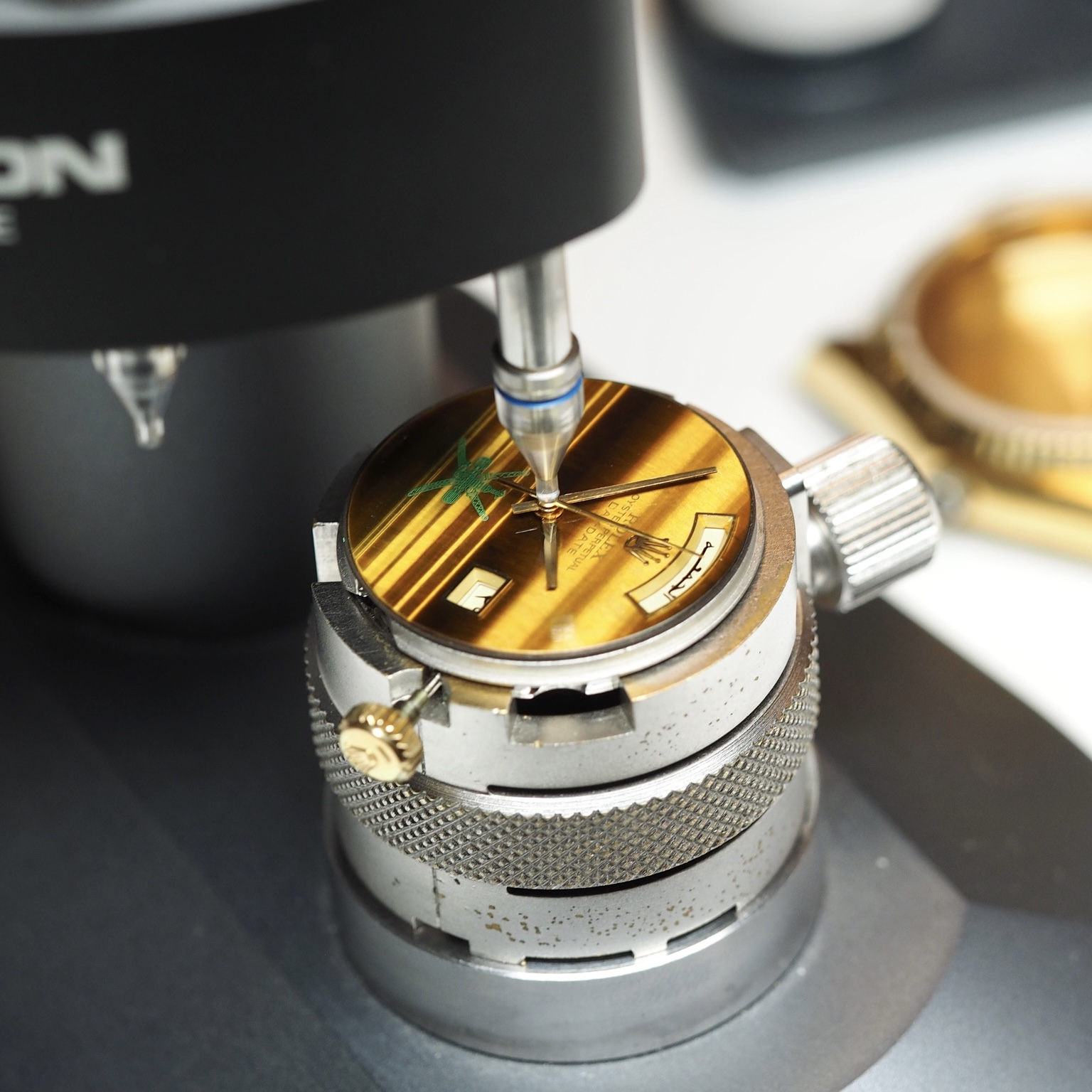
The use of “T SWISS T” on stone dials gradually disappeared during the late 1980s and was replaced by dials signed simply “SWISS”. Dates should not be treated too rigidly. Stone dials were expensive options and were often supplied on special request. A dial could therefore remain in stock for some time before eventually being fitted to a watch. As a result, it is perfectly possible to encounter, for example, a “SWISS” stone dial in a case dating from 1984, or a “T SWISS T” example in a watch from 1986, while both may still be completely correct.
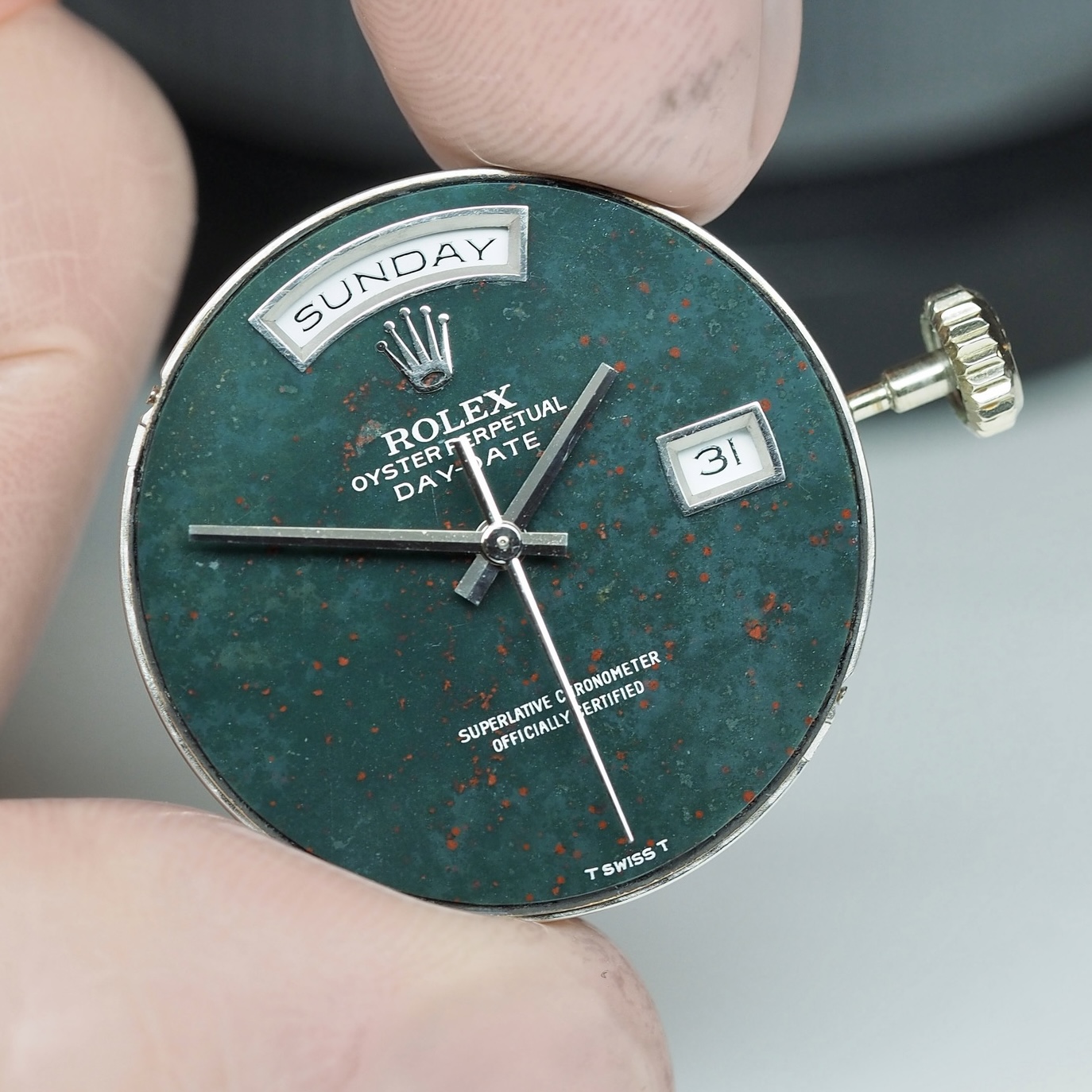
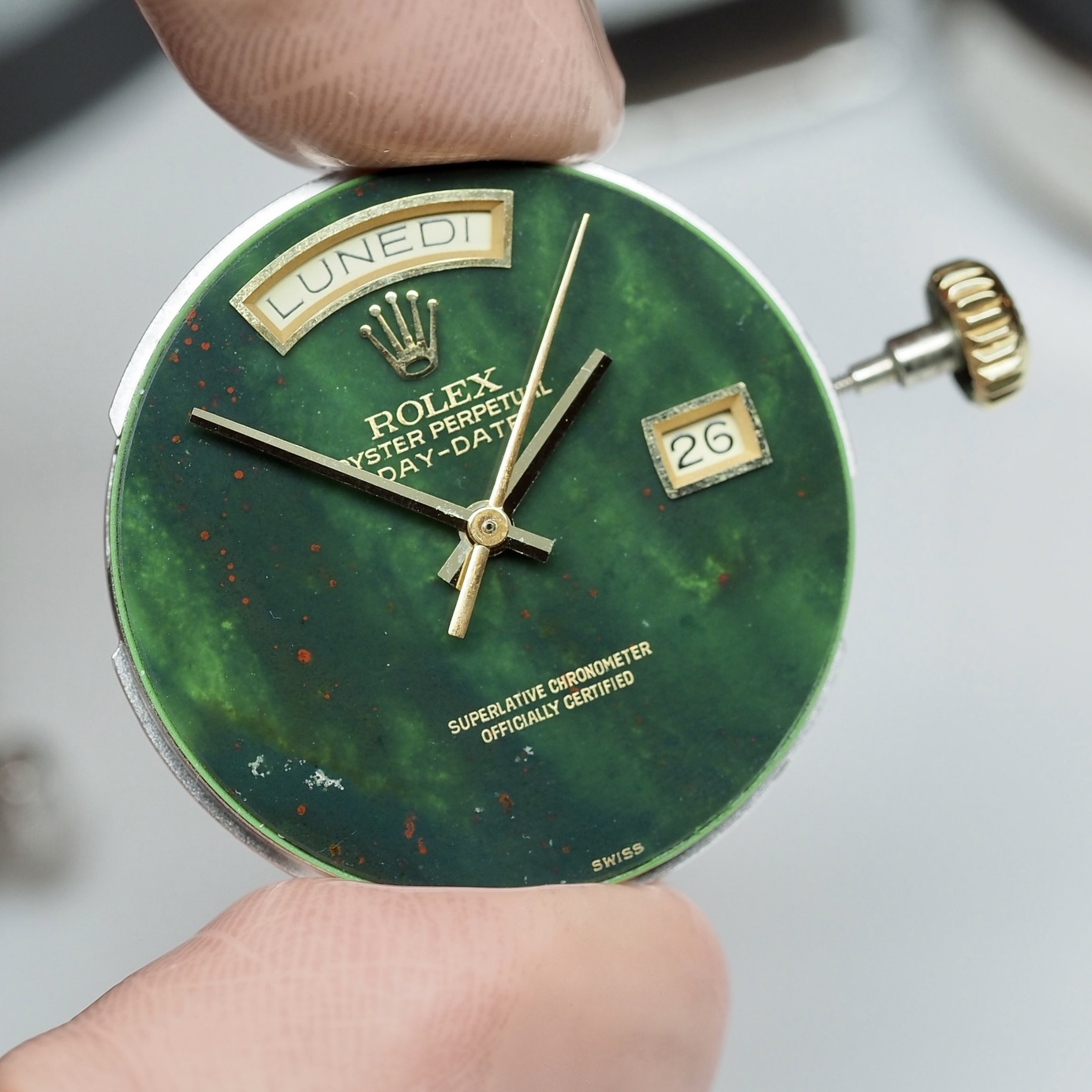
Personally, I would therefore have little problem with an earlier-production stone dial being mounted in a somewhat later case. The reverse (a clearly later-generation dial in a substantially earlier watch) would bother me considerably more. In such a situation, I would generally advise finding a more period-correct case to swap the dial.
The final generation, as well as many post-production service dials, is signed “SWISS MADE”. Depending on the exact configuration, dials with applied markers can also be found signed “T SWISS MADE T”, with later examples again carrying simply “SWISS MADE”.
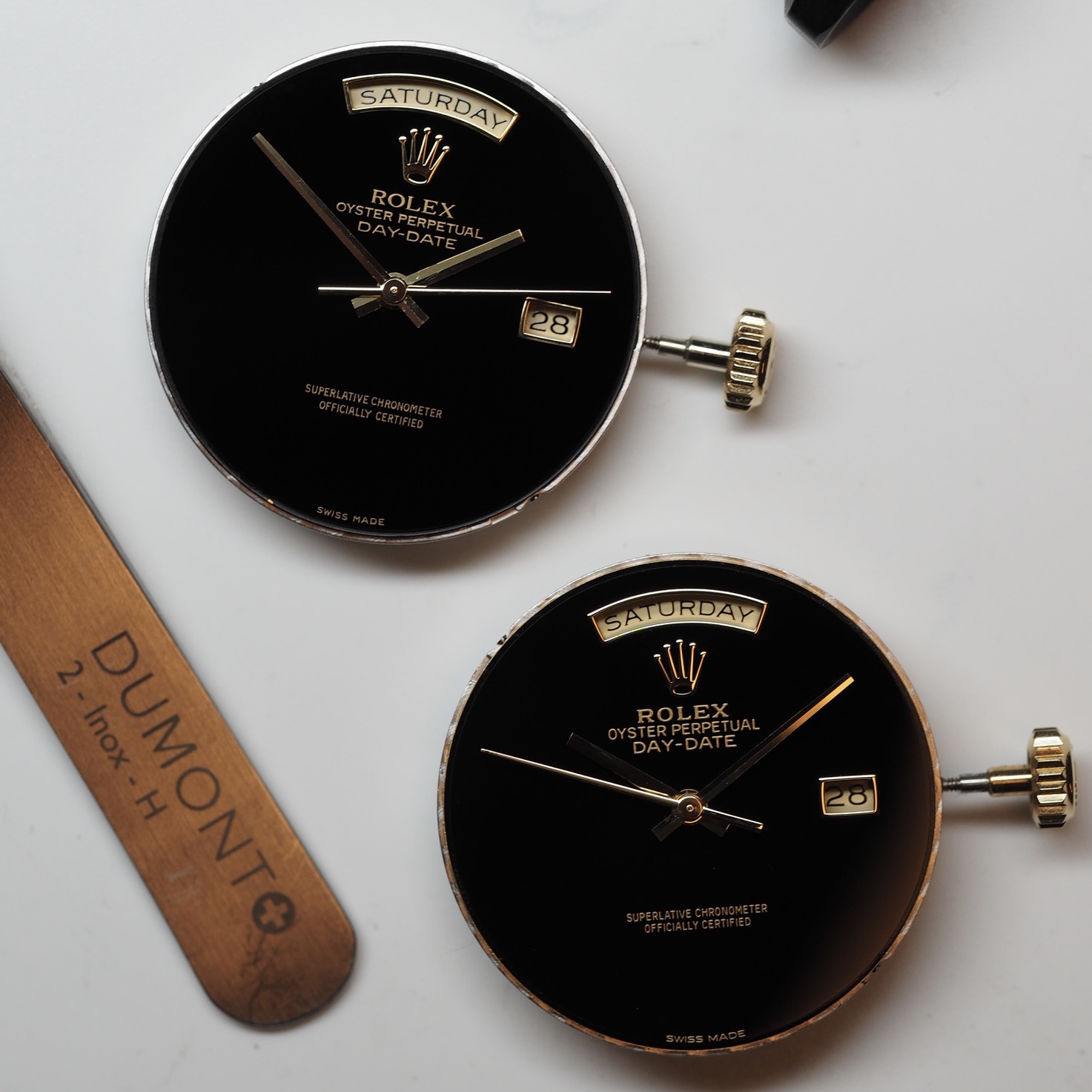
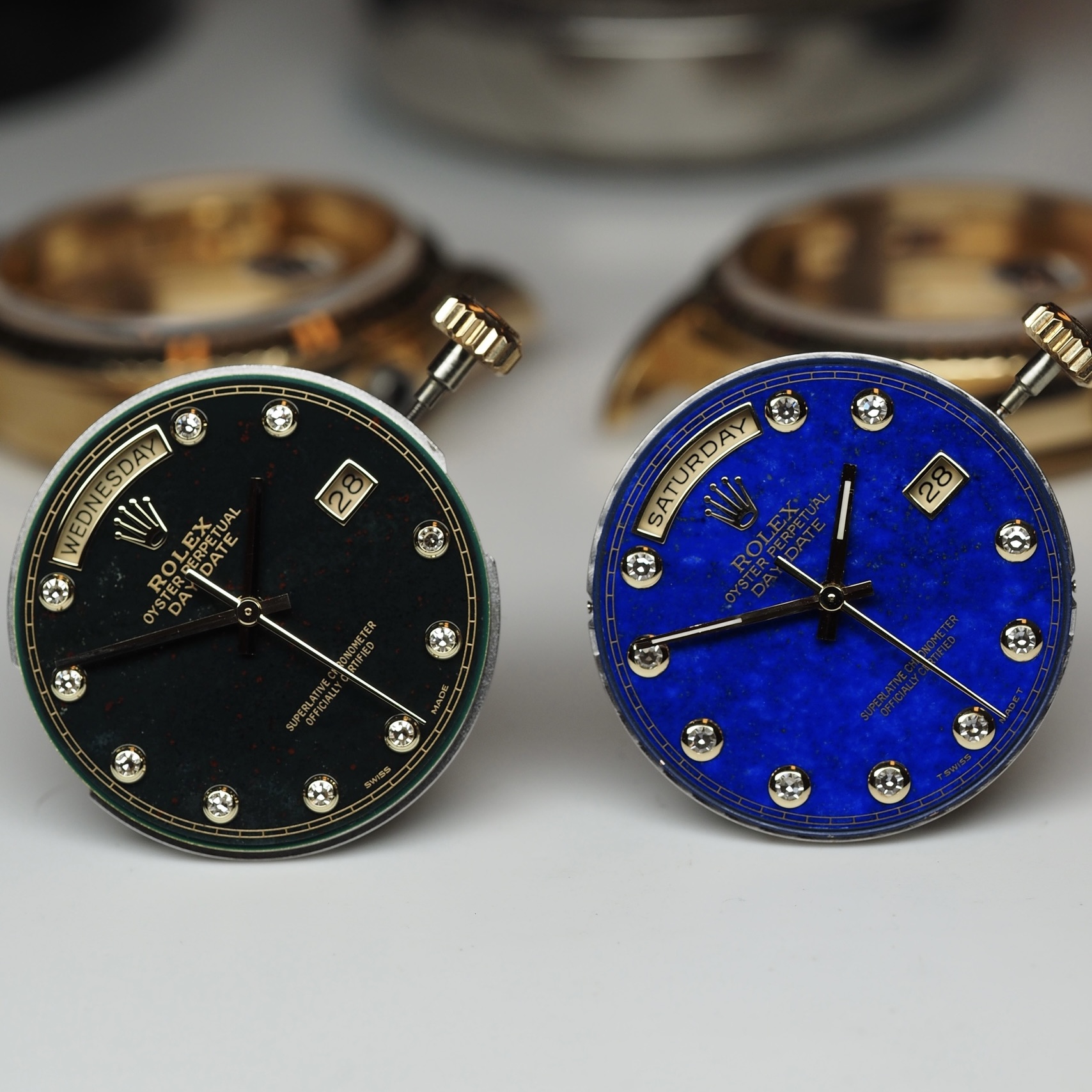
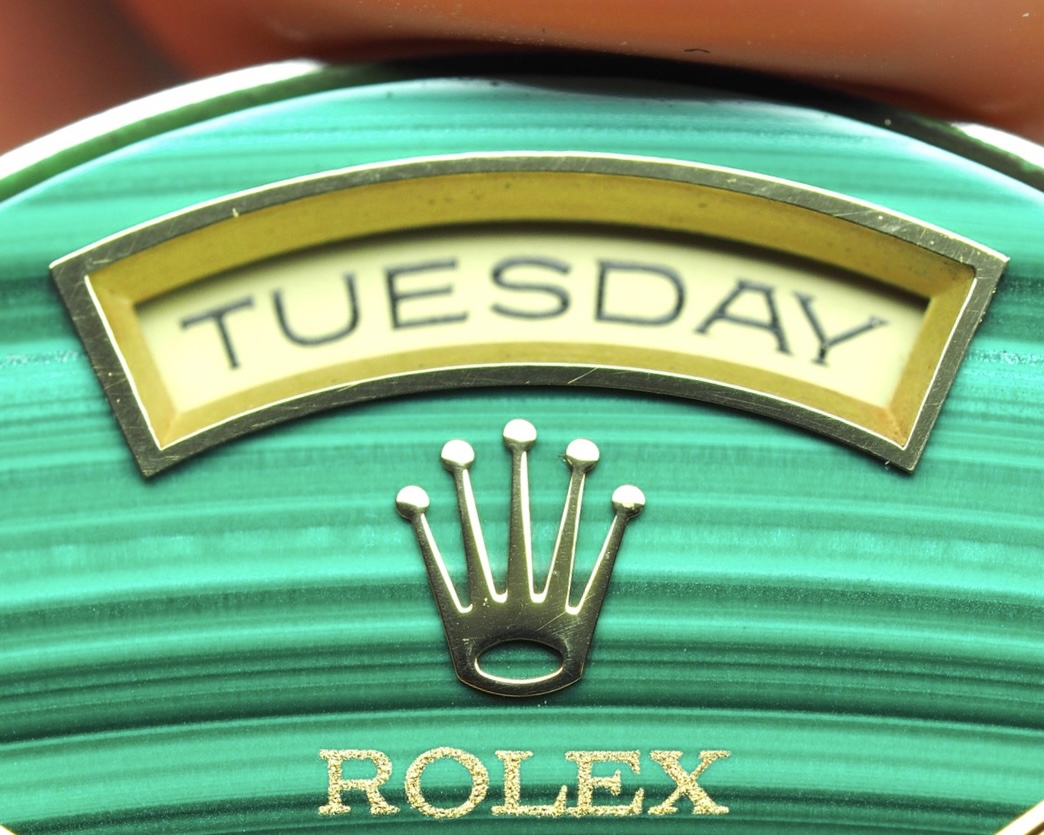
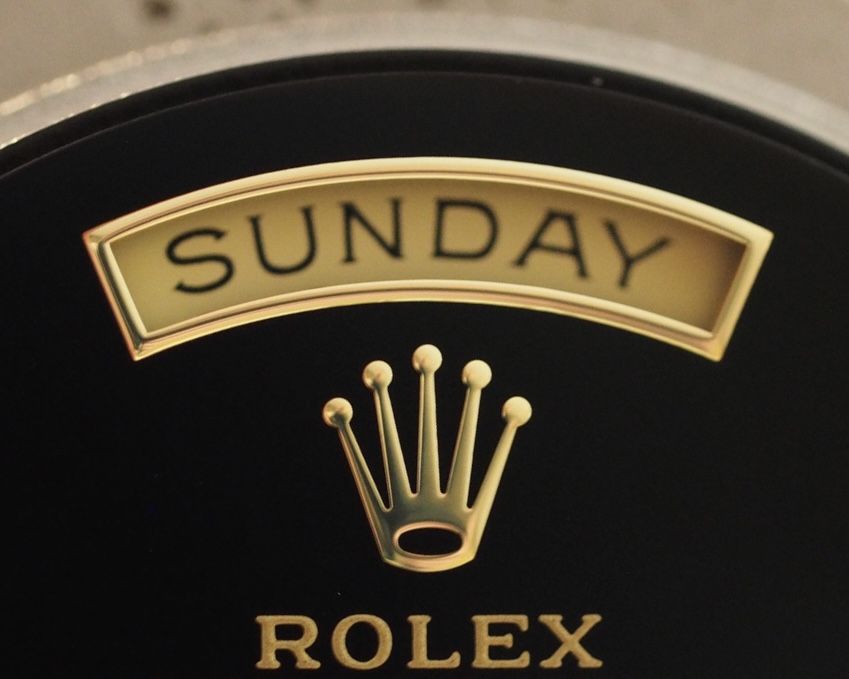
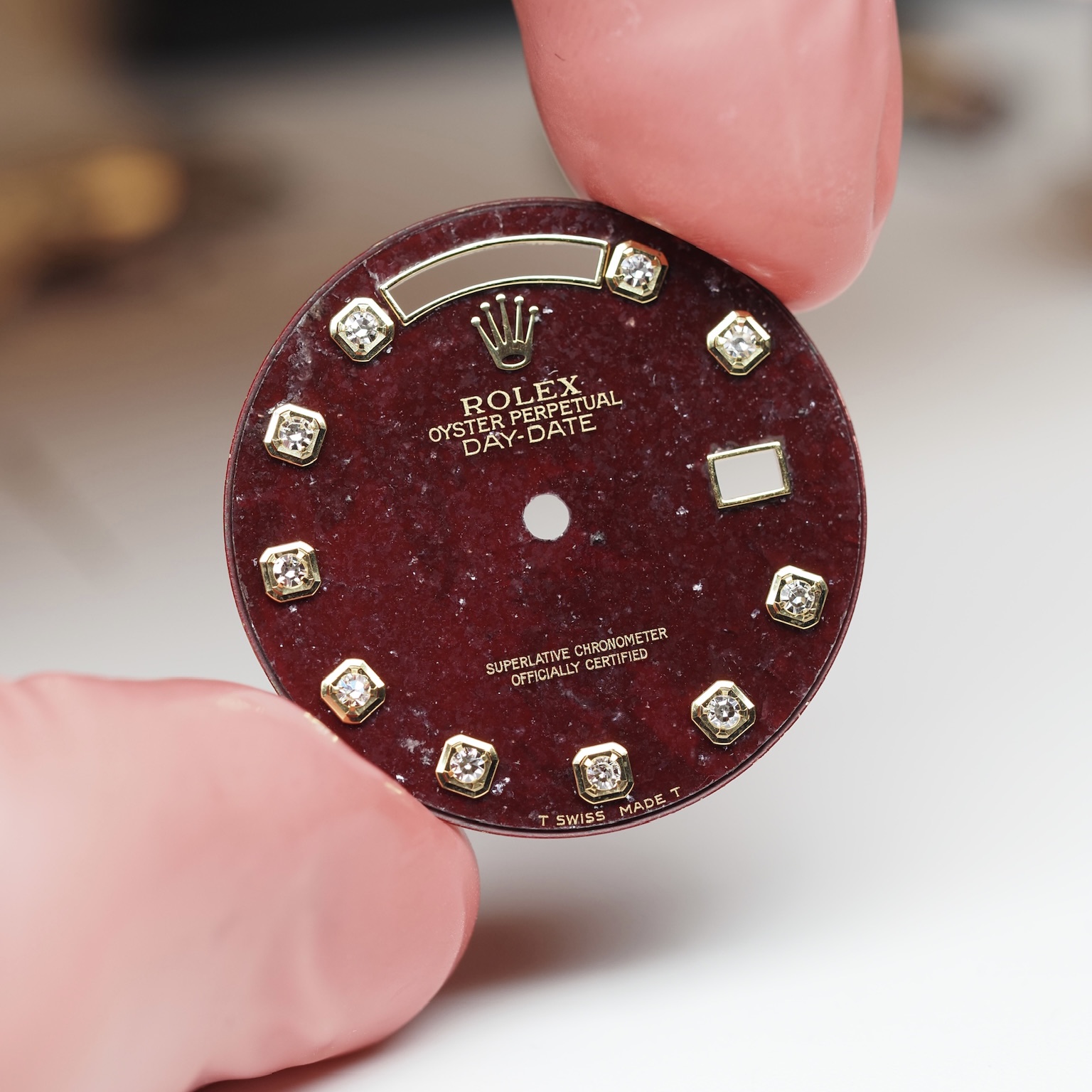
All of this can become rather confusing, so there is a more useful way to divide stone dials into generations. Earlier examples have a faceted sloped aperture with a flat top. Later-production dials and many service replacements have a straight-sided aperture cut at 90 degrees and display a more domed surface.
Markers:
A number of specialist workshops were involved in producing dials for Rolex over the years. Whether the work was carried out by artisans at GT Cadrans near Lausanne or specialists working in Bienne, Geneva or Chavornay, they all faced the same fundamental problem: stone is unforgiving. This becomes particularly important when installing hour markers.
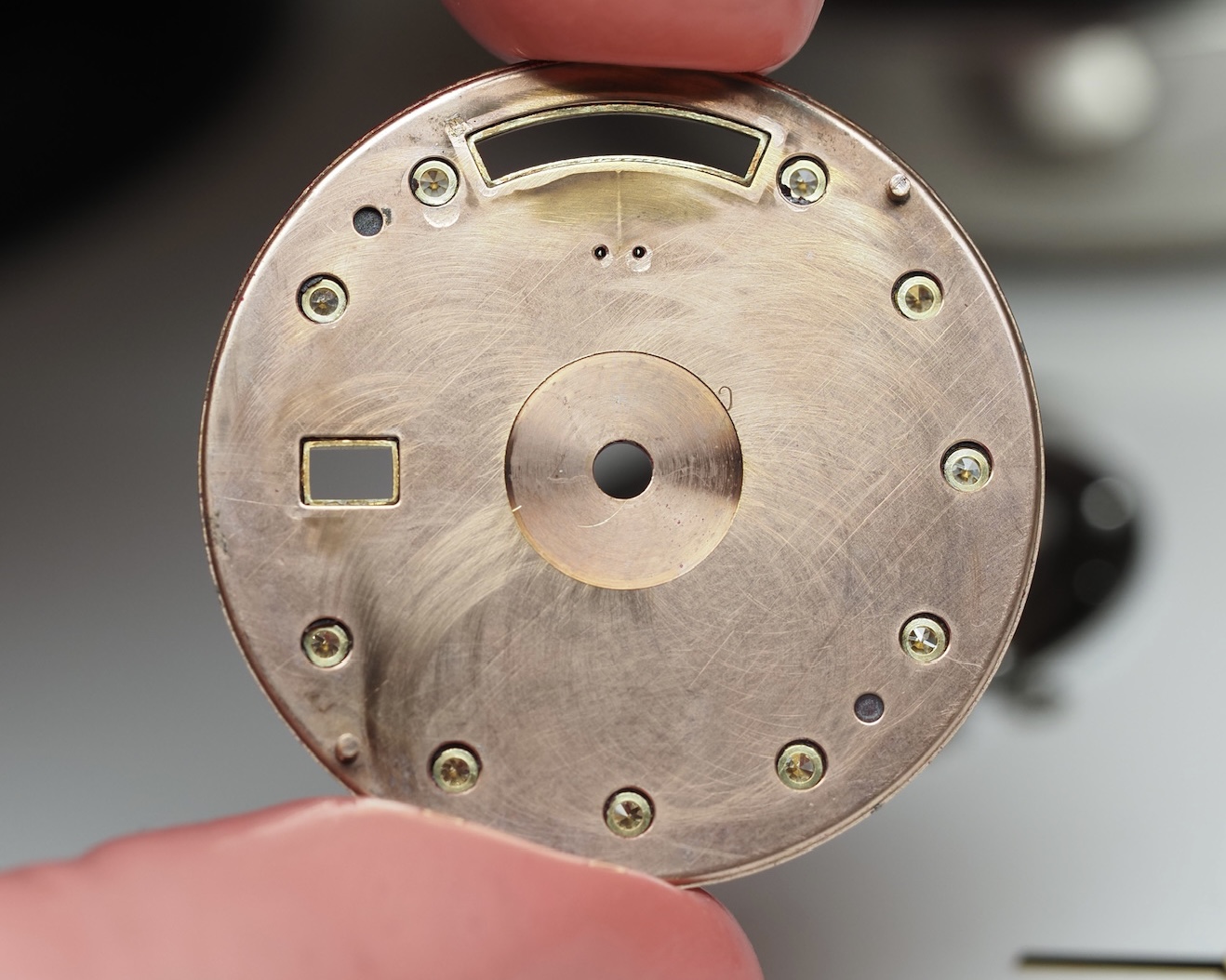
Every additional hole drilled through the material introduces another potential point of failure. This is one reason many early stone dials, including the first generation made for plexiglass Datejust models, were produced without hour markers. (with a prototype as exception) Today we often prefer this configuration aesthetically because it allows the natural material to dominate the dial. But its origins were mainly practical.
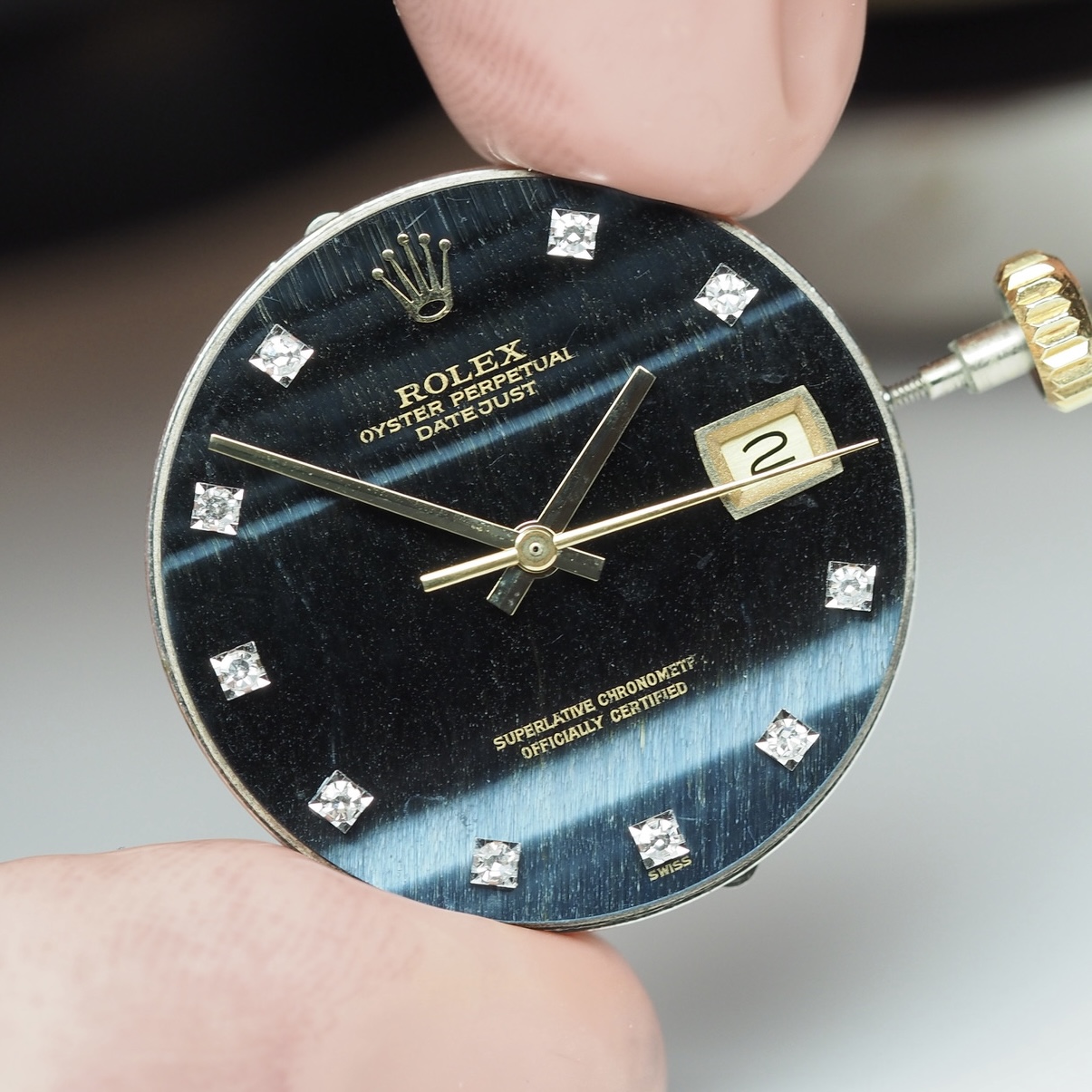
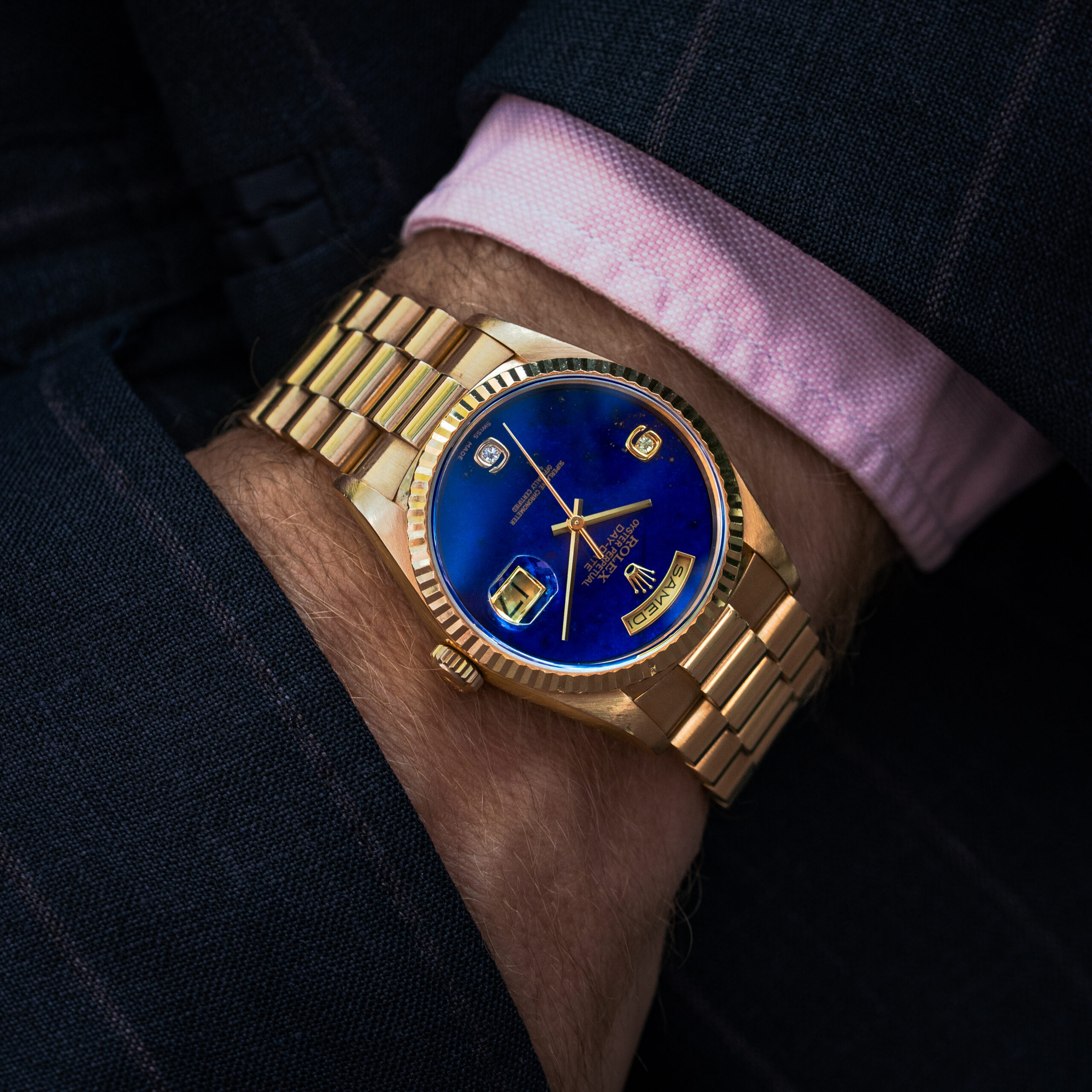
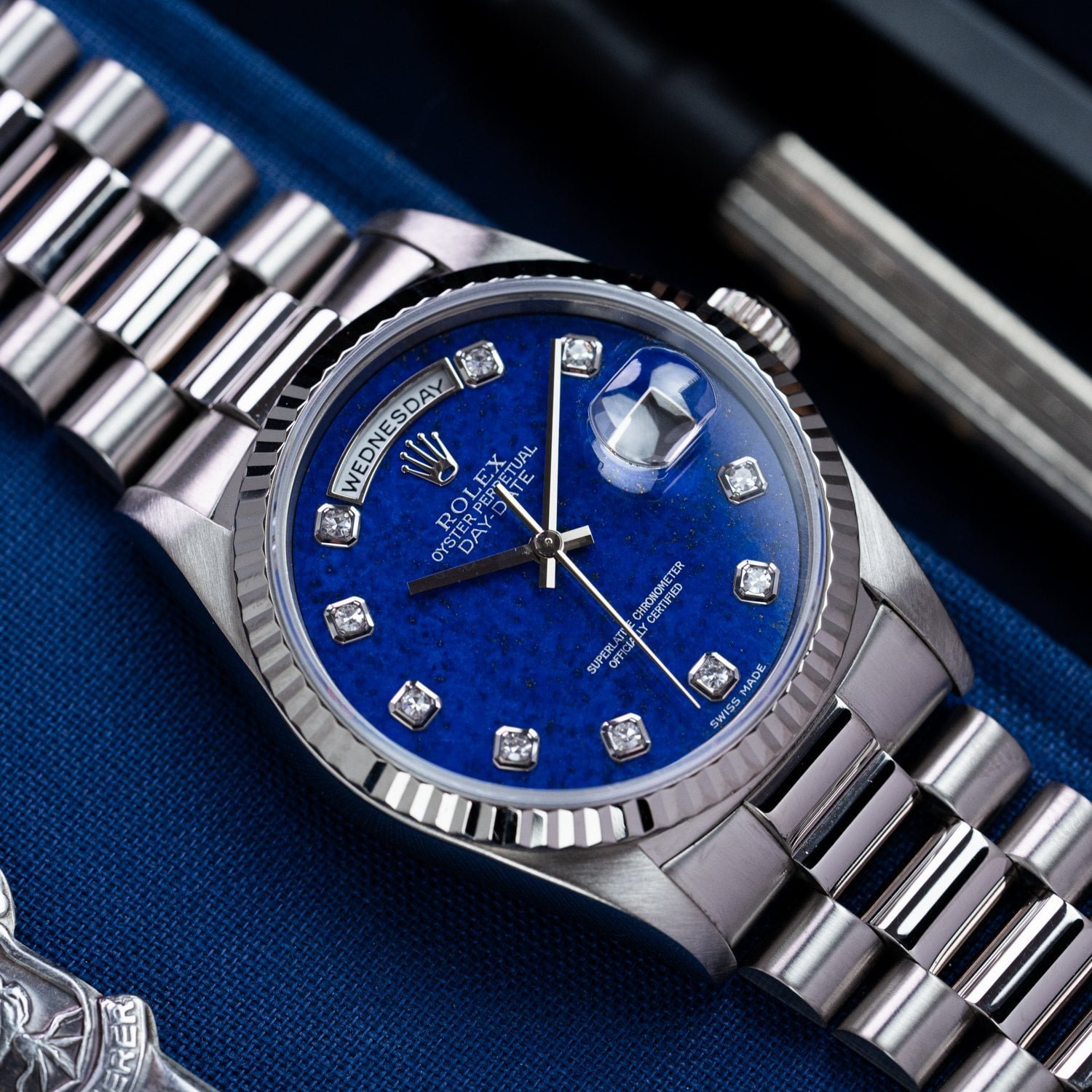
Where markers were used, Rolex experimented with several configurations. Applied Roman numerals can be found, as can various forms of sertissage. Diamond-set stone dials appear in three distinctive configurations. There are round diamonds in the so-called “pinball” setting, diamonds held in square chatons, and another particularly recognisable configuration featuring applied numerals at six and nine o’clock, each decorated with a diamond.
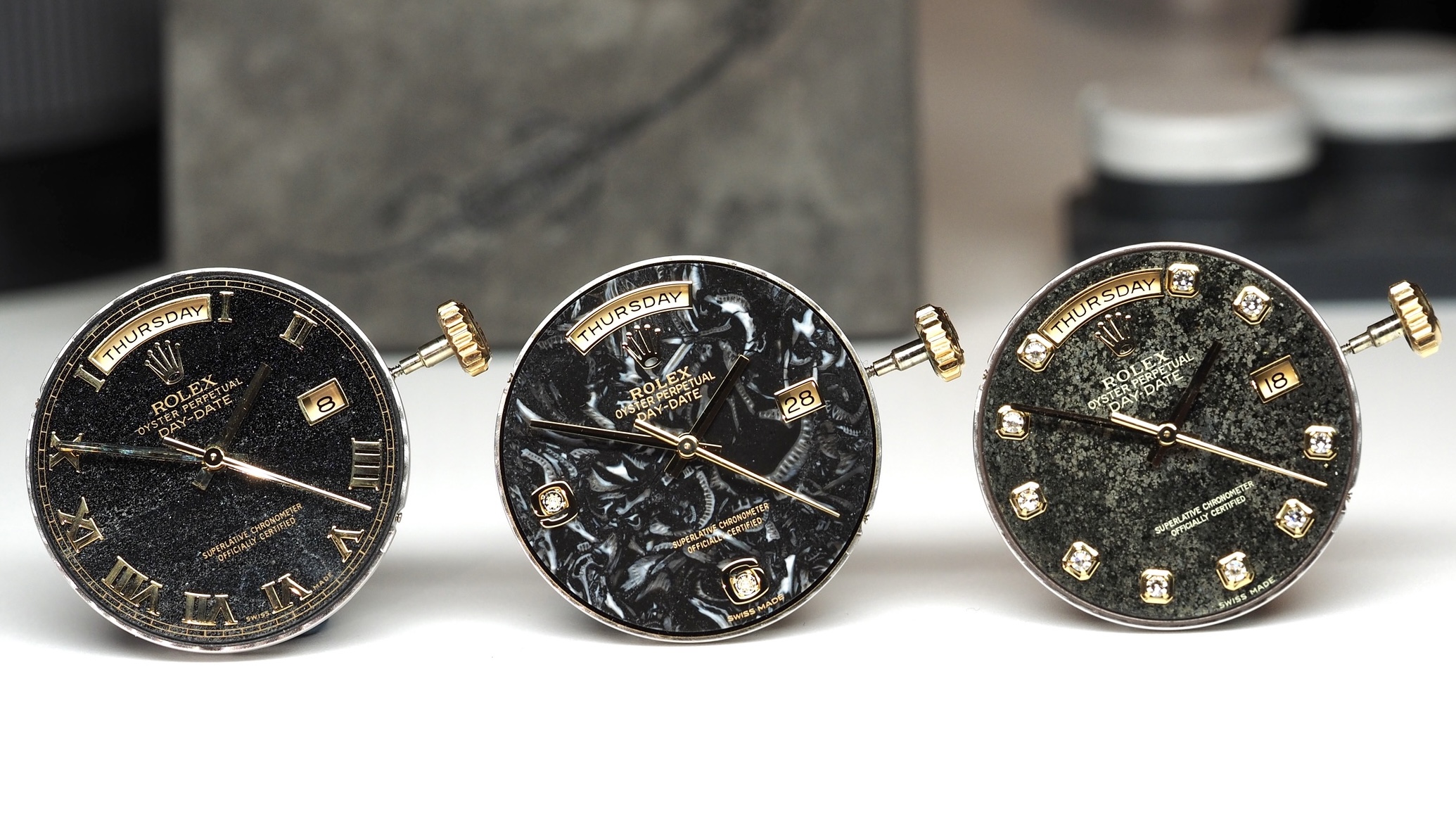
The combination of the mineral itself, the type of setting and the dial generation can make an enormous difference to both rarity and desirability. Generally speaking, the most sought-after and valuable are the stone dials without any markers.
Condition:
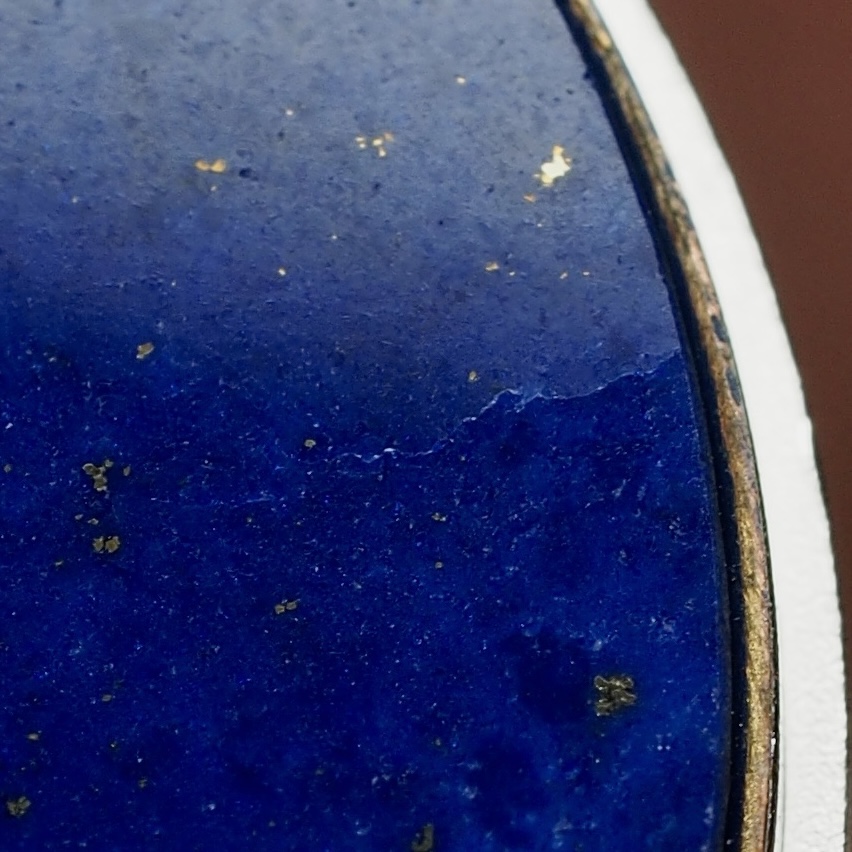
Condition is absolutely crucial when evaluating a stone dial and should be studied carefully. It has a major influence on both collectability and value. A microscope and a lighting set-up is almost mandatory.
As mentioned earlier, these dials are inherently fragile. The thin slab of stone is mounted onto a metal base dial with chrysocolla, with the underlying brass structure providing the necessary support. The metal base protrudes the stone to absorb some of the stresses created when the watch receives an impact. Brass is much more forgiving, a stone doesn’t bend.
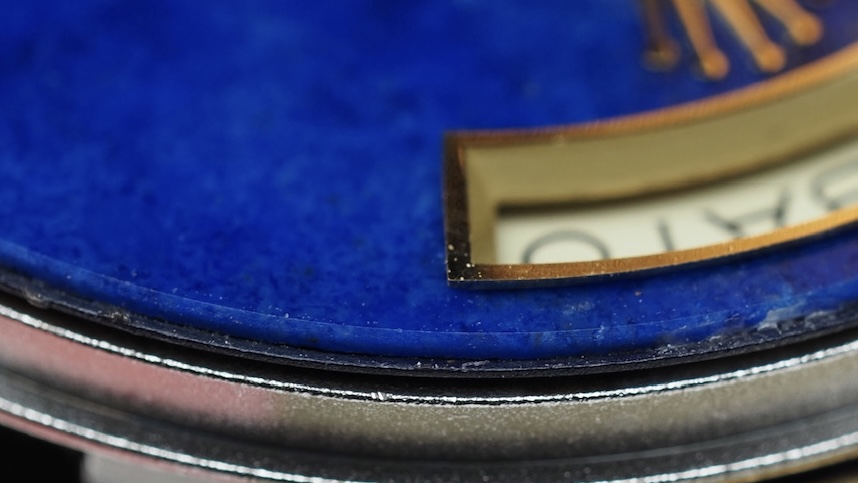
When subjected to sufficient stress, a hardstone dial simply cracks. Dropping it is obviously not recommended, but surprisingly often the damage is caused during servicing rather than while the watch is being worn. An inexperienced or careless watchmaker can easily create a hairline crack while removing the dial, handling it or reinstalling it onto the movement.
These fractures most commonly appear around the weakest points: the date or day apertures, next to the markers, near the periphery and the centre hole. A small hairline may initially appear relatively harmless, but once the structure of the stone has been compromised, the crack can continue to develop. This is why even seemingly minor damage can have a substantial effect on value.
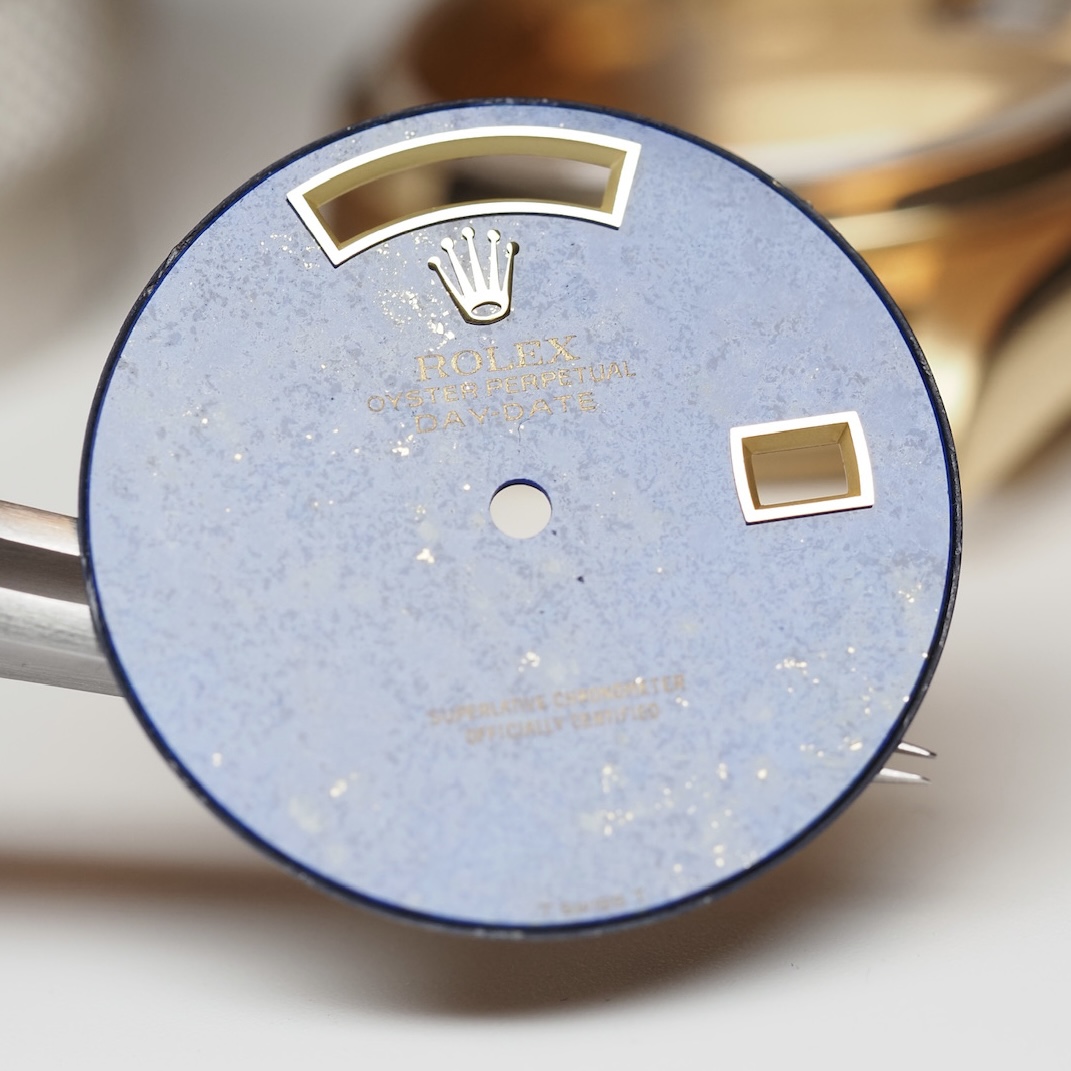
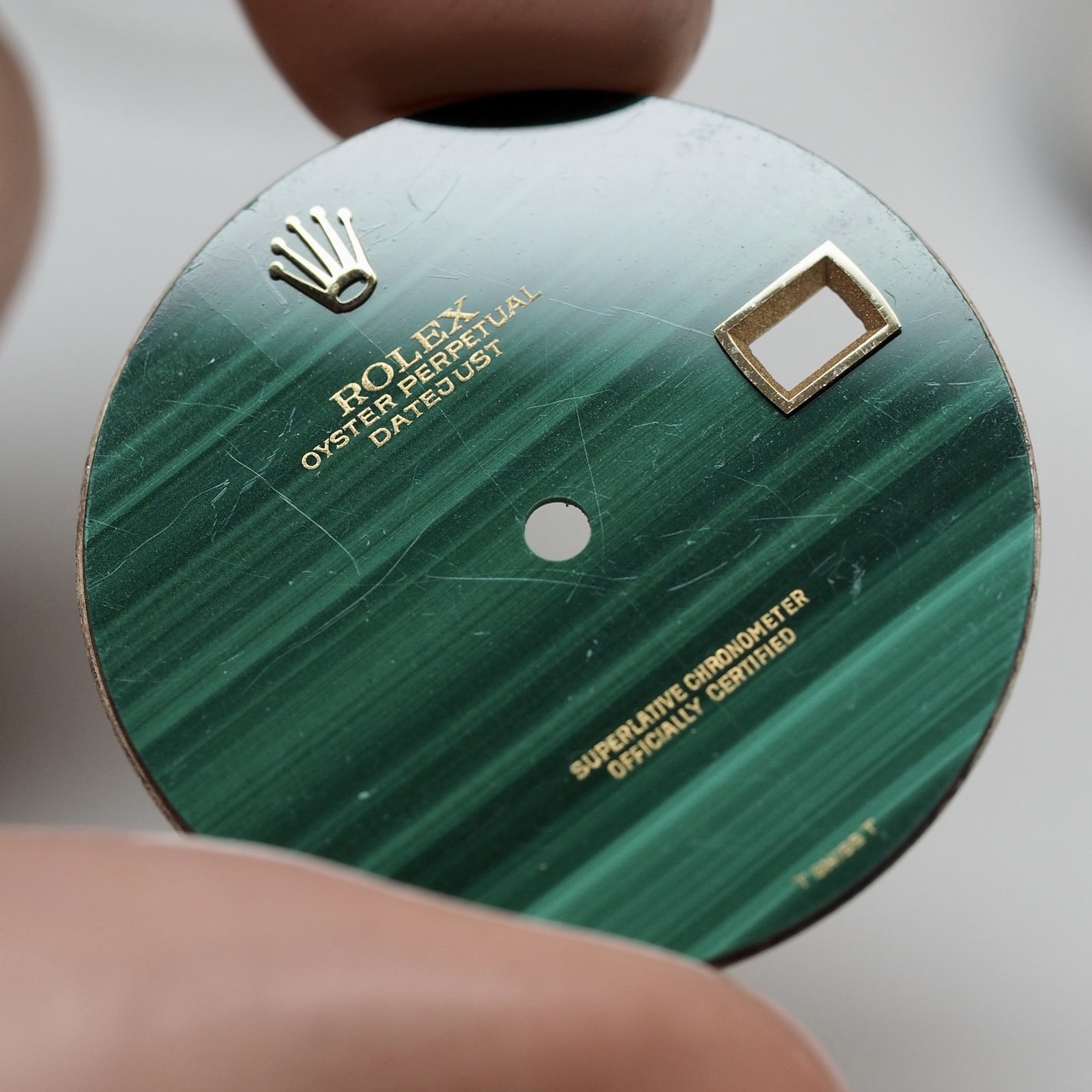
The stone itself is not the only thing to examine. The quality of the printing and the condition of the surface are equally important. Scratches, damaged text and other inconsistencies are not uncommon, particularly on dials that spent years or even decades loose in storage.
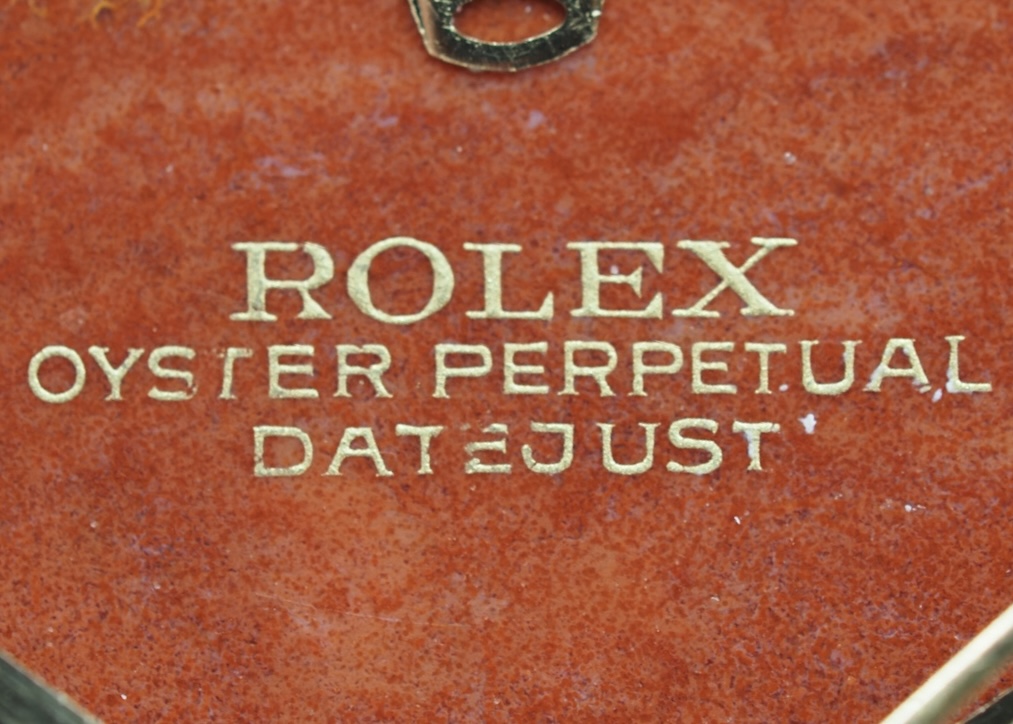
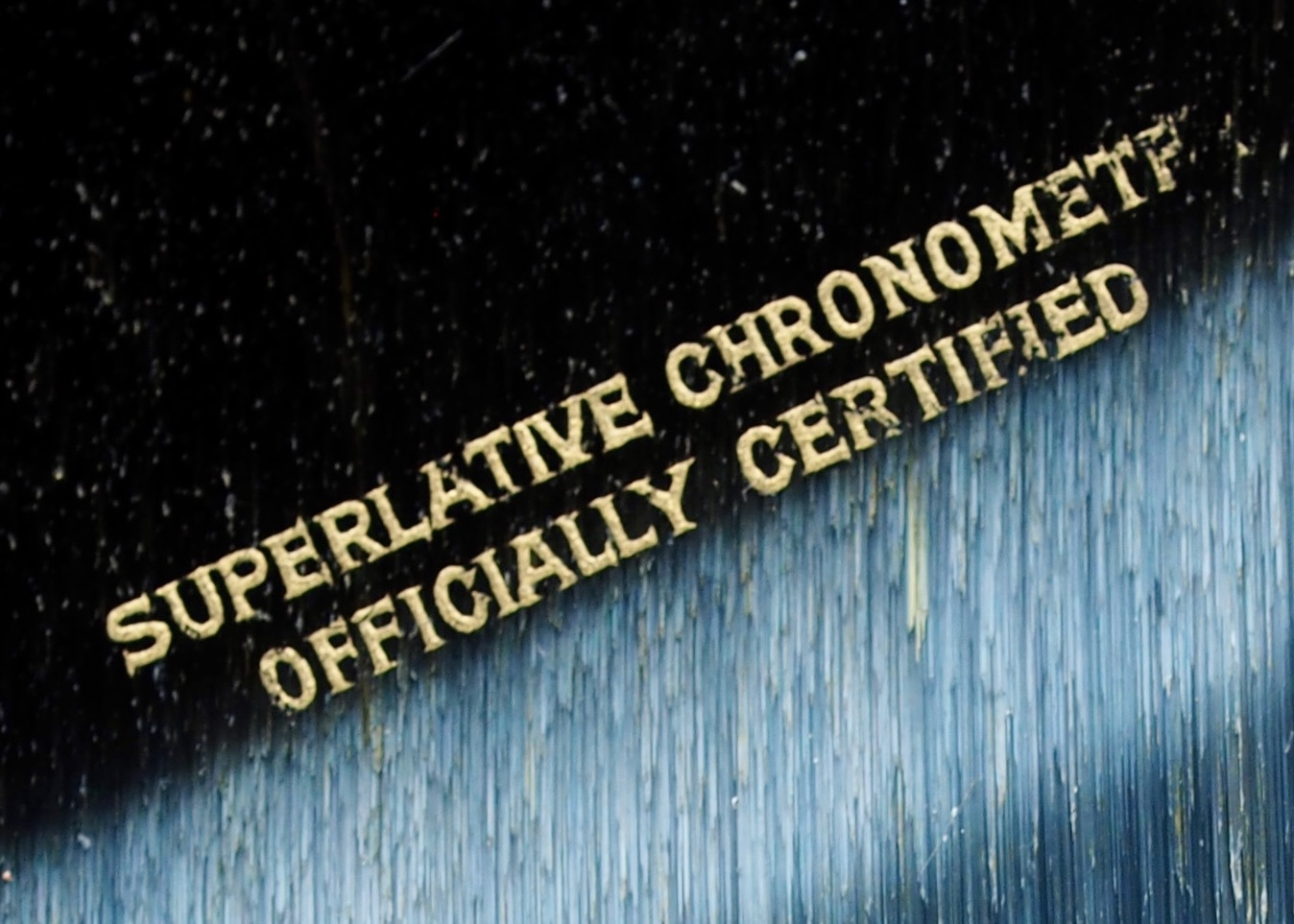
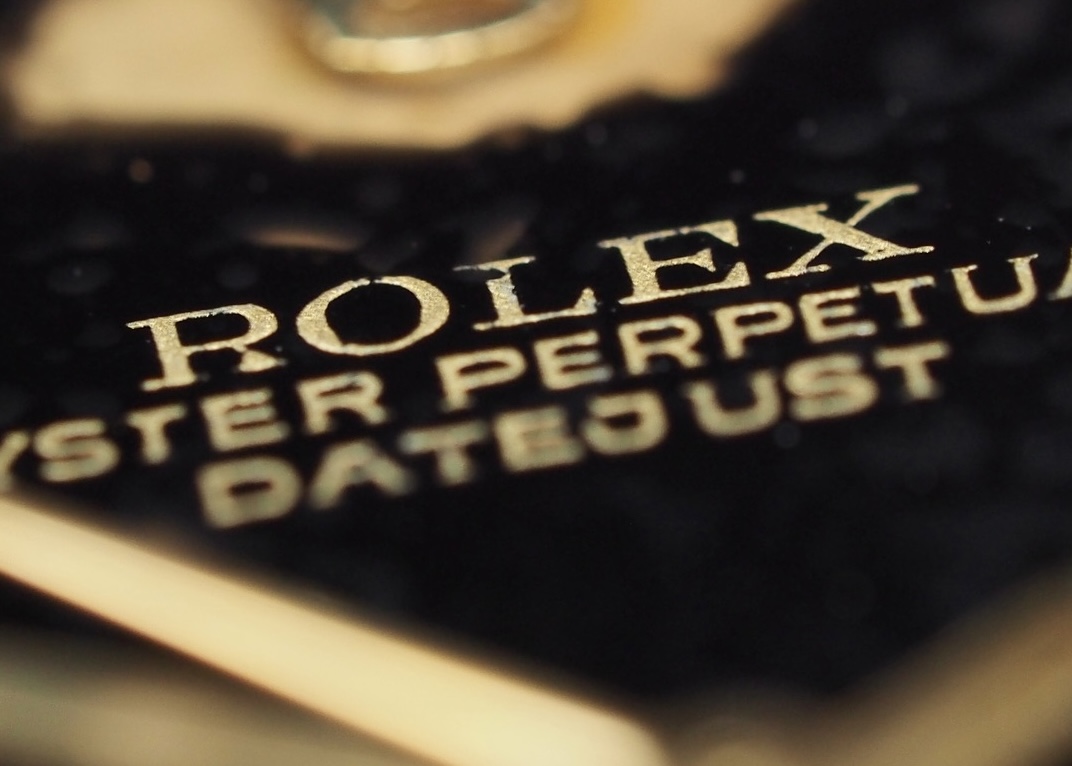
Remember that many stone dials were an upgrade options. They could sit in stock for years waiting for a client to request it. Some were stored carefully, others clearly were not. Ironically, a dial that was never fitted to a watch is therefore not necessarily in better condition than one that spent decades in a drawer. For example, the influx of damaged stone dials that happened around 2021 due to a large batch being discovered sitting at one of the producers. They were not stored carefully thus displaying these imperfections.
Counterfeits:
With the increase in demand, and consequently the dramatic rise in prices, counterfeit stone dials have inevitably become more prevalent. Earlier fakes were generally quite easy to identify. At the time, genuine stone dials were simply not valuable enough to justify investing serious money into R&D.
One of the most notorious examples is an alleged opal dial that was sold at the Phillips Glamorous Day-Date auction in 2015 and resurfaced several years later at Christie’s Dubai. The same dial was also published in one of Pucci Papaleo’s books. With the knowledge we have today, it is relatively easy to identify the dial as fake. The sloppy finish of the apertures, the low quality printing, wrong graphics, glue underneath the coronet and unsigned Swiss or T Swiss T. But back then the collective research into stone dials was far less developed and dealers and auction houses had considerably fewer reference points to work with.
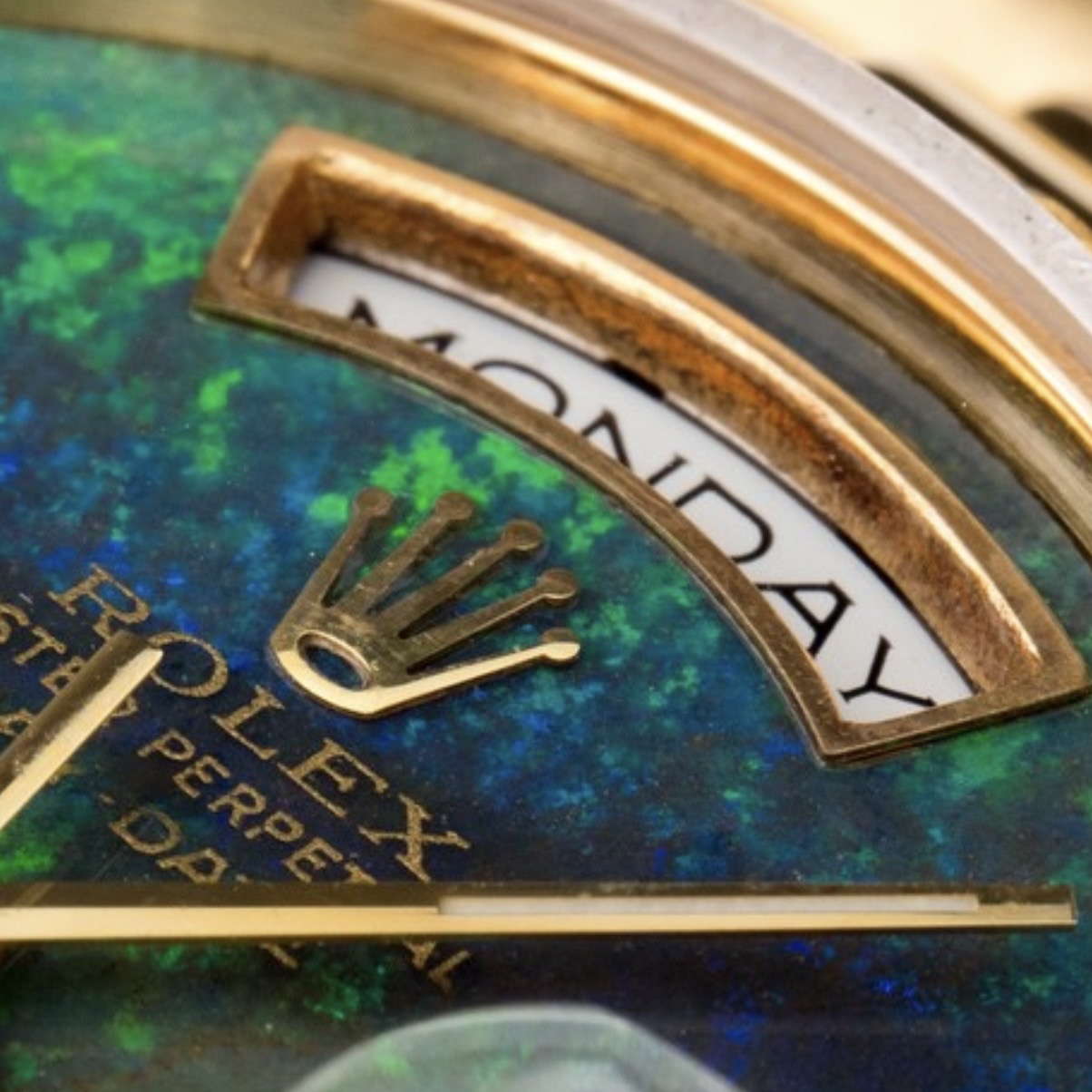

Since around 2022, however, the quality of counterfeits has improved dramatically. Instead of simply imitating the appearance of stone with paste or other artificial materials, counterfeiters now use actual slabs of natural stone. Original production methods are replicated surprisingly well, while the quality of the printing, dial construction and finishing is becoming increasingly convincing.
For obvious reasons, I will not explain every detail I use to distinguish a genuine Rolex stone dial from a counterfeit. The people producing these dials are watching too, and publishing a complete checklist simply gives them a blueprint for improving the next generation of fakes.
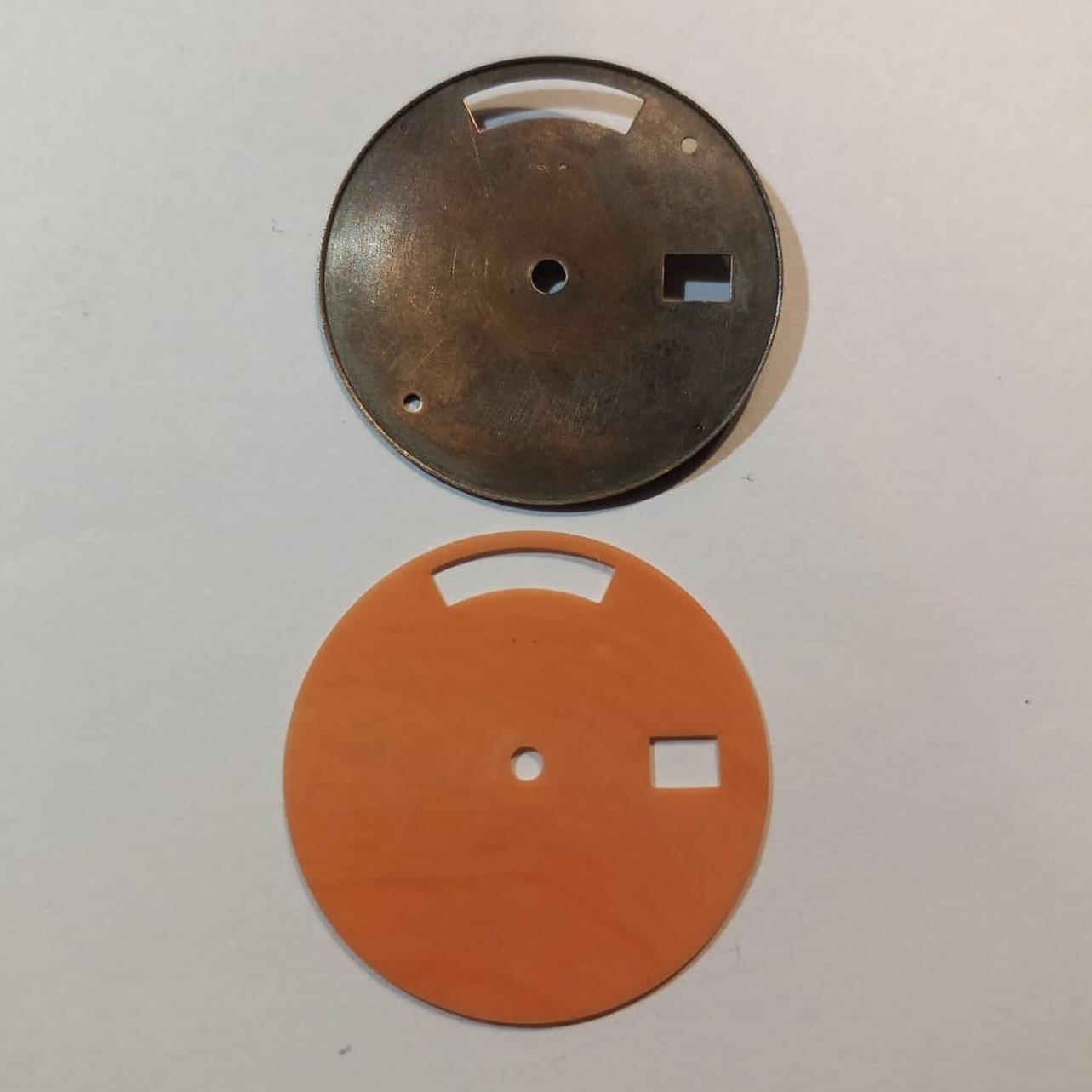

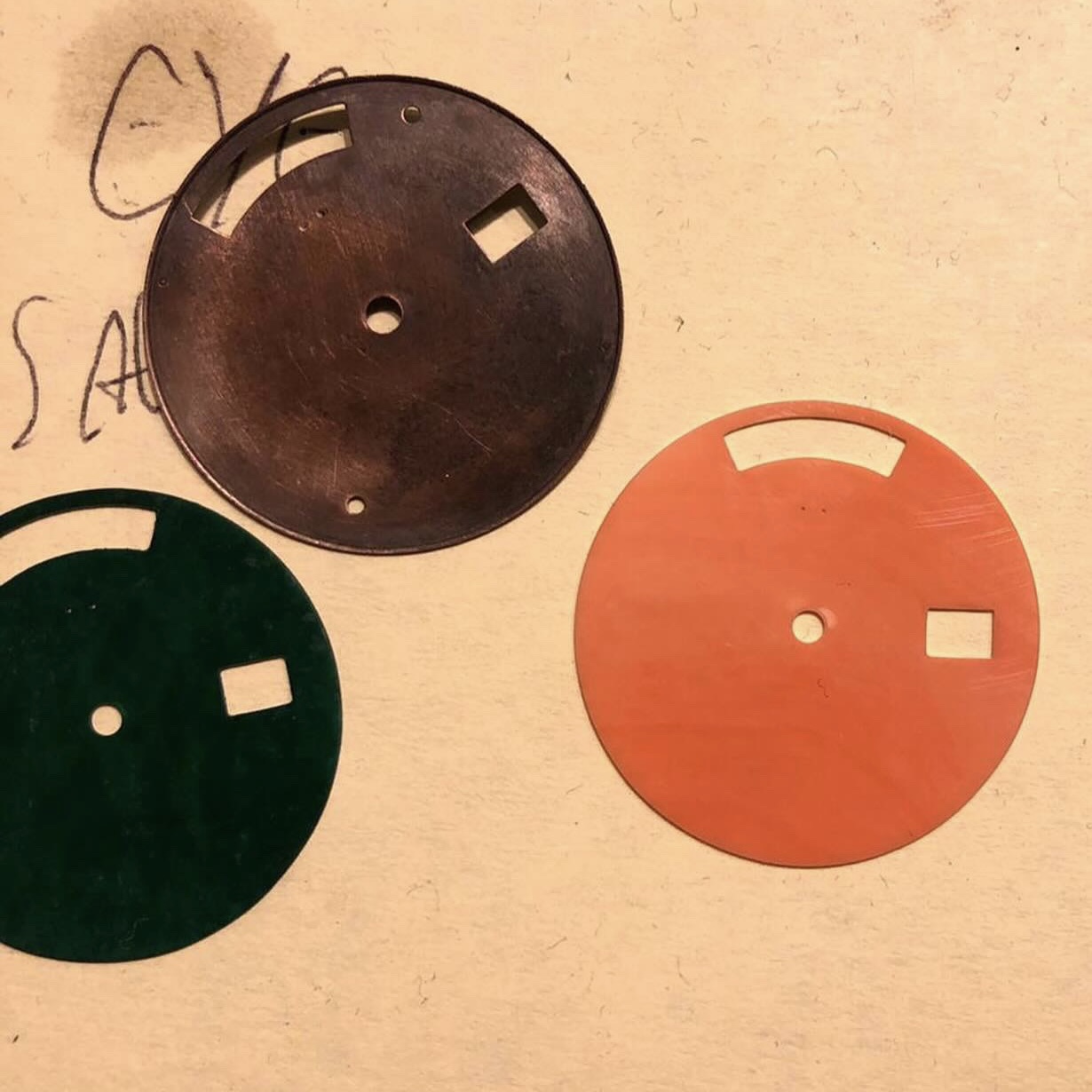
That said, there are several areas that should always be examined carefully. Compare the dial layout and typography against known original examples, (use pieces published before 2022) study the back, and pay particular attention to the printing itself, including the compound and behaviour of the paint. Most importantly, never judge one detail in isolation. Authentication comes from understanding how all these characteristics should work together on a particular generation and configuration.
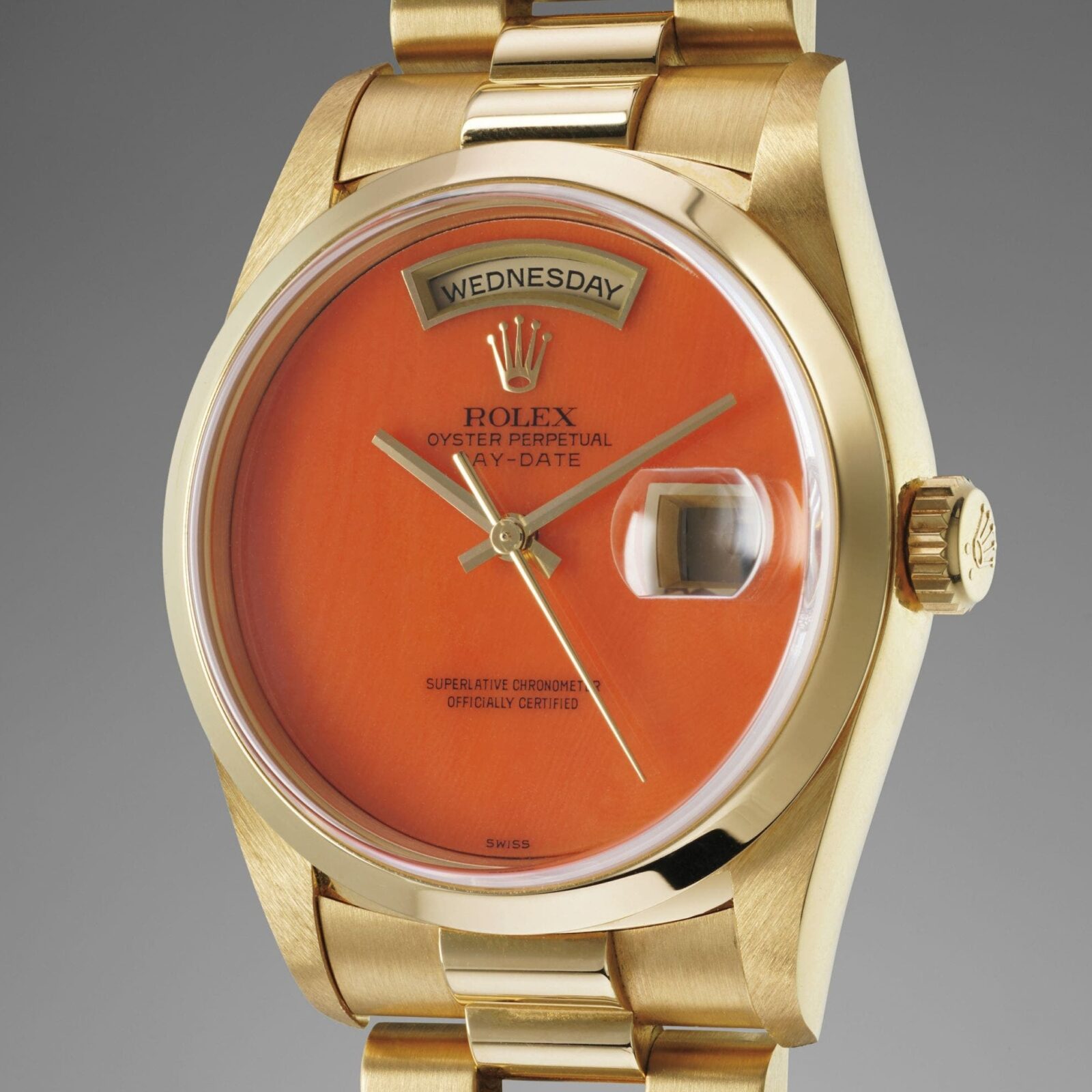
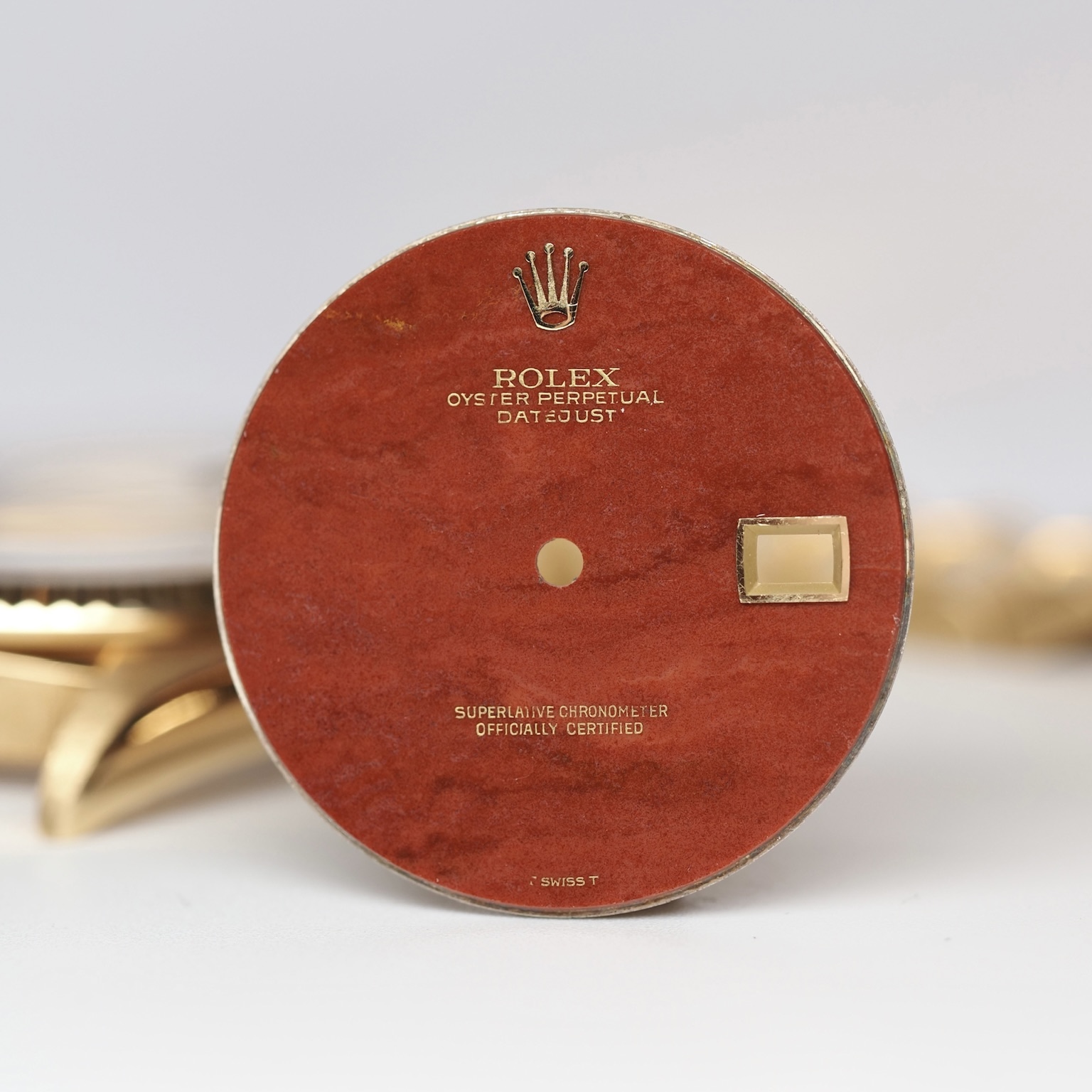
Another issue to be aware of is coral dials being converted from yellow-gold to white-gold configurations. With most stone dials, this would be impossible because the color of the printing corresponds with the metal for which the dial was intended. A white-gold (or platinum) stone dial typically features white printing, while its yellow-gold counterpart uses gold printing.
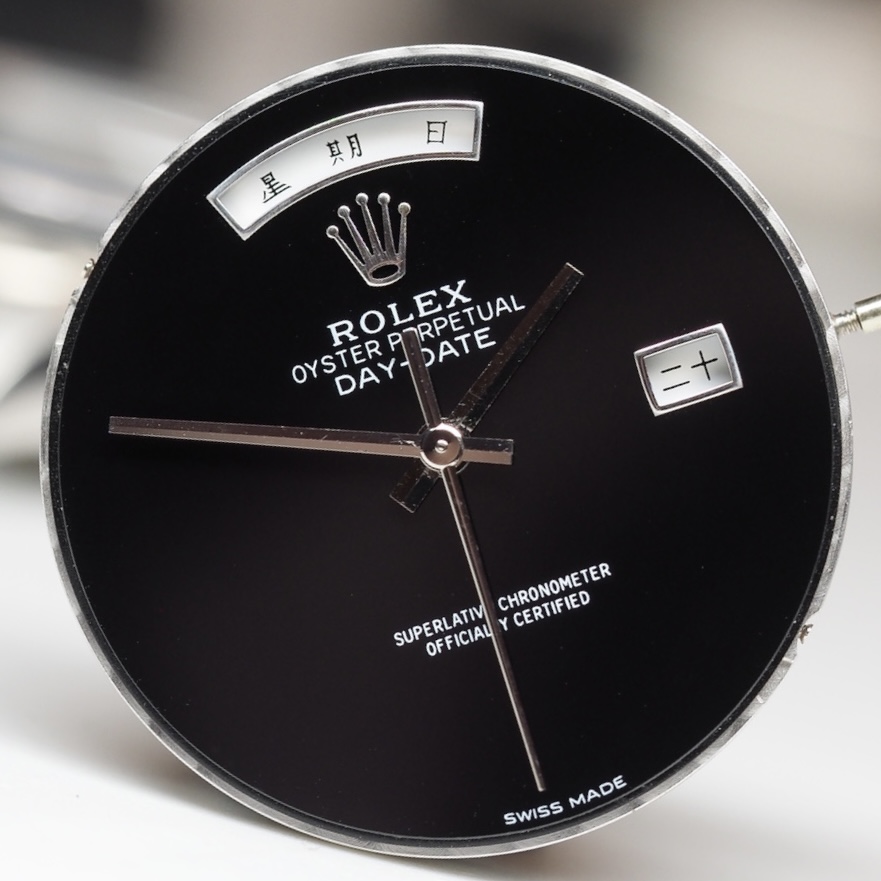
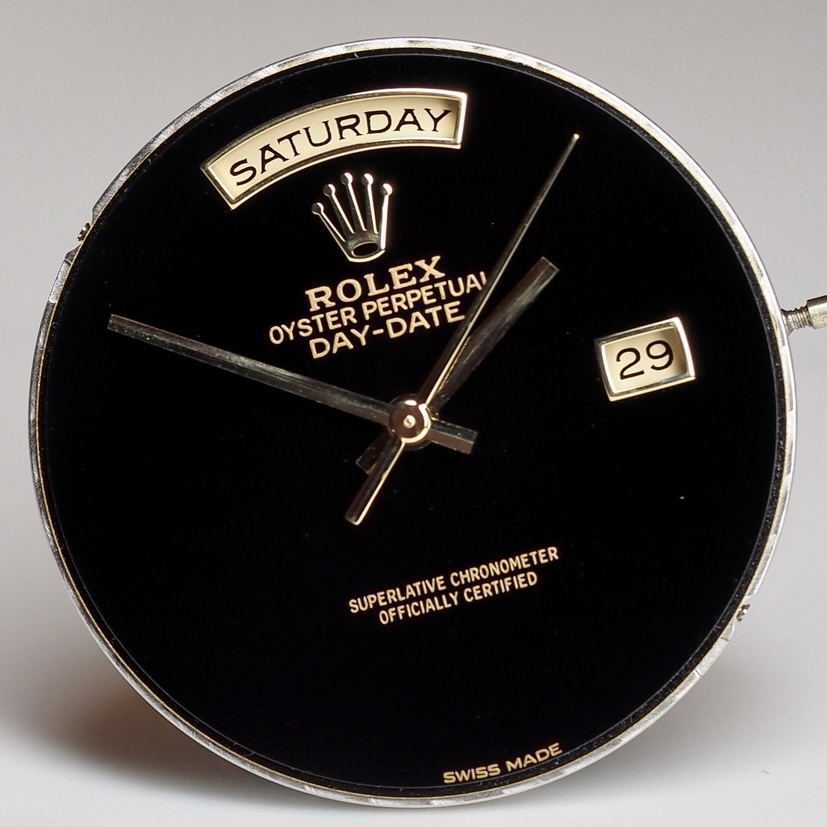
Coral is an important exception. Due to the light color of the material, the printing is generally black on both yellow- and white-gold examples. (with only very few exceptions). Since white-gold stone dials are considerably rarer and more valuable across the board, there is an obvious financial incentive to convert a yellow-gold coral dial. This can easily be achieve replacing the yellow-gold coronet and framed day and date apertures with their white-gold equivalents.
Lastly, like always, do not make the mistake of treating Rolex service documentation as any guarantee of originality. I have personally encountered recent counterfeit stone dials that were approved by Rolex in the process of servicing.
Stones:
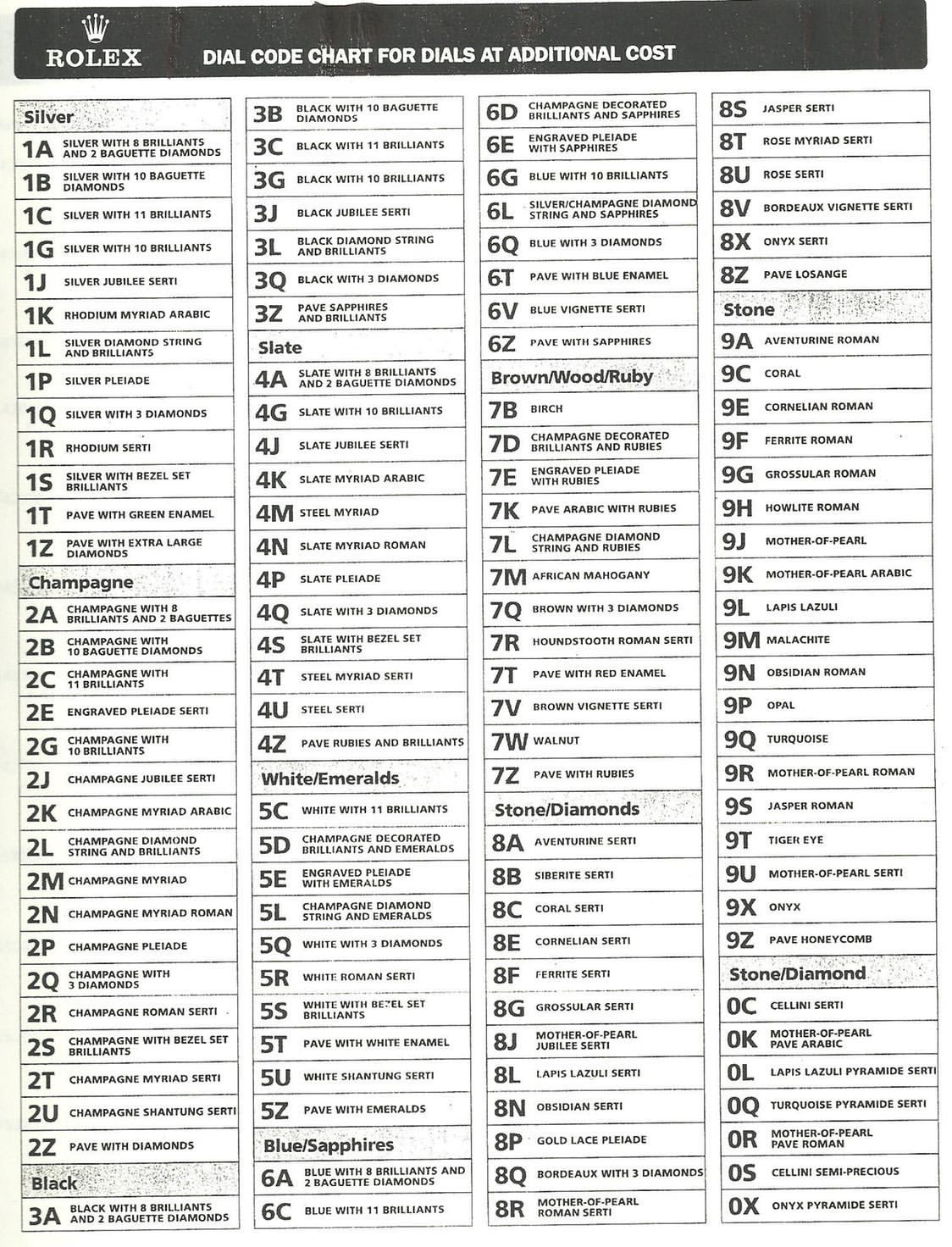
Without further delay, let’s take a closer look at the different varieties offered on vintage Day-Dates and 36mm Datejusts. We will go through them in alphabetical order, briefly explaining each material and showing some examples for reference. Please consult the table we have compiled for a comprehensive overview of the different possibilities known for each stone
Ammonite
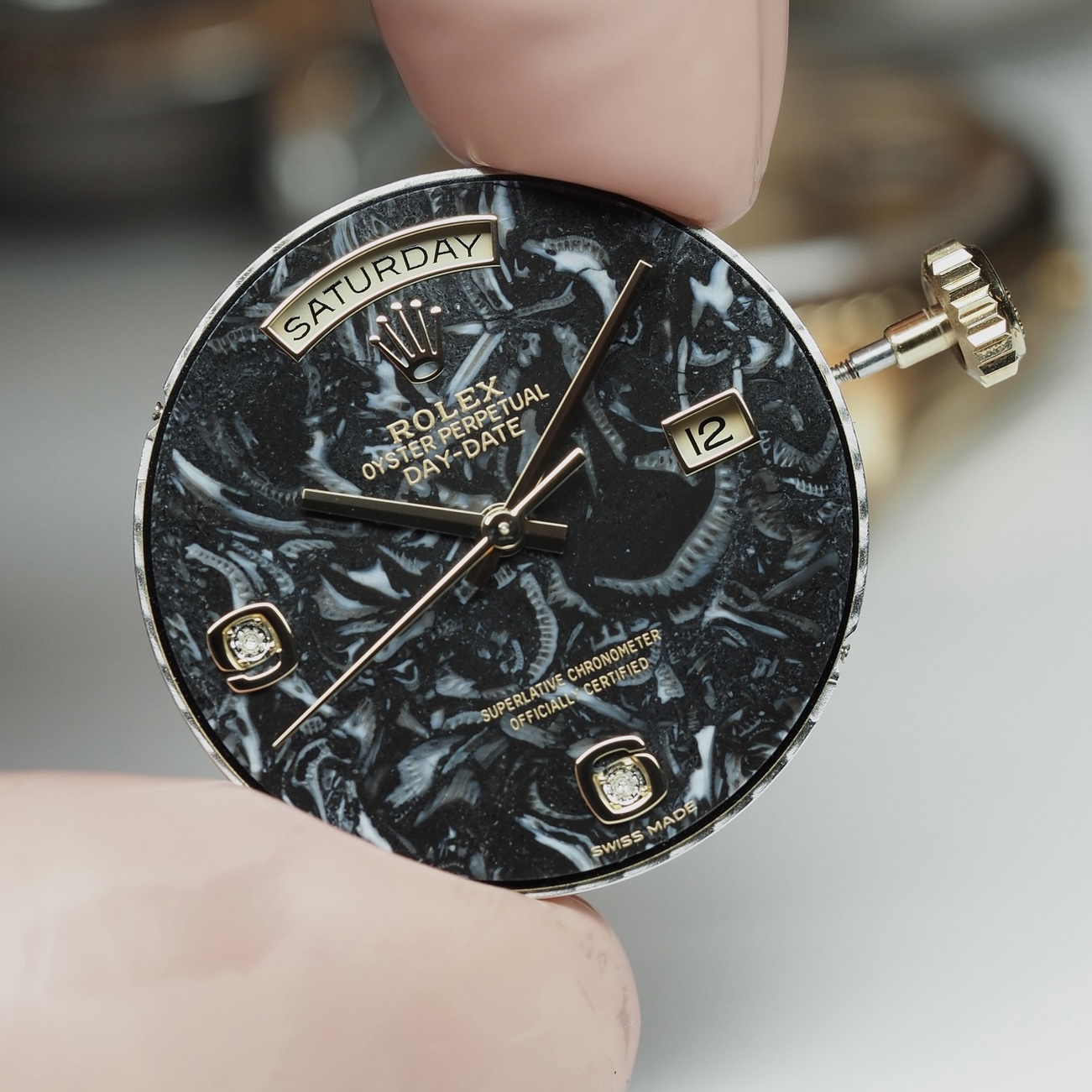
A fossil rather than a mineral, ammonite is formed from the preserved shells of extinct marine molluscs that lived millions of years ago. Its characteristic chambered patterns make every slice completely unique.
Aventurine
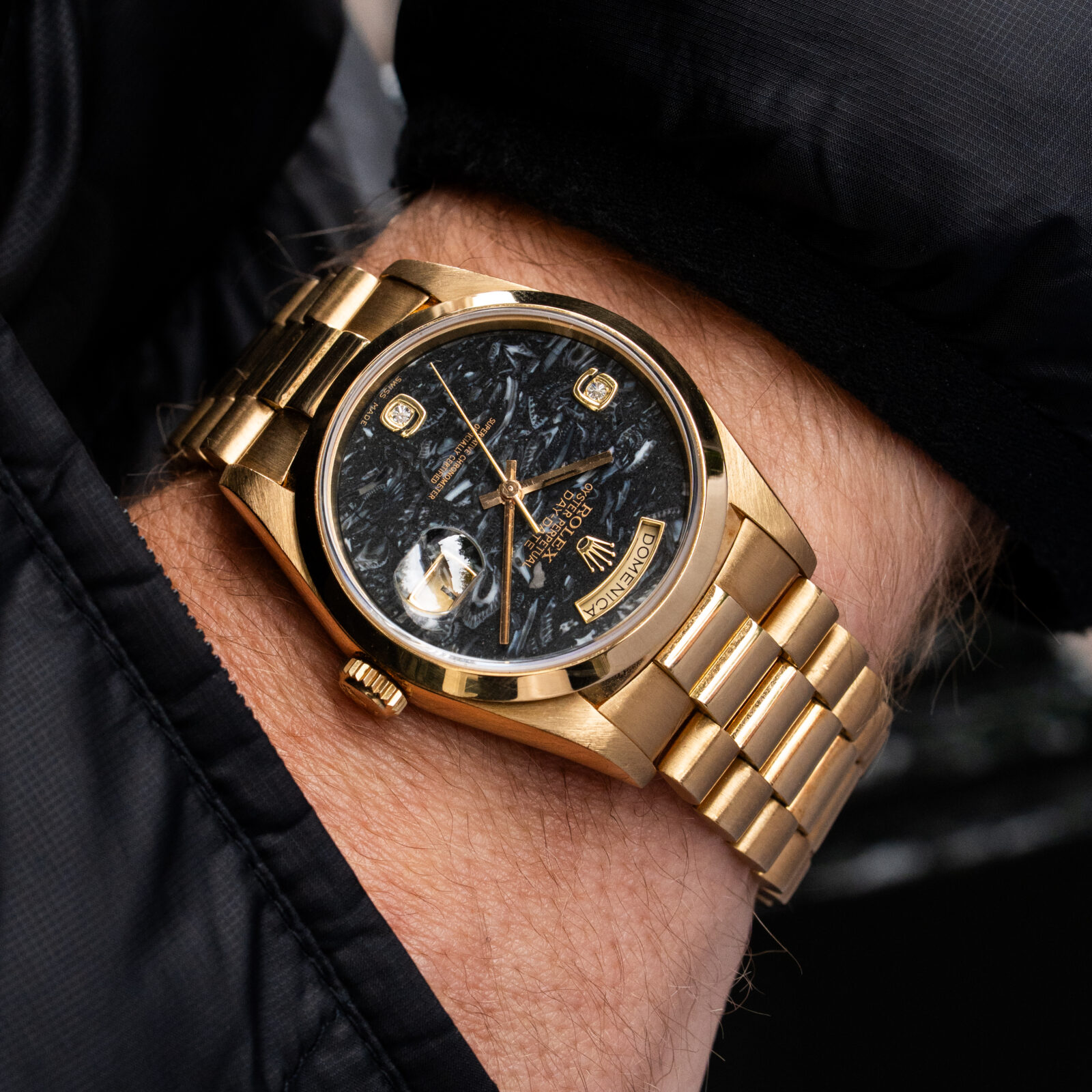
A variety of quartz distinguished by tiny reflective mineral inclusions that create its characteristic shimmer, known as aventurescence. Depending on the material, it can sparkle dramatically as it catches the light.


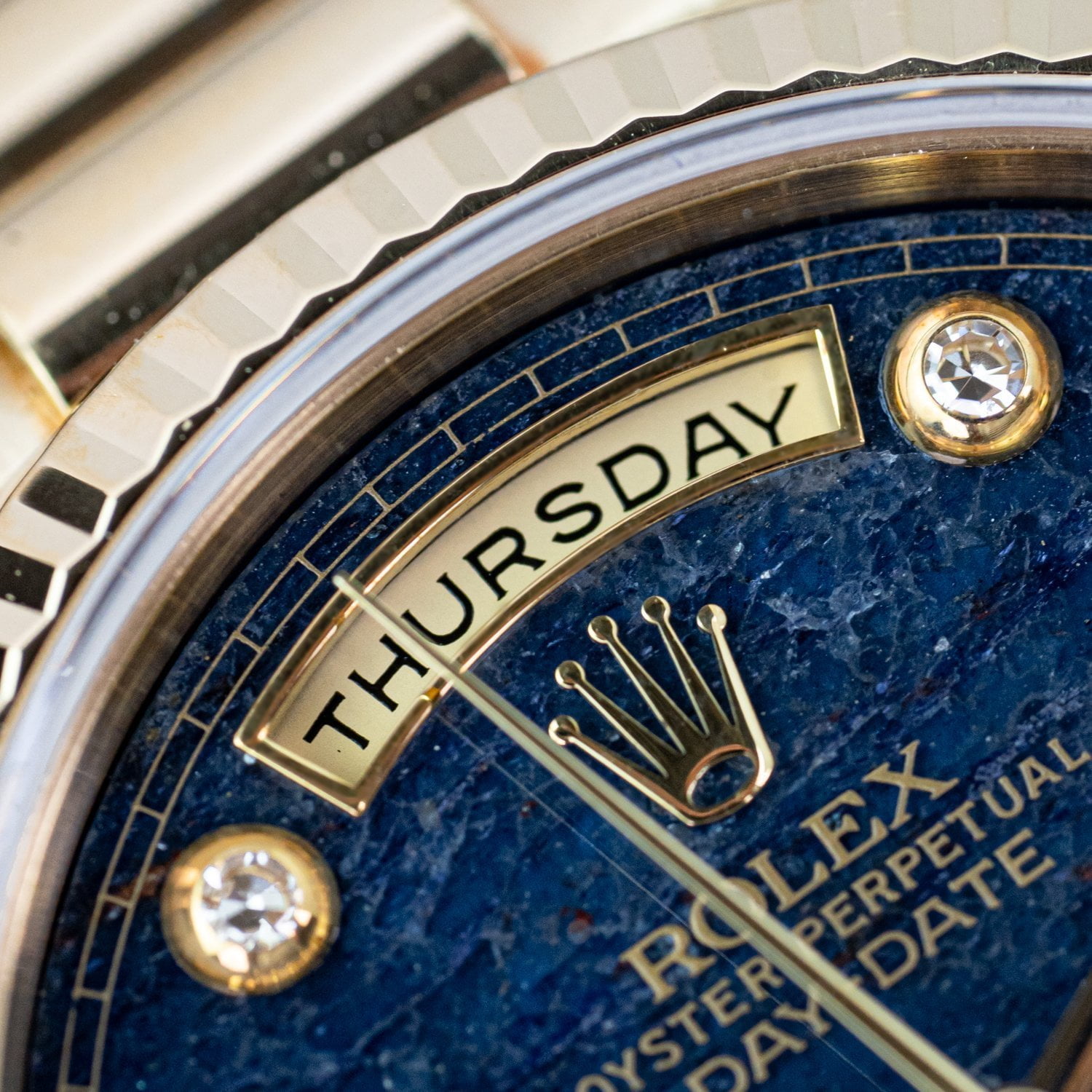
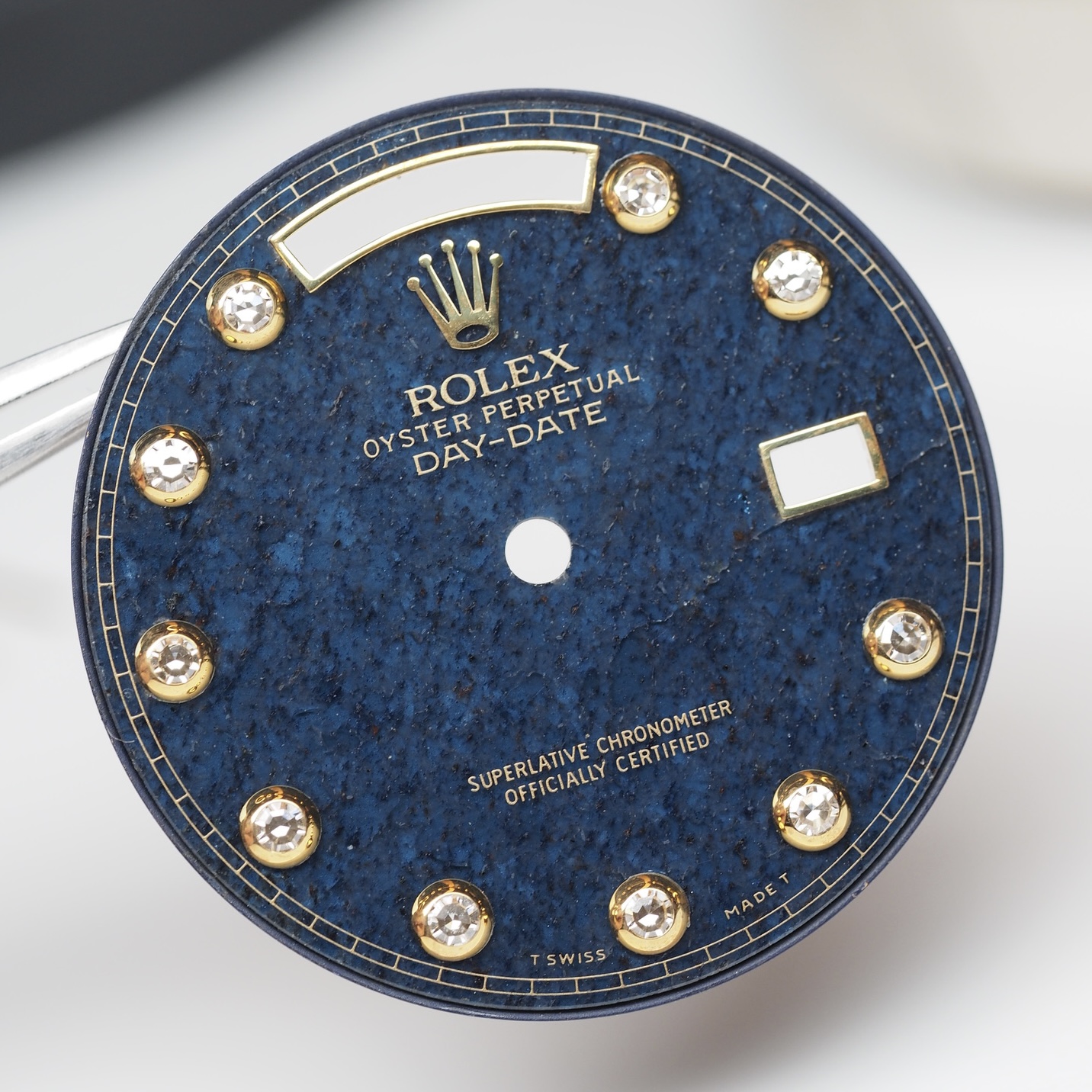
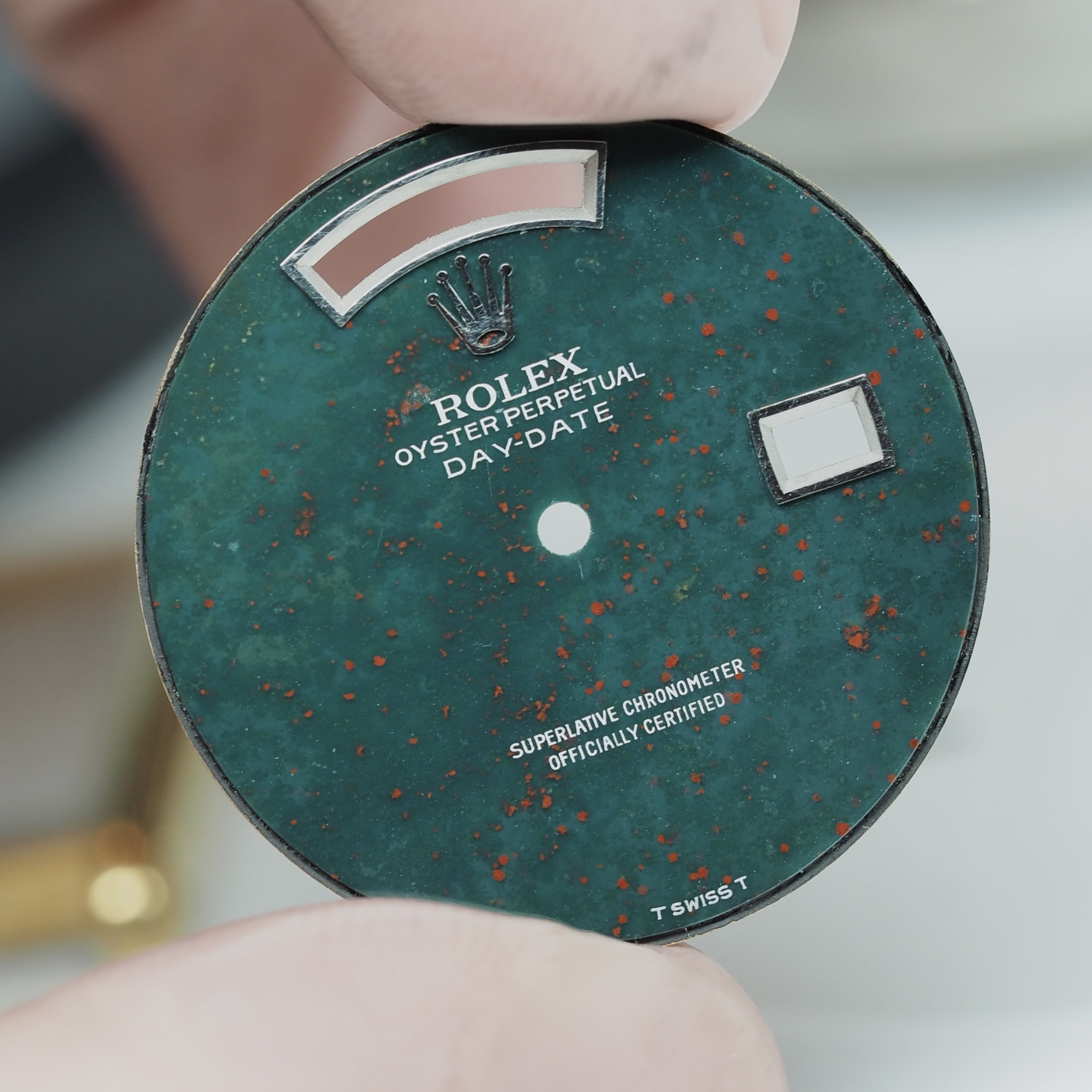
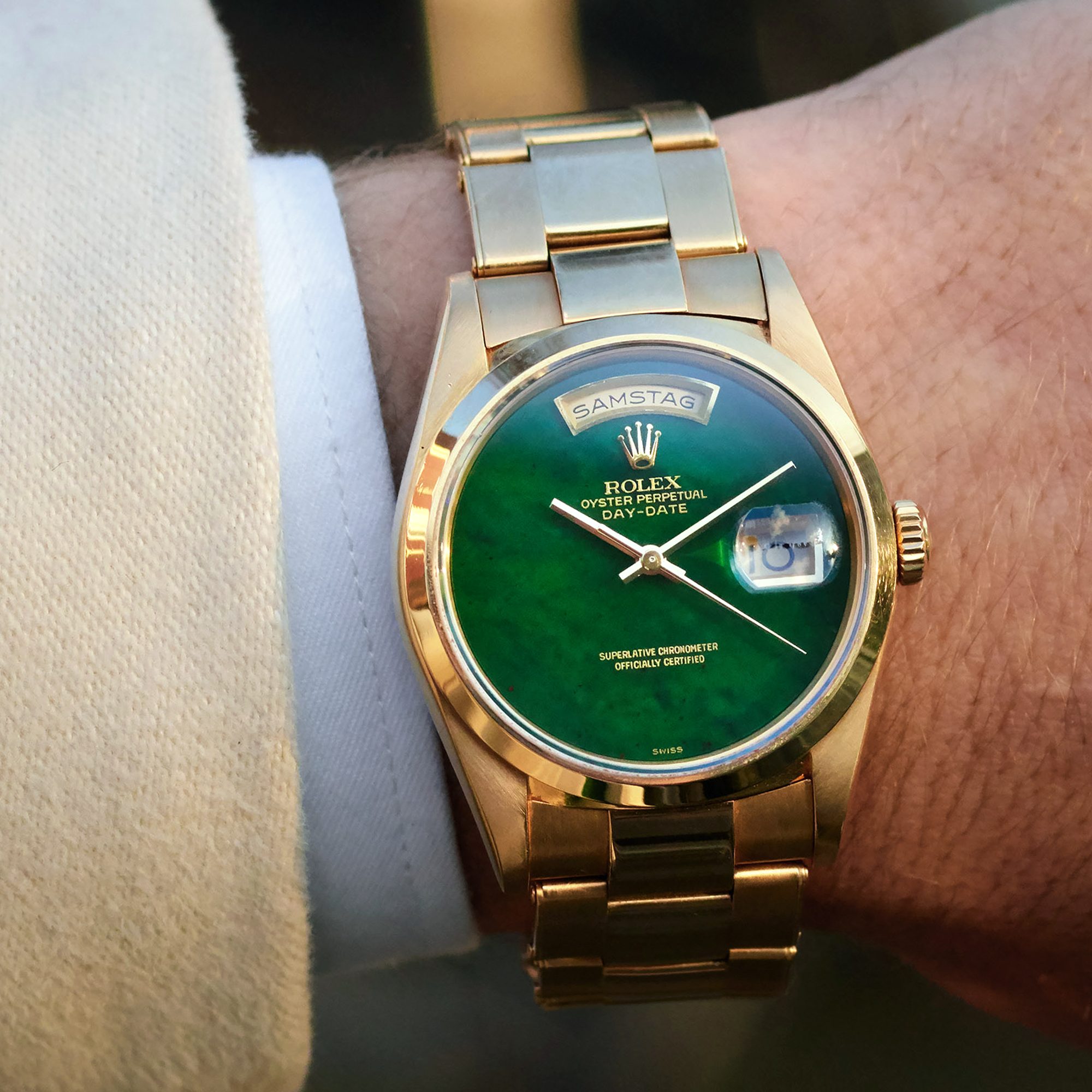
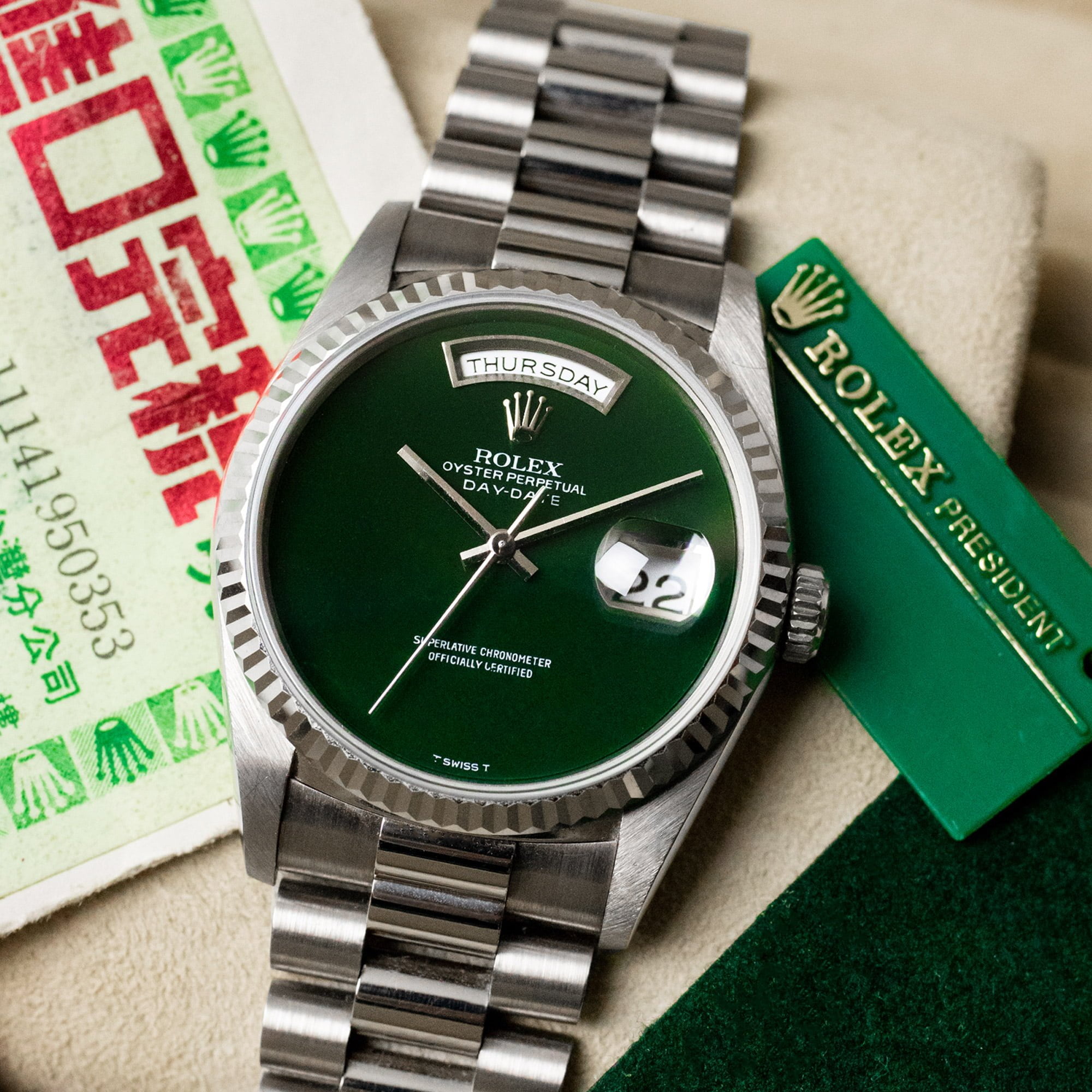
Bloodstone
A dark-green variety of chalcedony (Jasper more specifically), typically marked by distinctive red inclusions of iron oxides called Hematite. These blood-like spots give the stone both its name and unmistakable appearance.
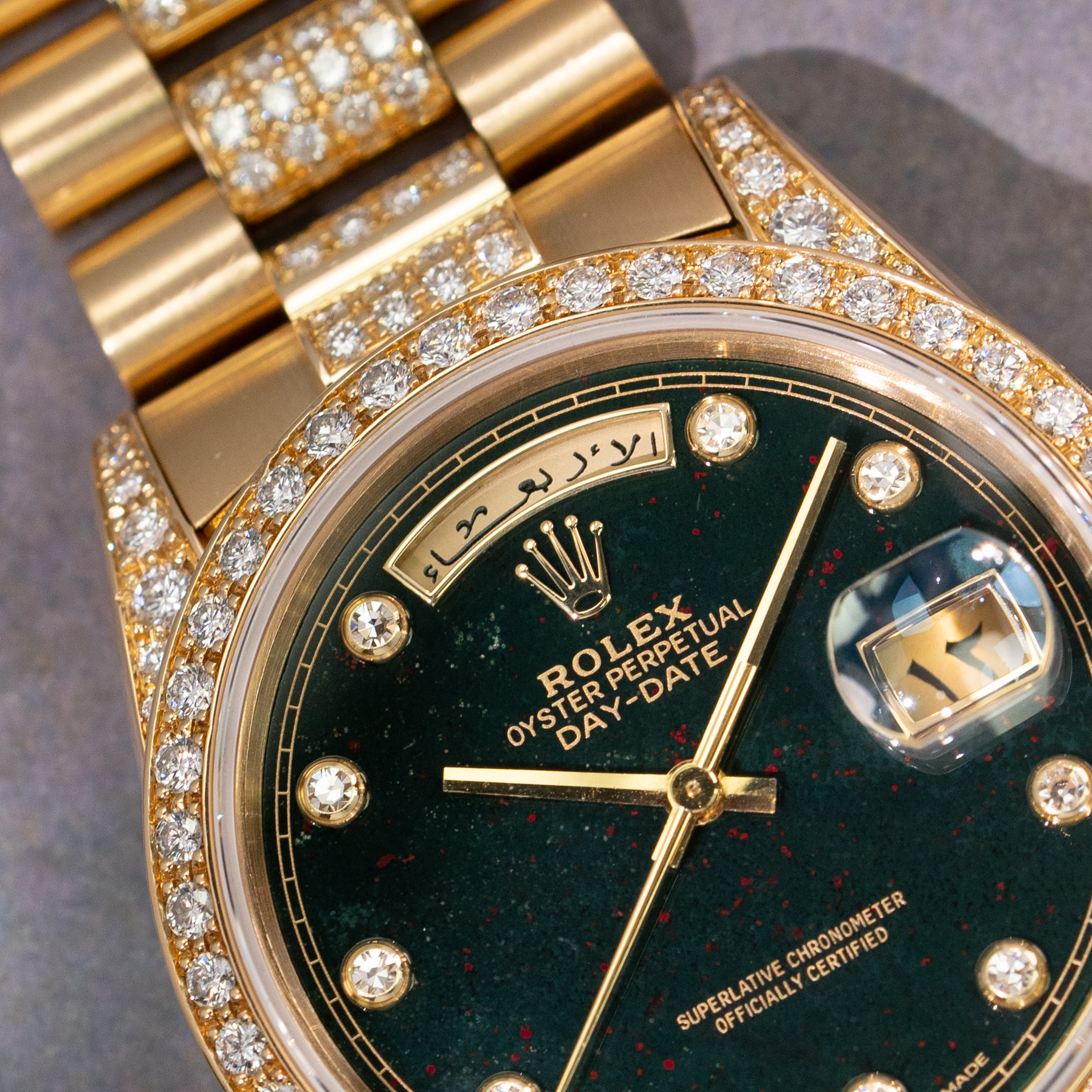
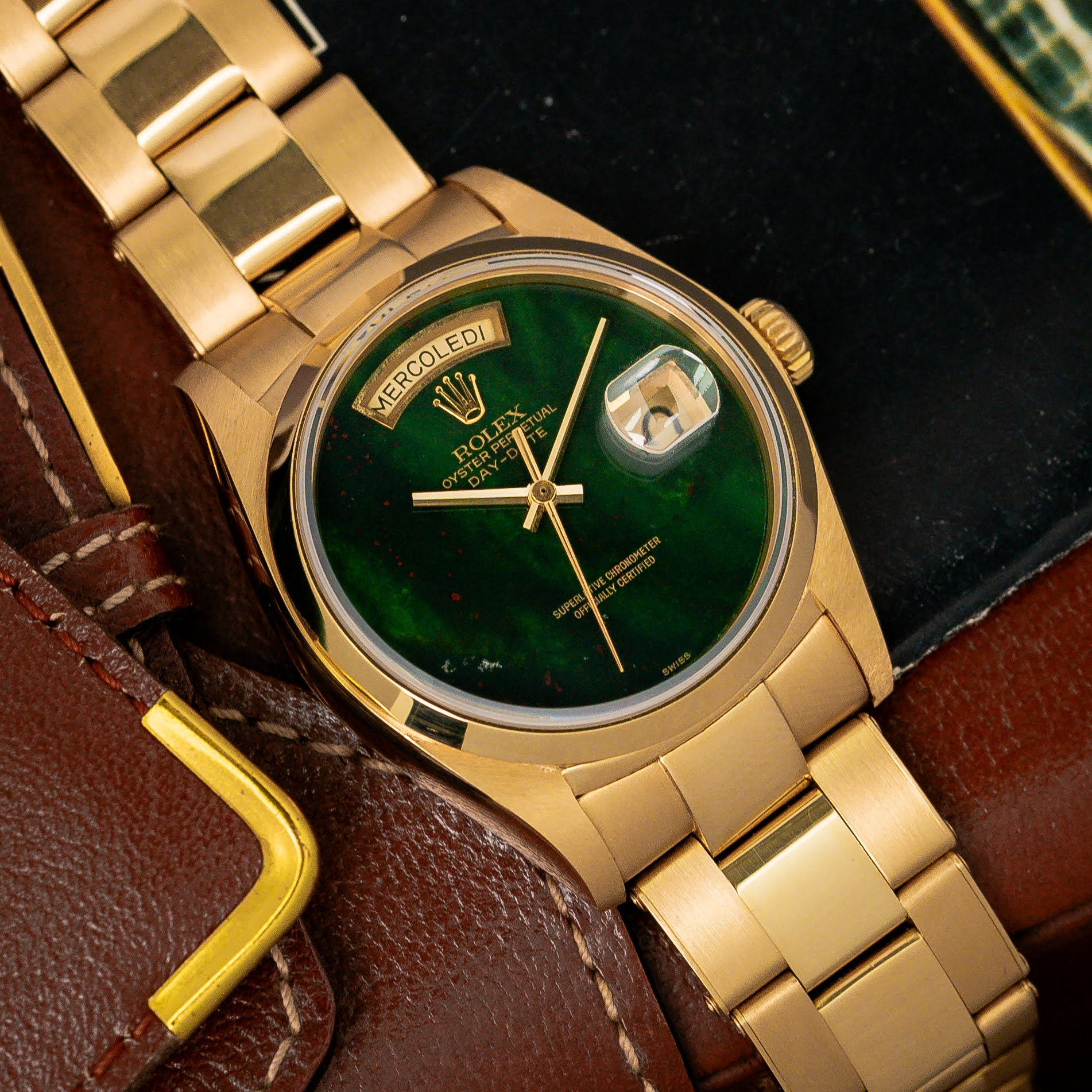

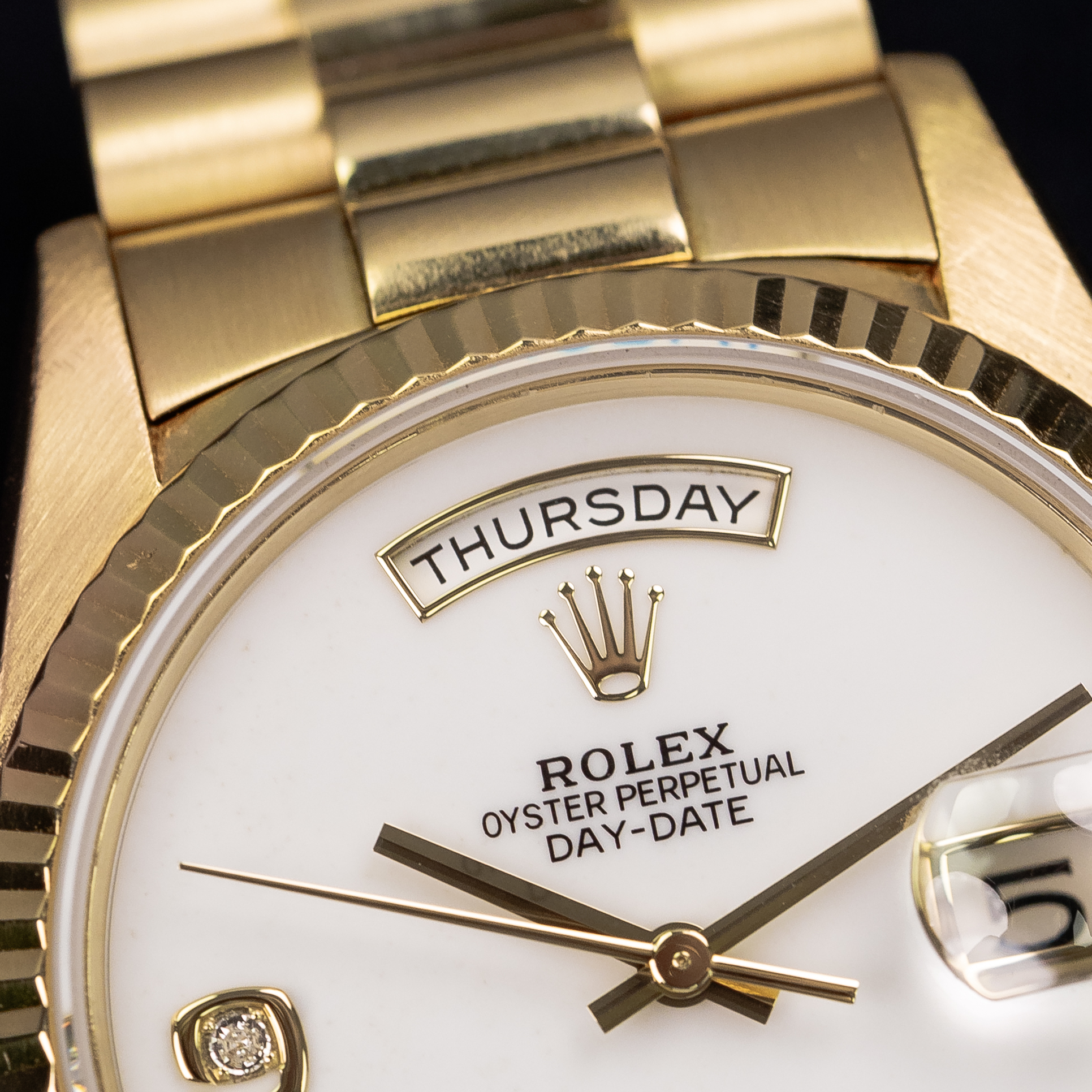
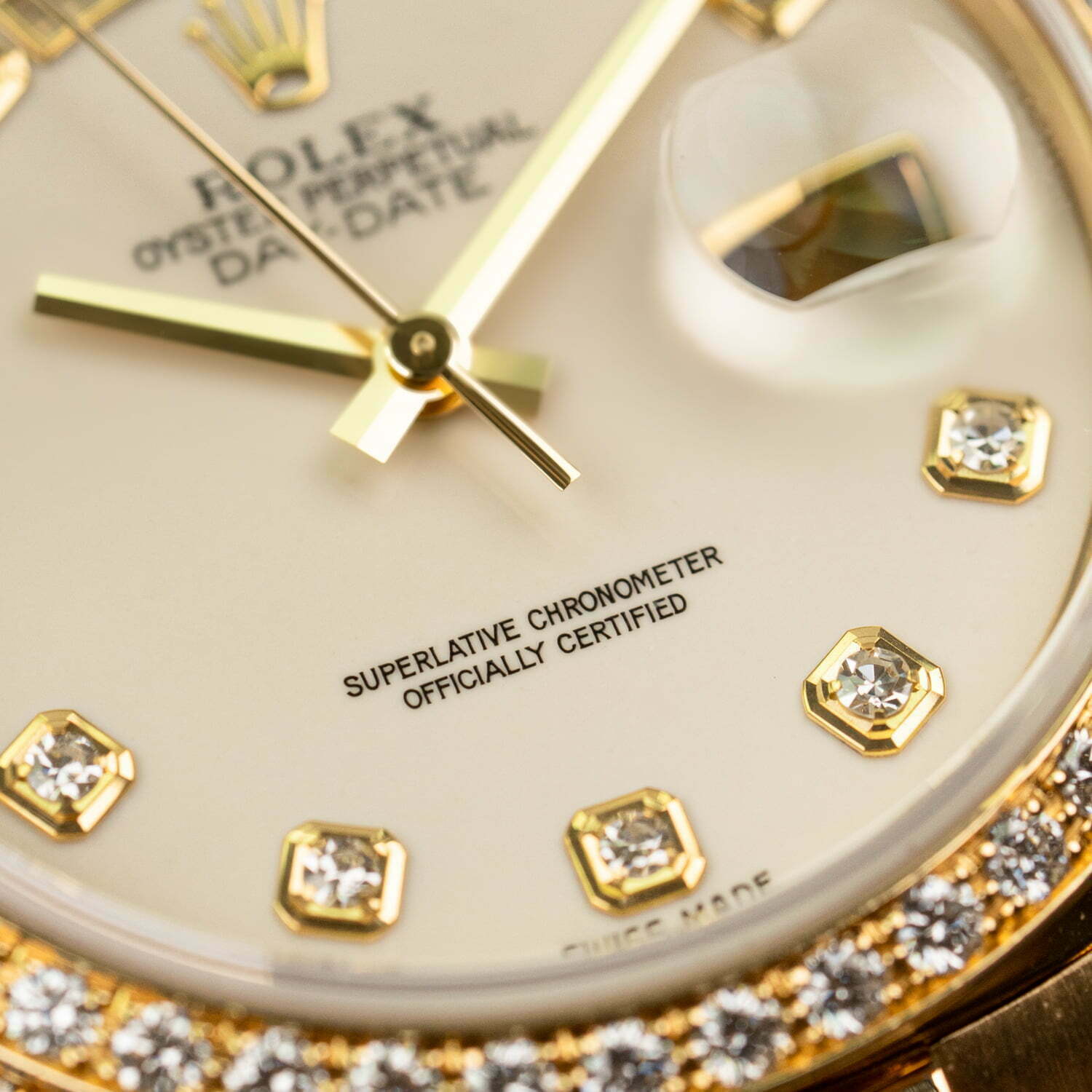
Cacholong
An opaque, milky-white variety of opal with a soft, porcelain-like appearance. Unlike precious opal, it displays no play of color, giving it an unusually clean and uniform character.


Coral
Unlike most materials in this overview, coral is not a mineral but an organic material formed from the calcium carbonate skeletons of marine organisms. Rolex used thin sections of precious coral for its dials, most commonly displaying vivid shades ranging from salmon and orange to deep red. Its naturally fine structure can reveal subtle streaks, pores and variations in color. Coral is also particularly delicate, making well-preserved examples increasingly difficult to find.

Cornelian
Better known as carnelian, this translucent variety of chalcedony ranges from warm orange to deep reddish brown. Its rich color comes from iron oxides within the stone.


Ferrite
An iron-rich material characterized by dark metallic tones and a naturally textured appearance. When cut into a thin dial, its irregular structure creates subtle variations that distinguish every example.
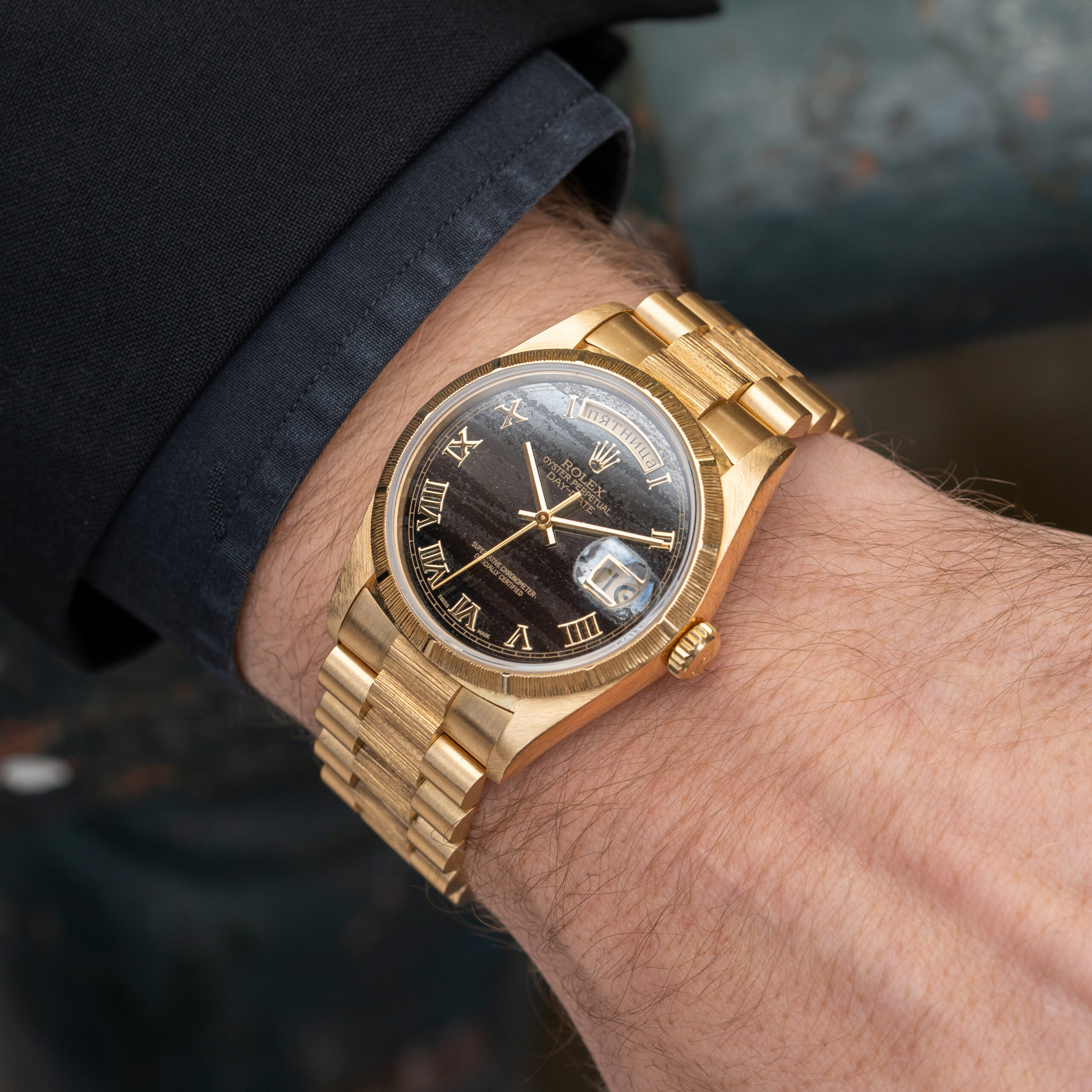
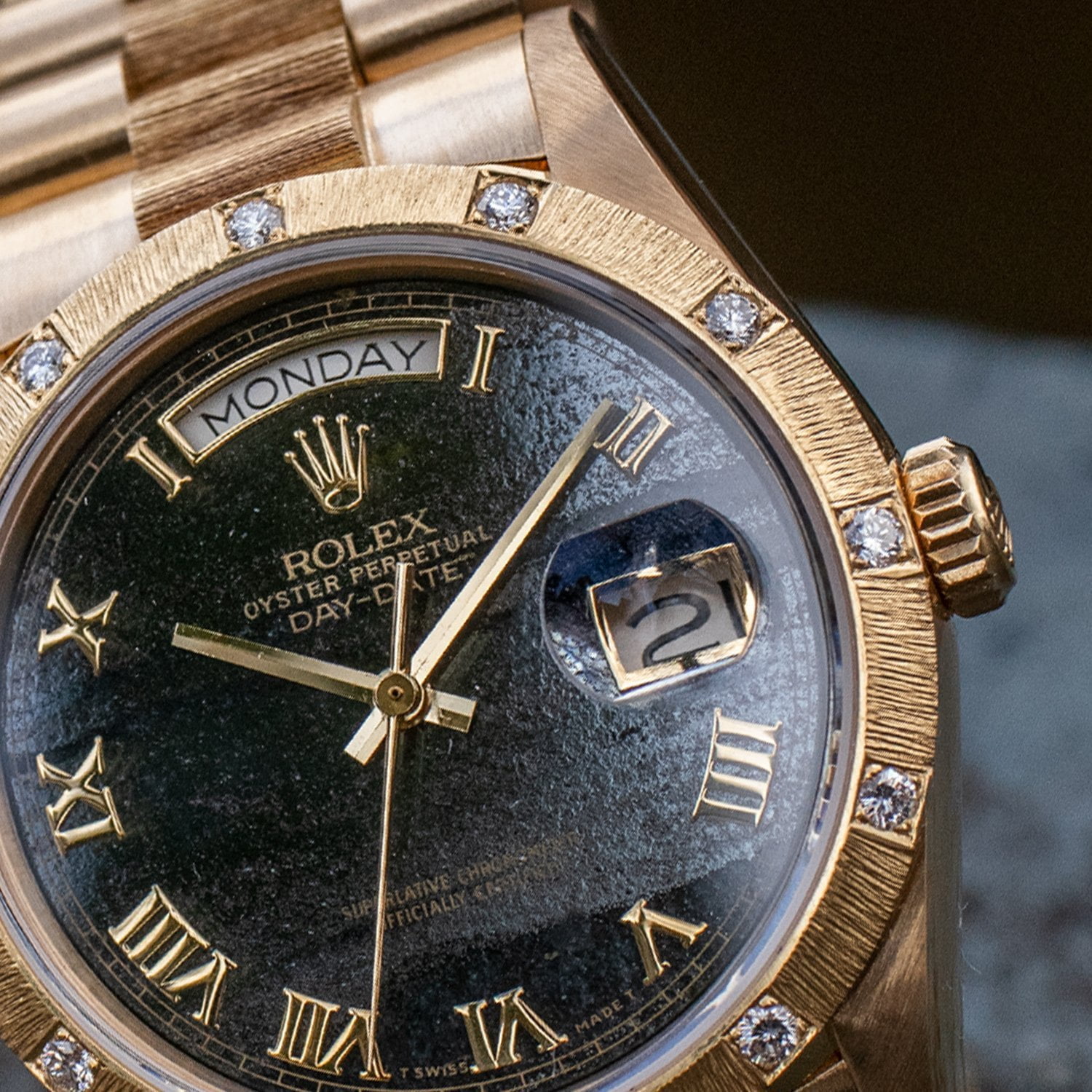
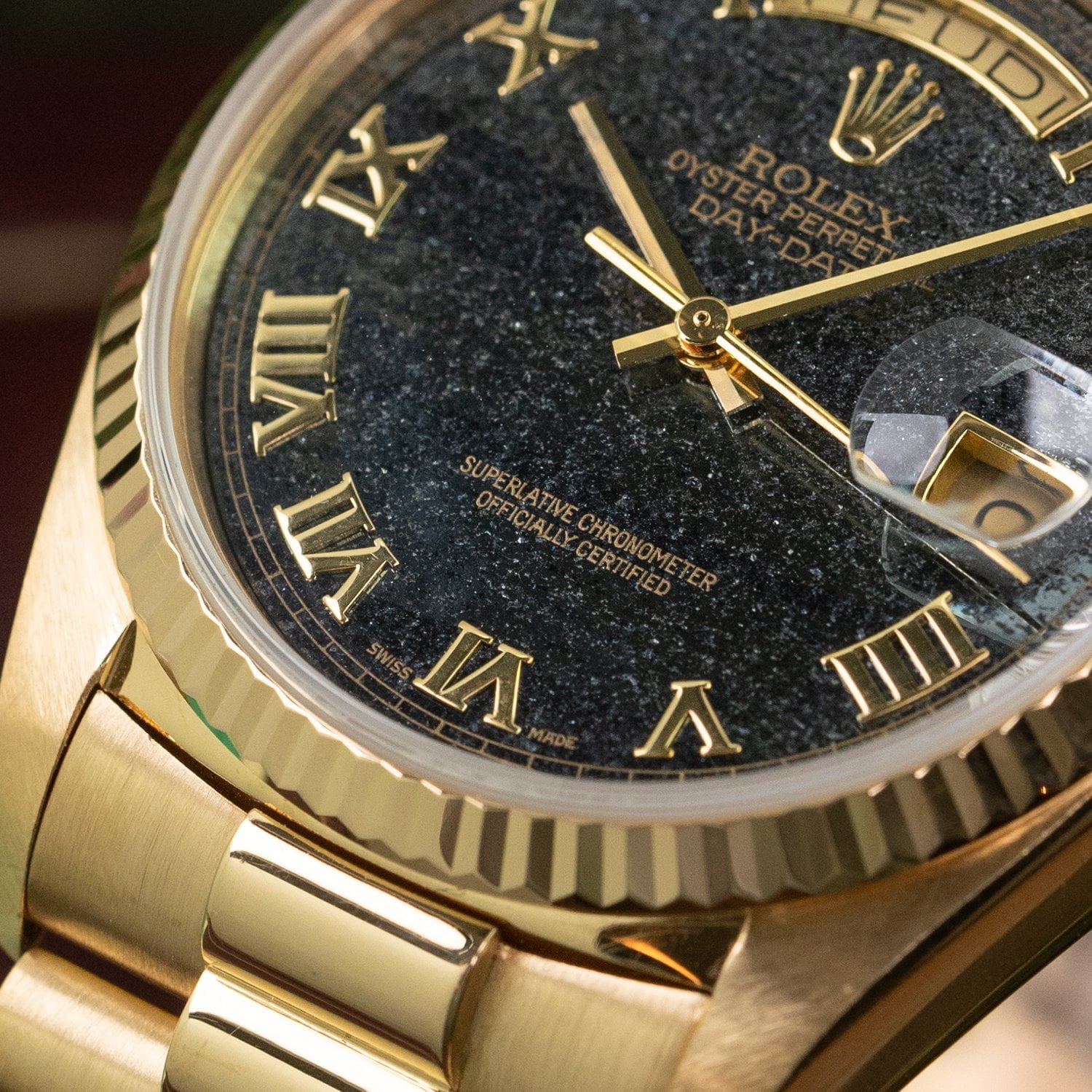
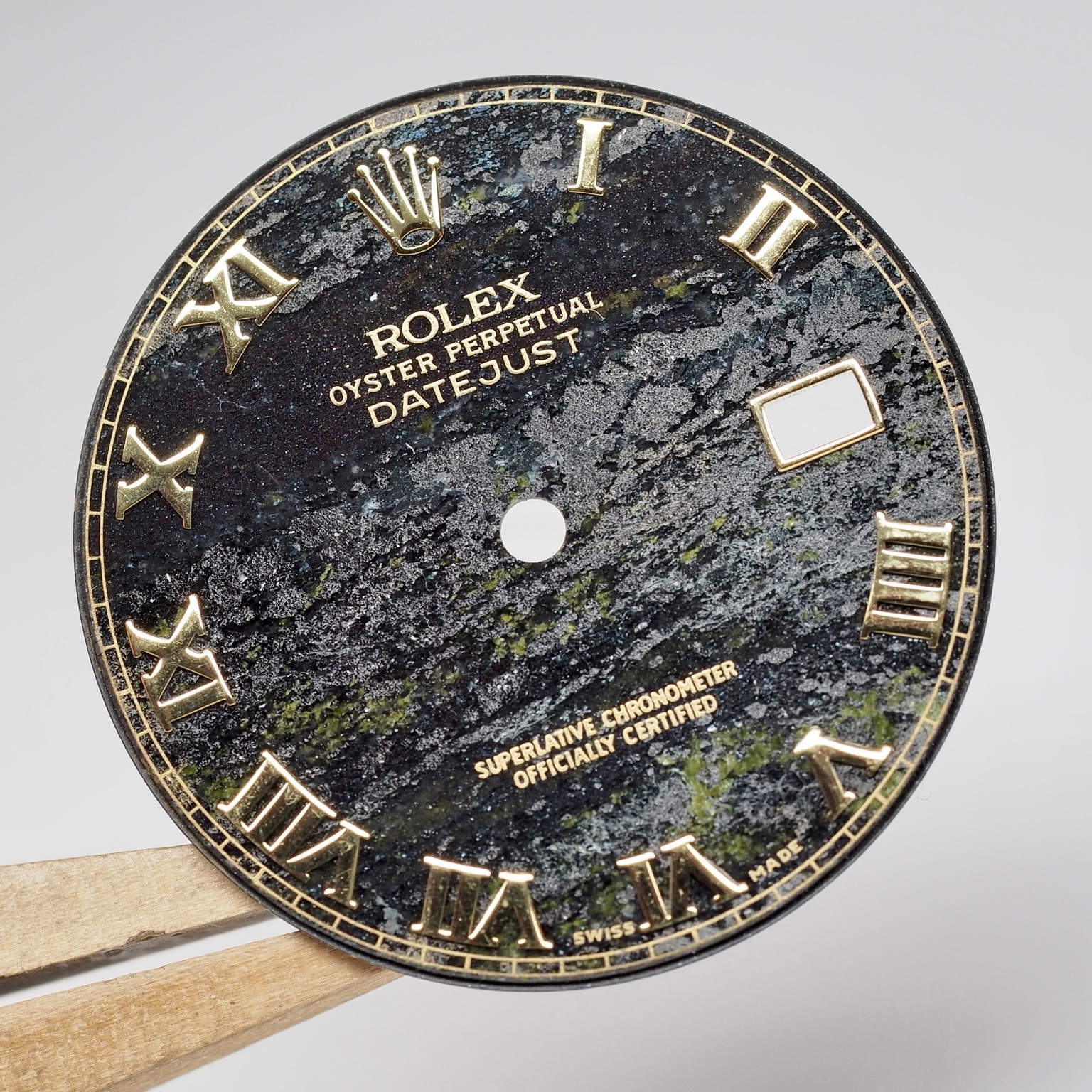
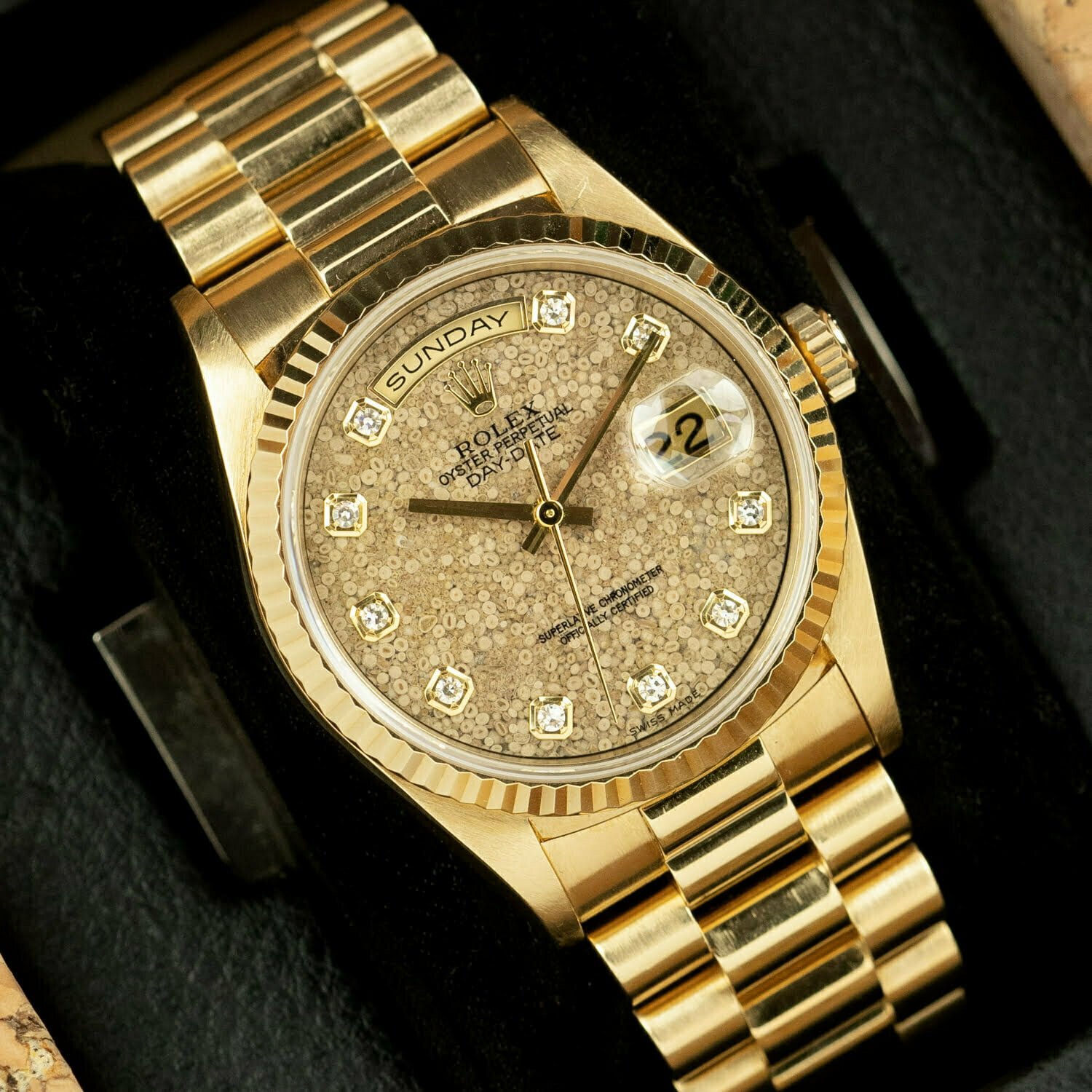
Fossil
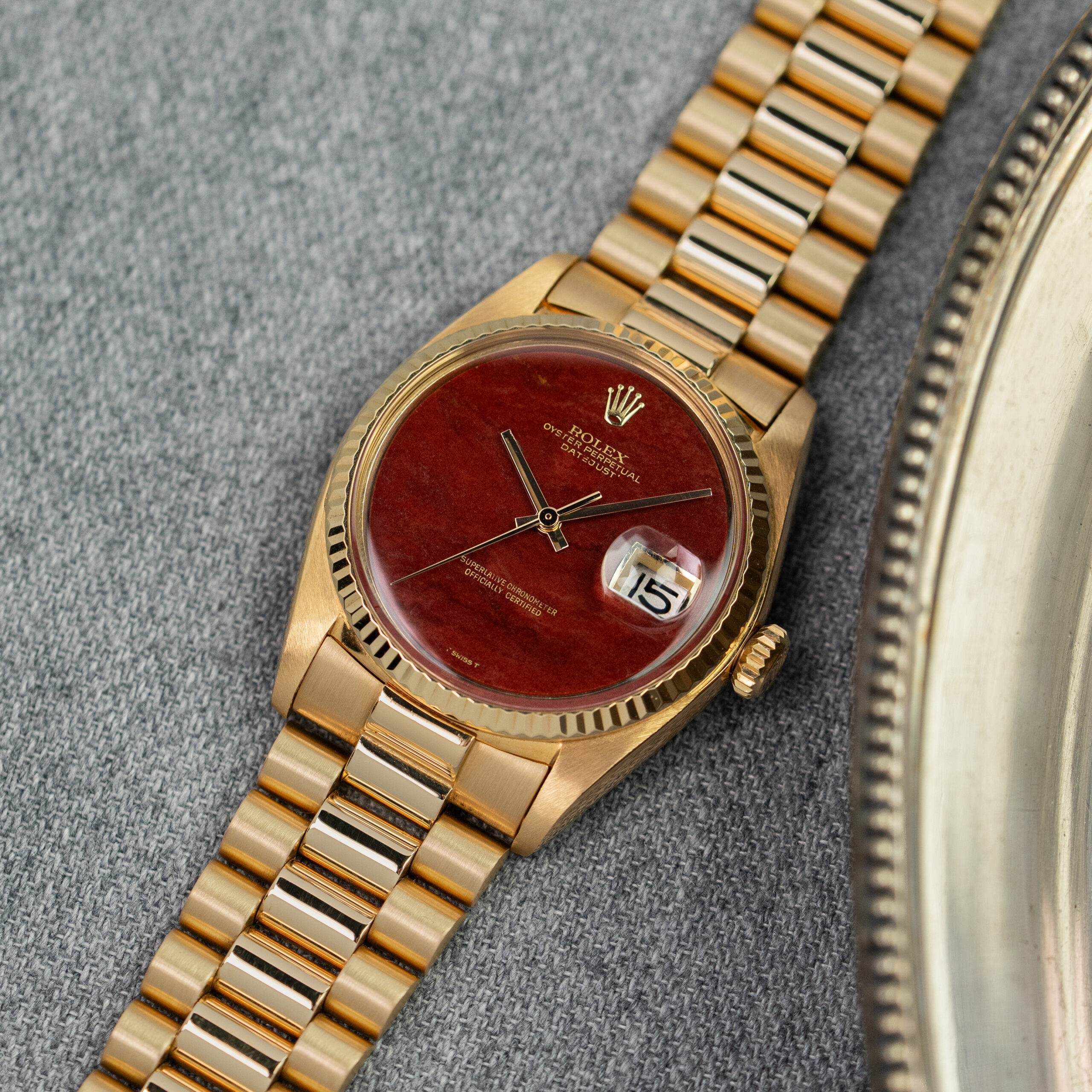
Cut from naturally fossilized material, these dials preserve organic structures formed millions of years ago. Their patterns can resemble anything from abstract landscapes to clearly visible traces of prehistoric life. There are 2 colors; a lighter yellowish tone and a darker grey variety. This is one of the most fragile stone dials. In internal Rolex documents, these dials are also referred to as “Ammonite”‘ which, of course, is itself a fossil. However, due to the clear visual differences from the Ammonite dials discussed earlier, the collector market has come to distinguish between the two and refers to this particular variety simply as “Fossil.”


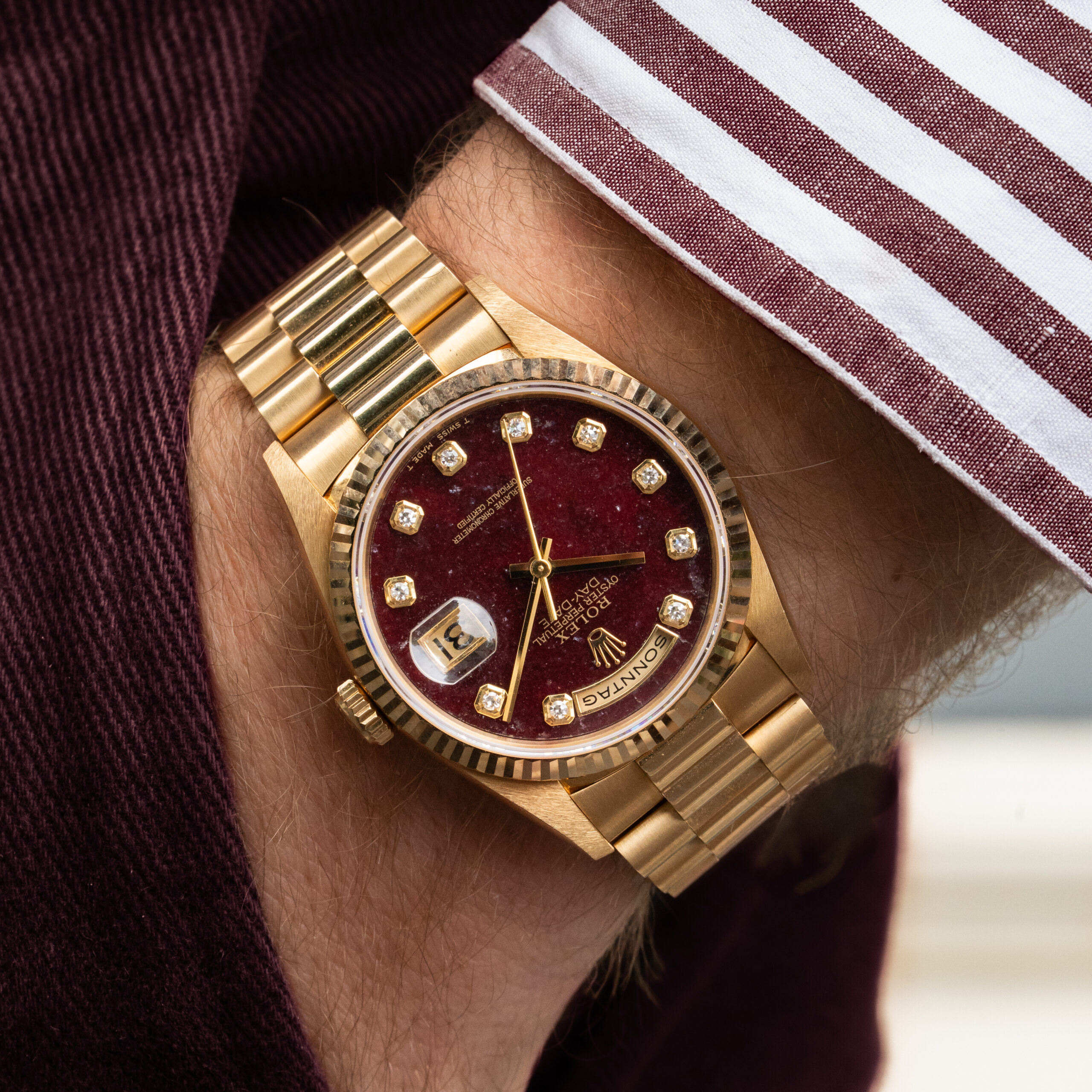
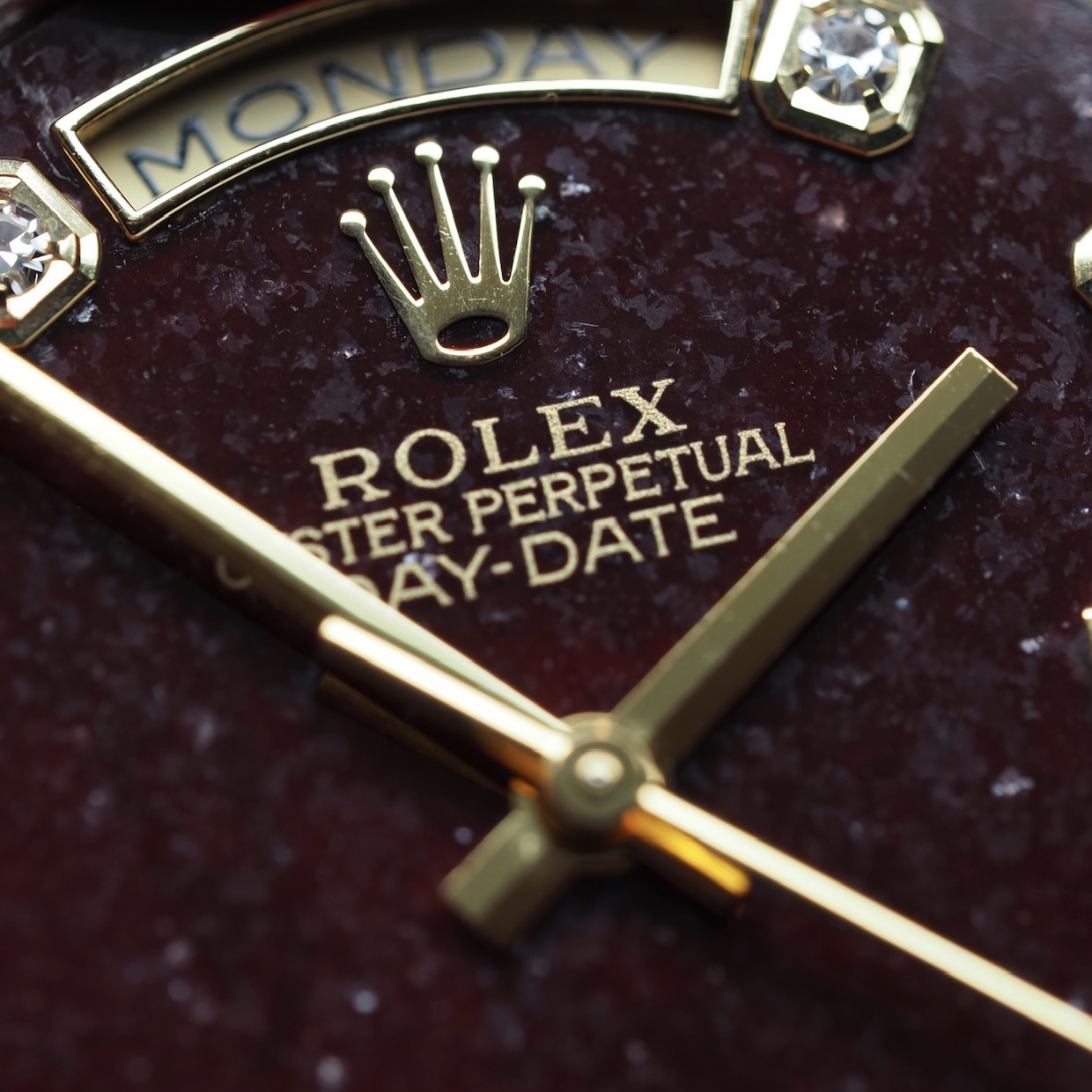
Grossular
A member of the garnet family that occurs in a surprisingly broad range of colors. The material used for dials is valued particularly for its rich red color and naturally mottled, almost granular appearance. Make sure not to mistake it with Rubelite.
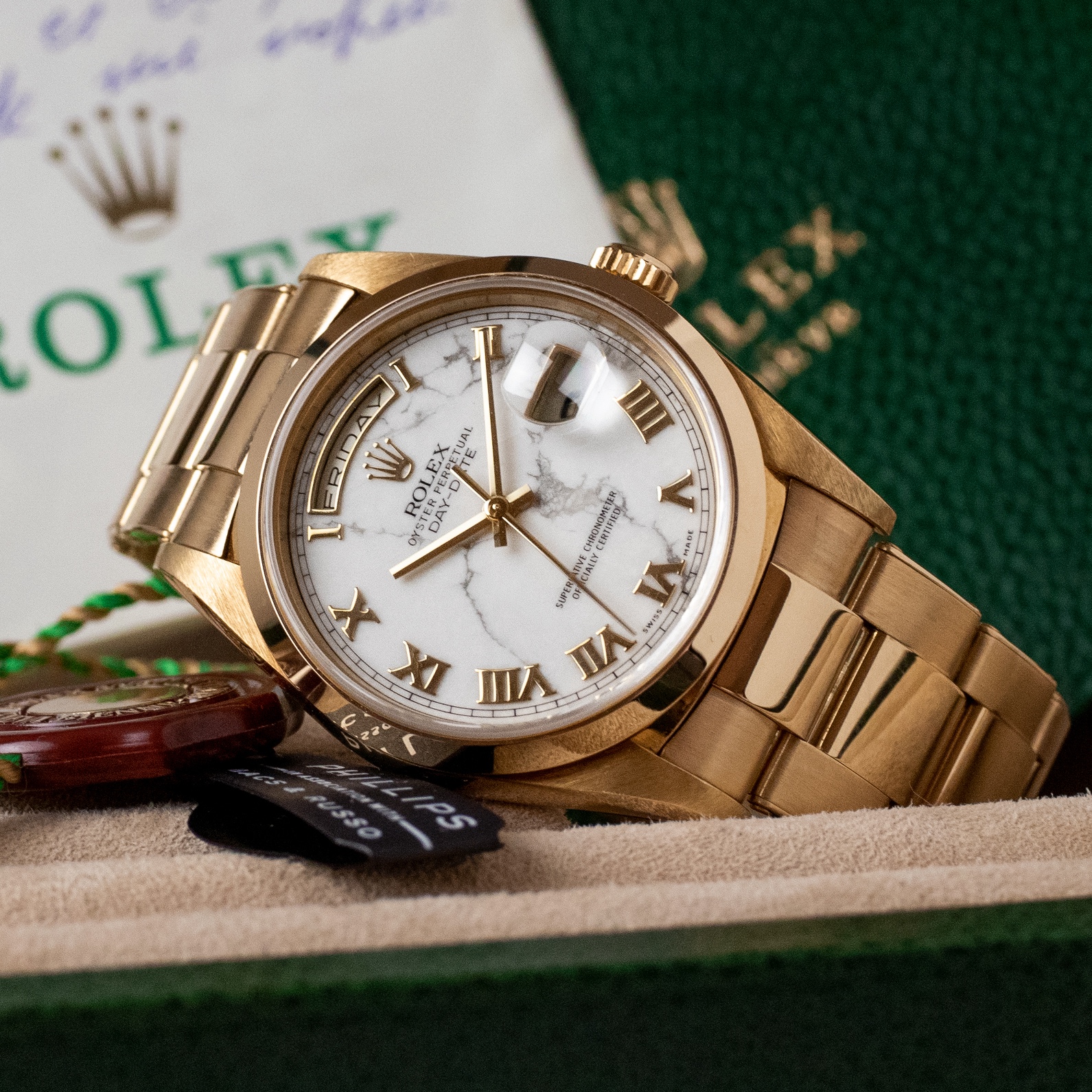
Howlite
A white mineral typically crossed by irregular grey or black veining. Its marble-like (it is NOT marble, as auction houses described this dial before) pattern gives it a striking graphic quality.


Jasper
An opaque variety of microcrystalline quartz found in numerous colors. Rolex used red Jasper and green Jasper. If last mentioned show traces of Hematite the determination should be Bloodstone or Heliotrope.



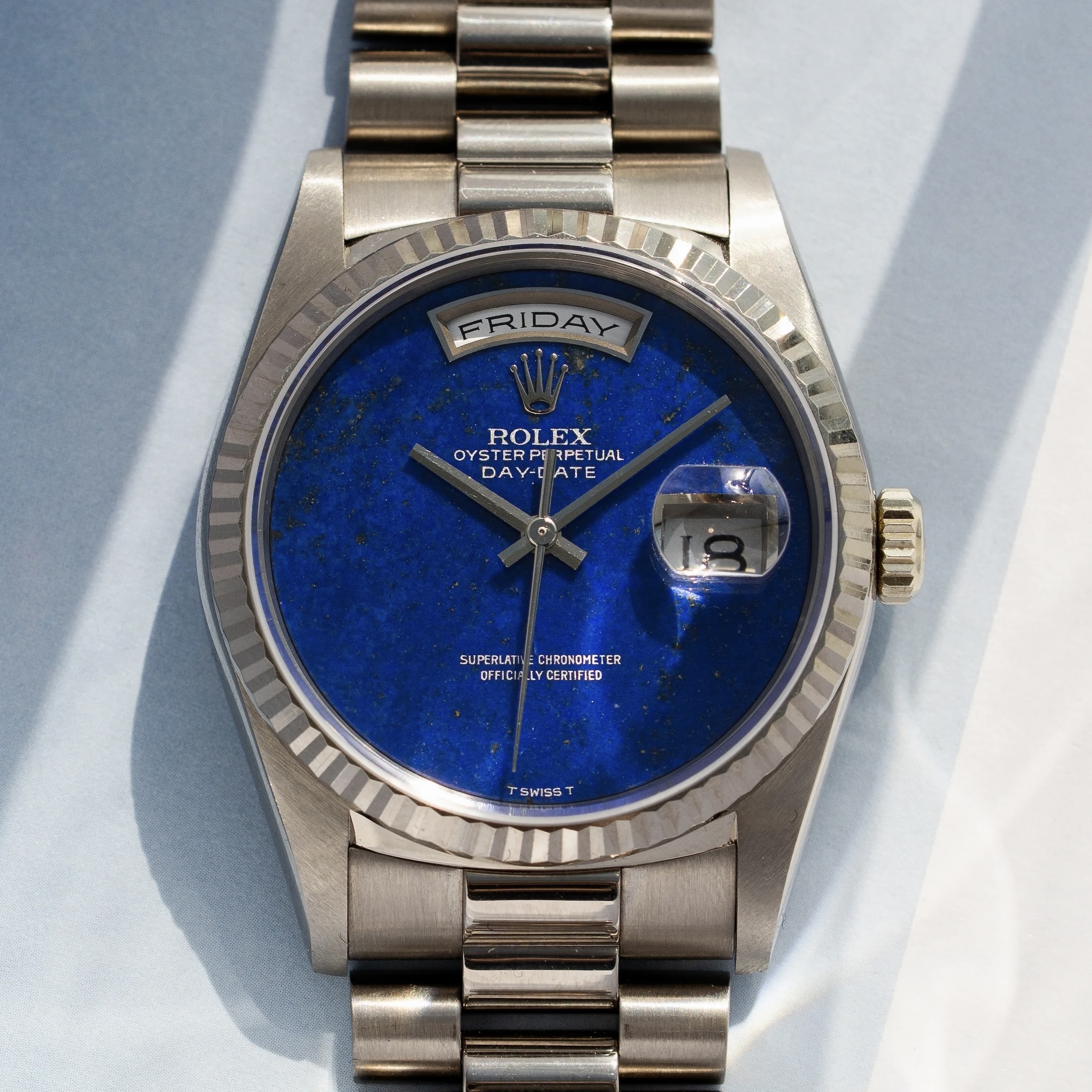
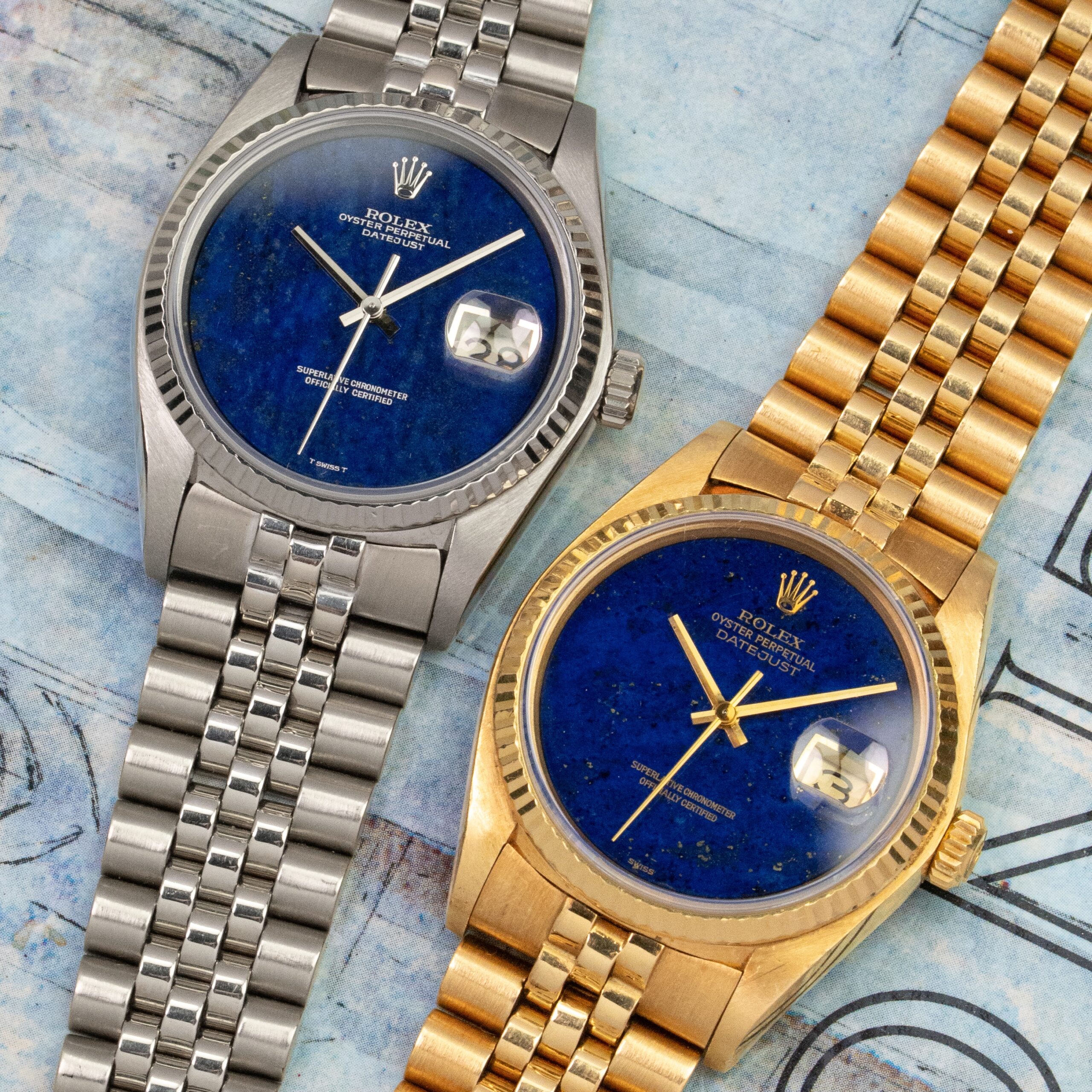
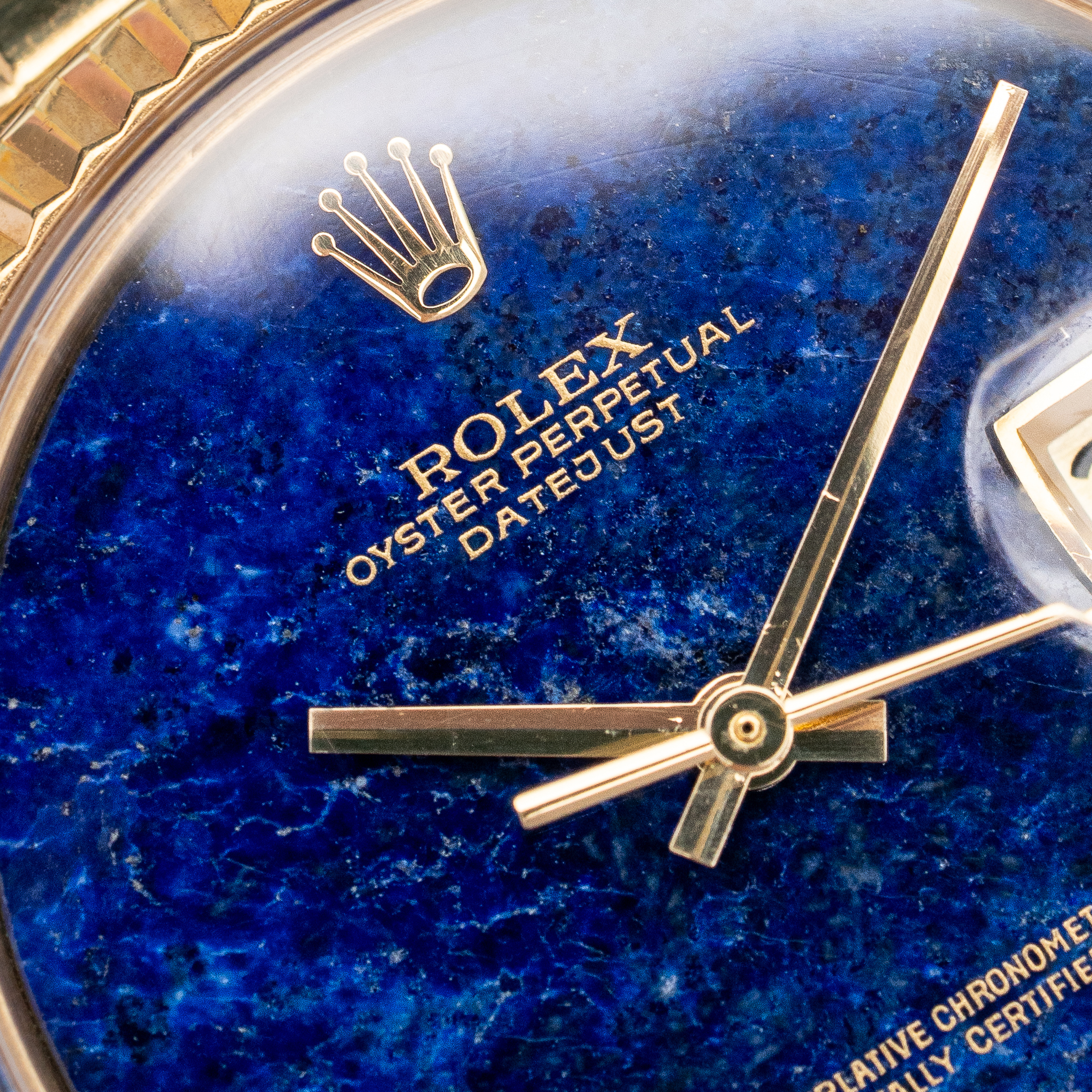
Lapis Lazuli
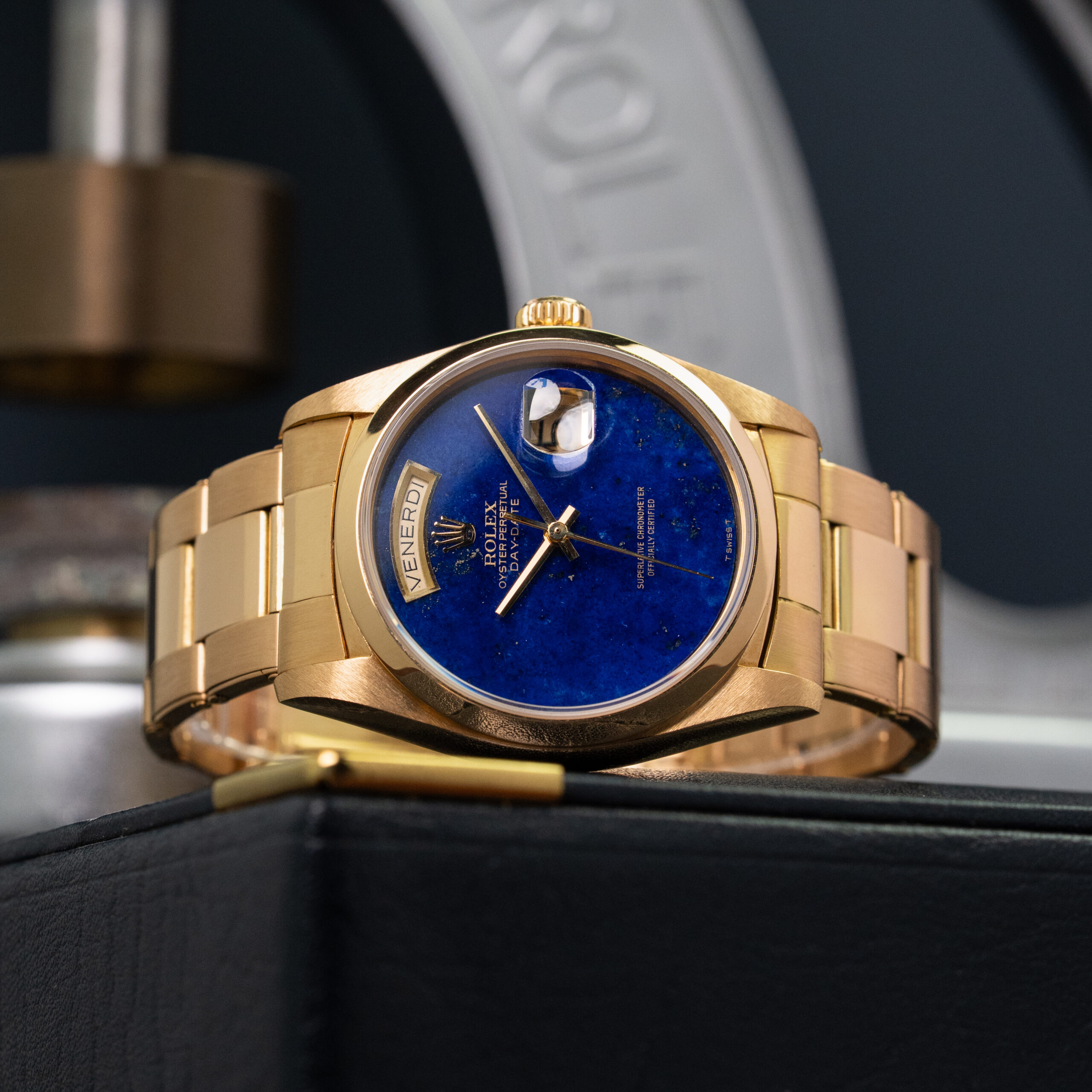
An intensely blue metamorphic rock composed primarily of lazurite, often accompanied by white calcite and metallic-looking pyrite inclusions. The finest examples combine a deep ultramarine ground with scattered golden flecks.

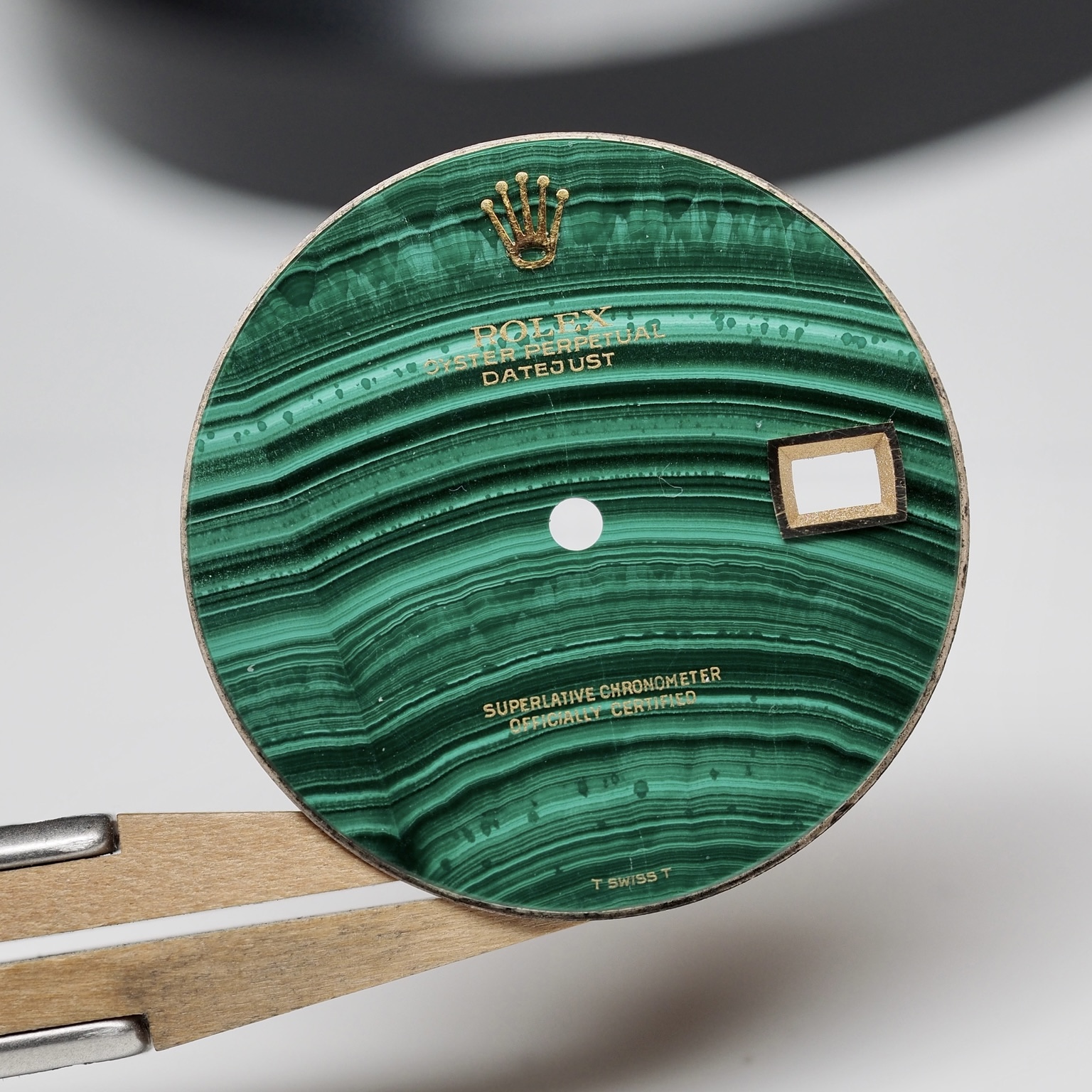
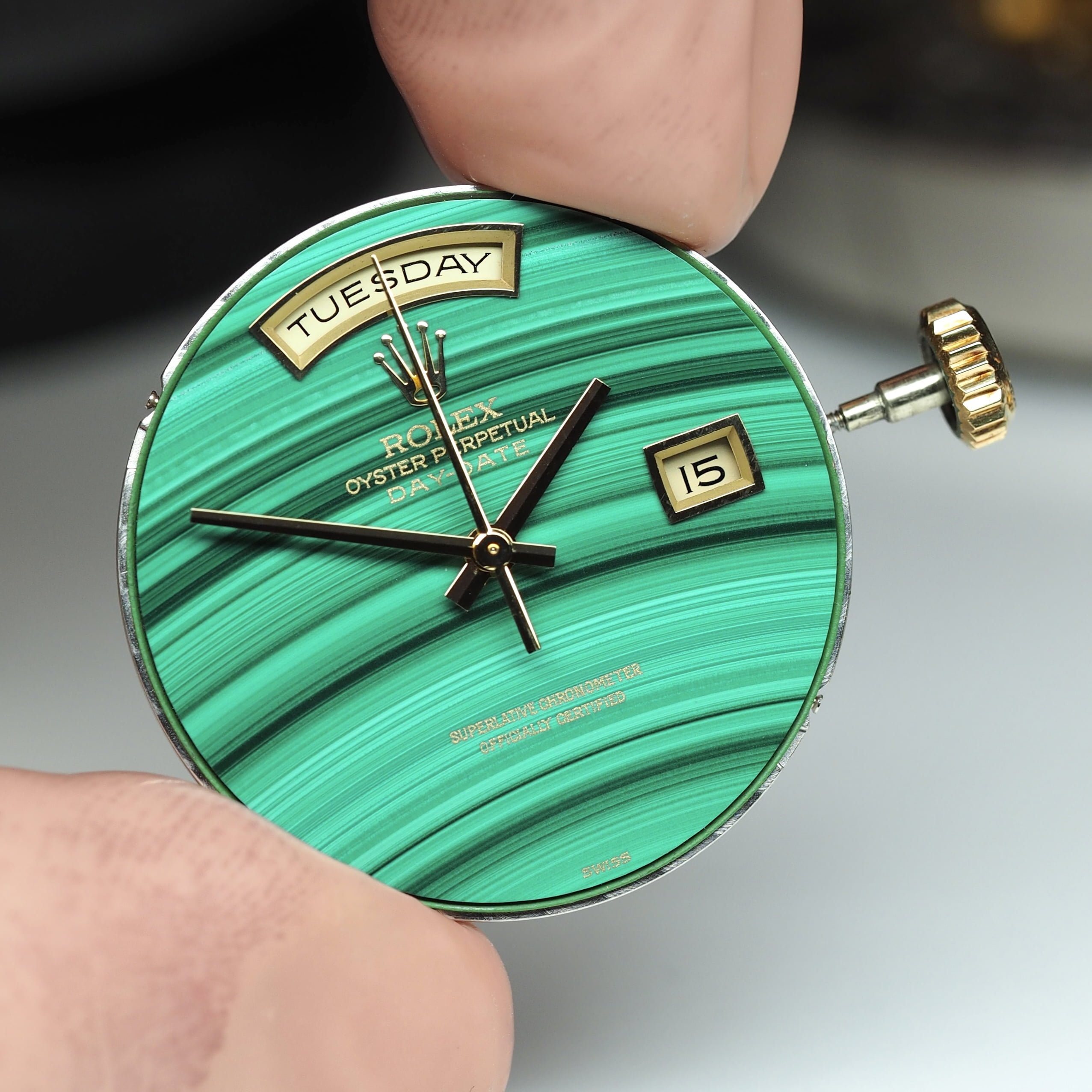
Malachite
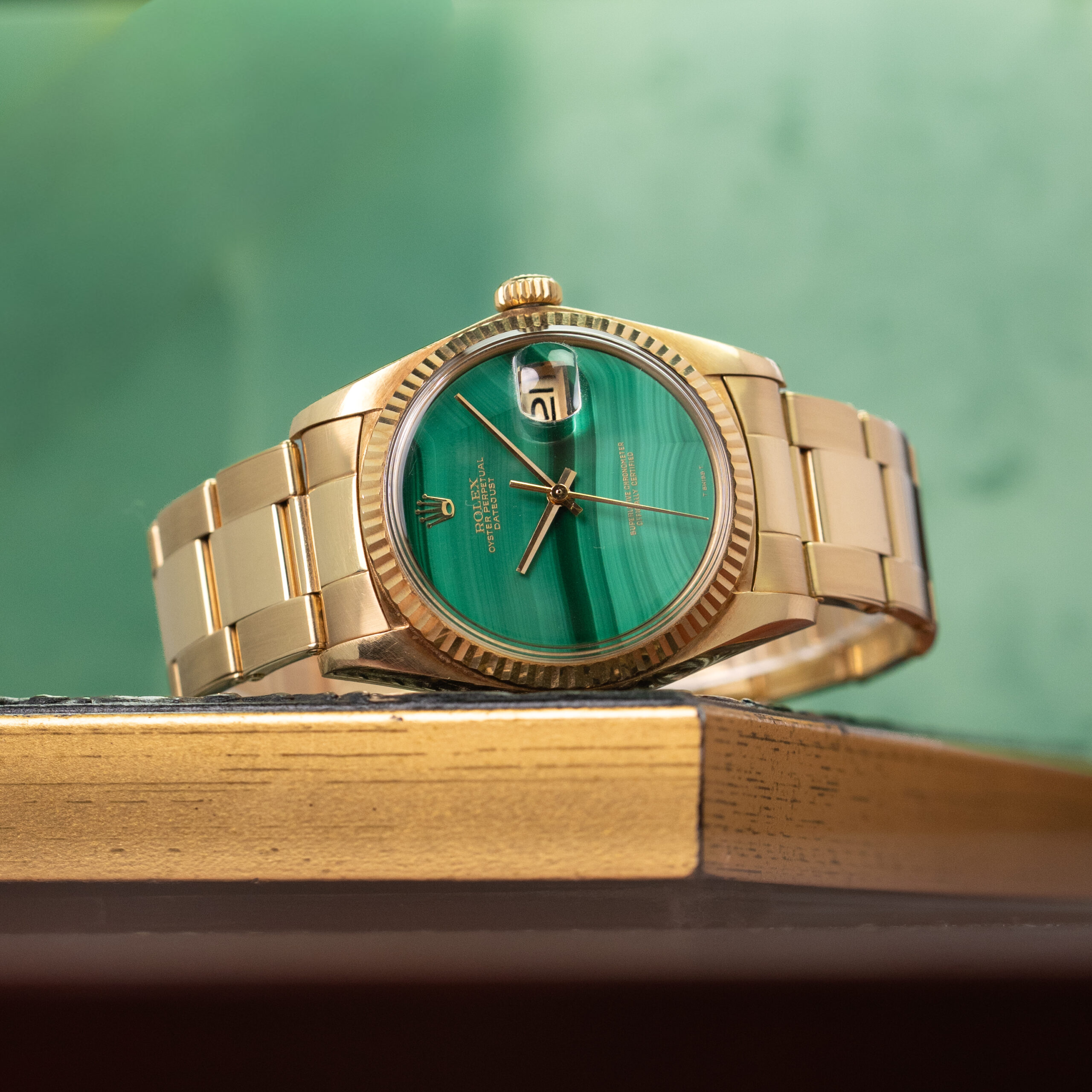
A copper carbonate mineral instantly recognizable by its vivid green color and characteristic bands. When sliced, these layers form dramatic waves, stripes and concentric patterns unique to each dial. Also one of the most fragile ones.

Obsidian
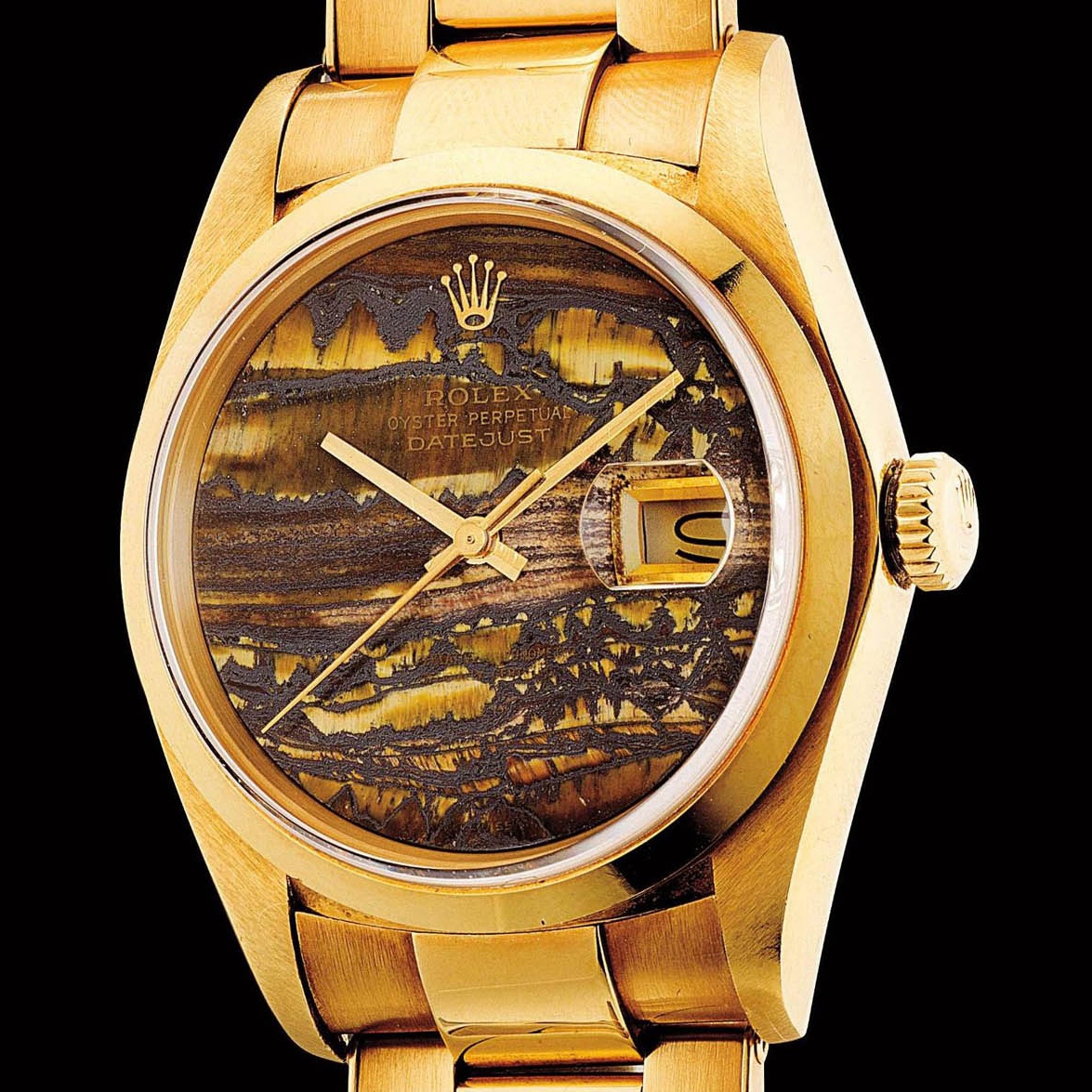
A naturally occurring volcanic glass formed when silica-rich lava cools extremely rapidly. Usually deep black, it can display subtle variations, inclusions or reflective effects depending on its composition. What Rolex refers to as Obsidian in its internal documentation is, based on our research, most likely not obsidian at all, but a material closer to Tiger Iron. The exact identification remains open to debate, however, and rather than drawing conclusions where certainty is lacking, we will use Rolex’s own historical terminology and present the material here as Obsidian.

Onyx
A variety of chalcedony prized in dial production for its exceptionally deep, uniform black appearance. Unlike heavily patterned stones, its appeal lies in the almost absolute absence of visible structure.
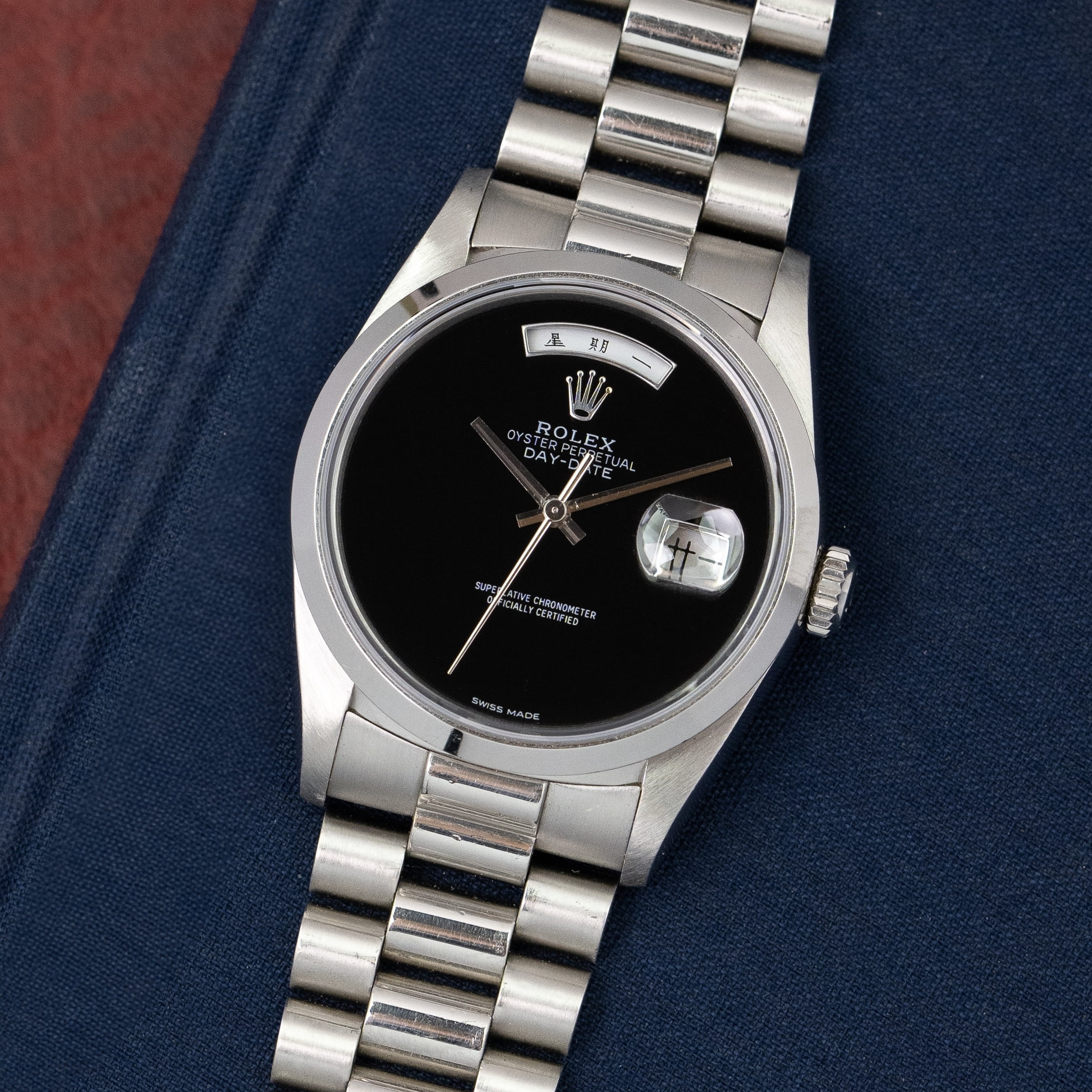
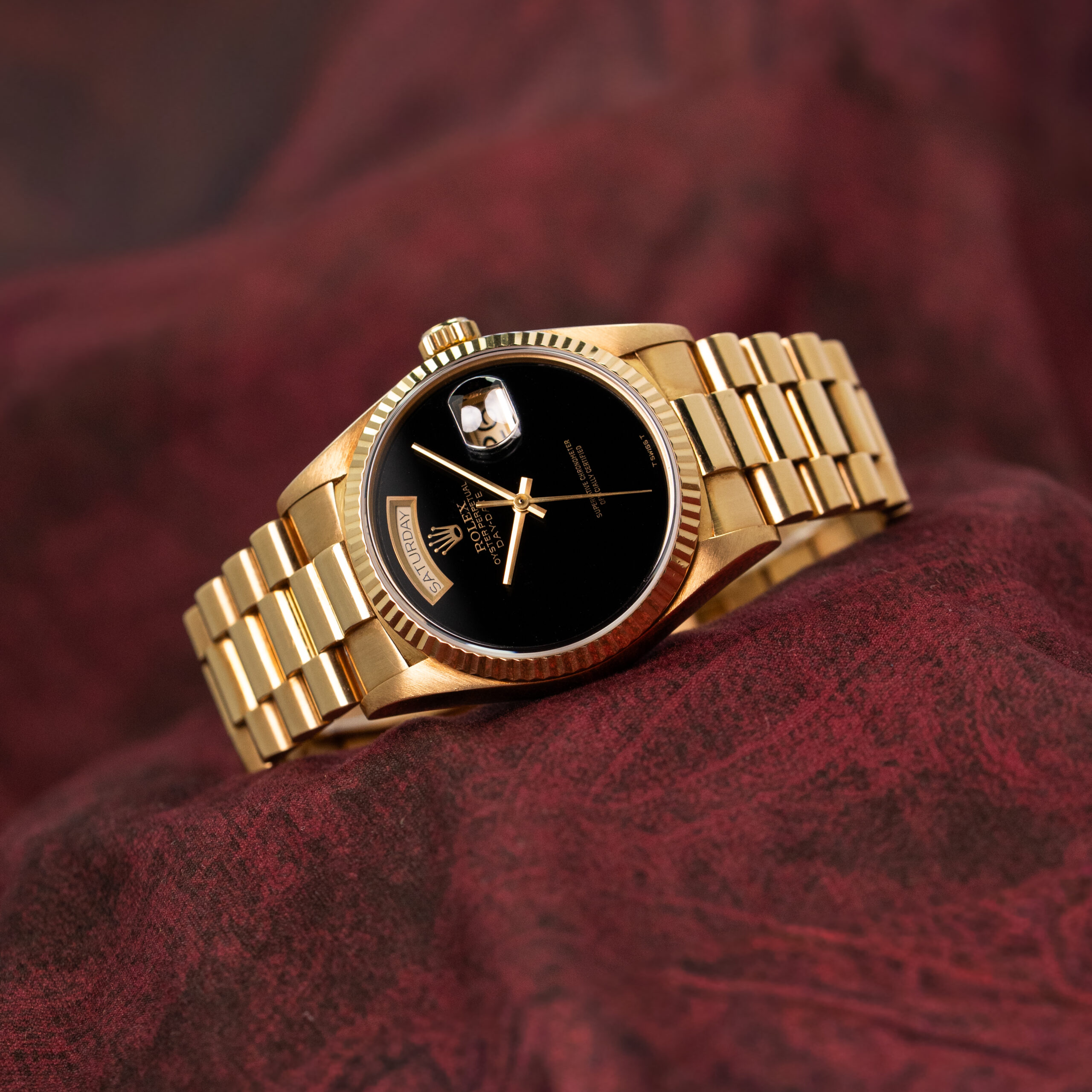
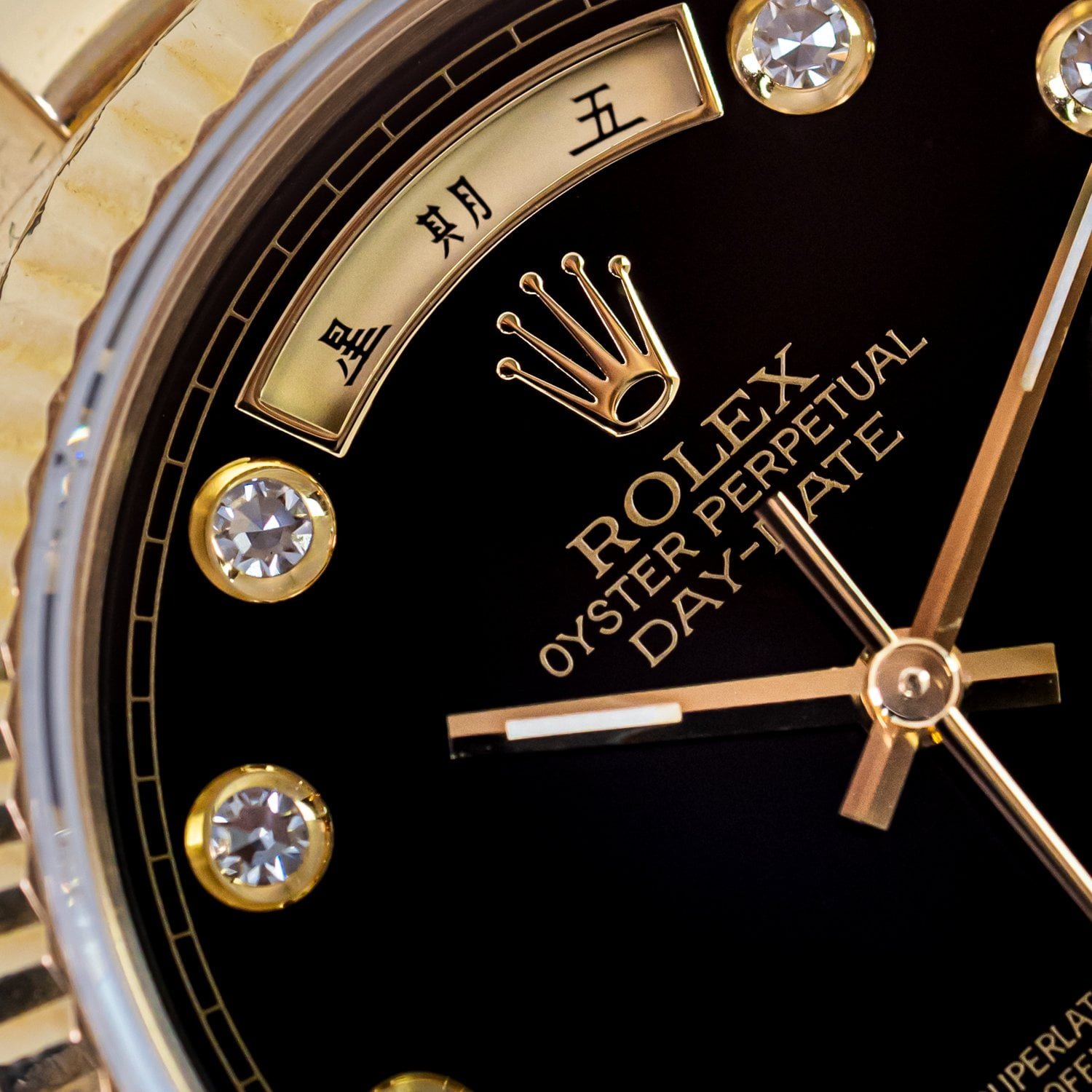
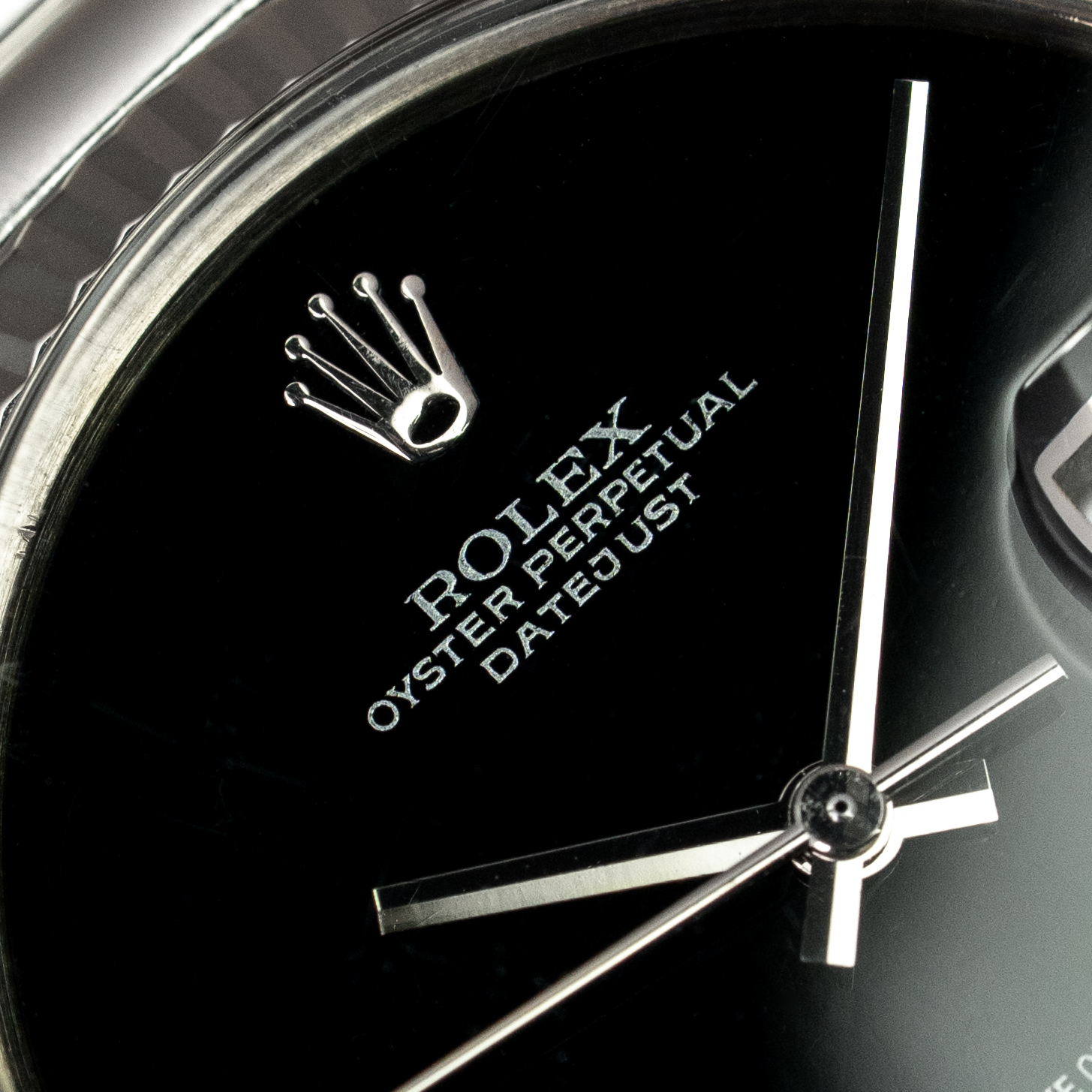

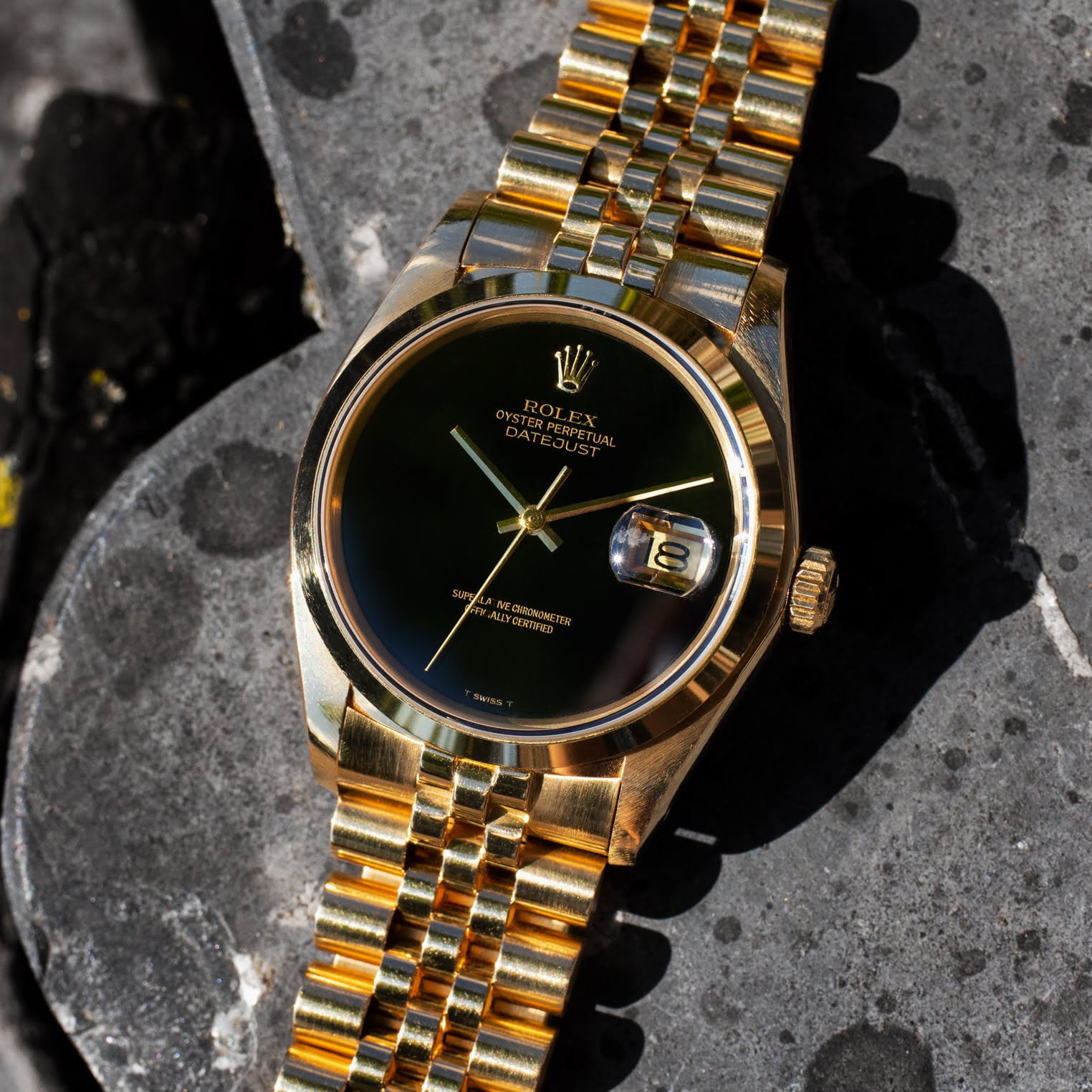
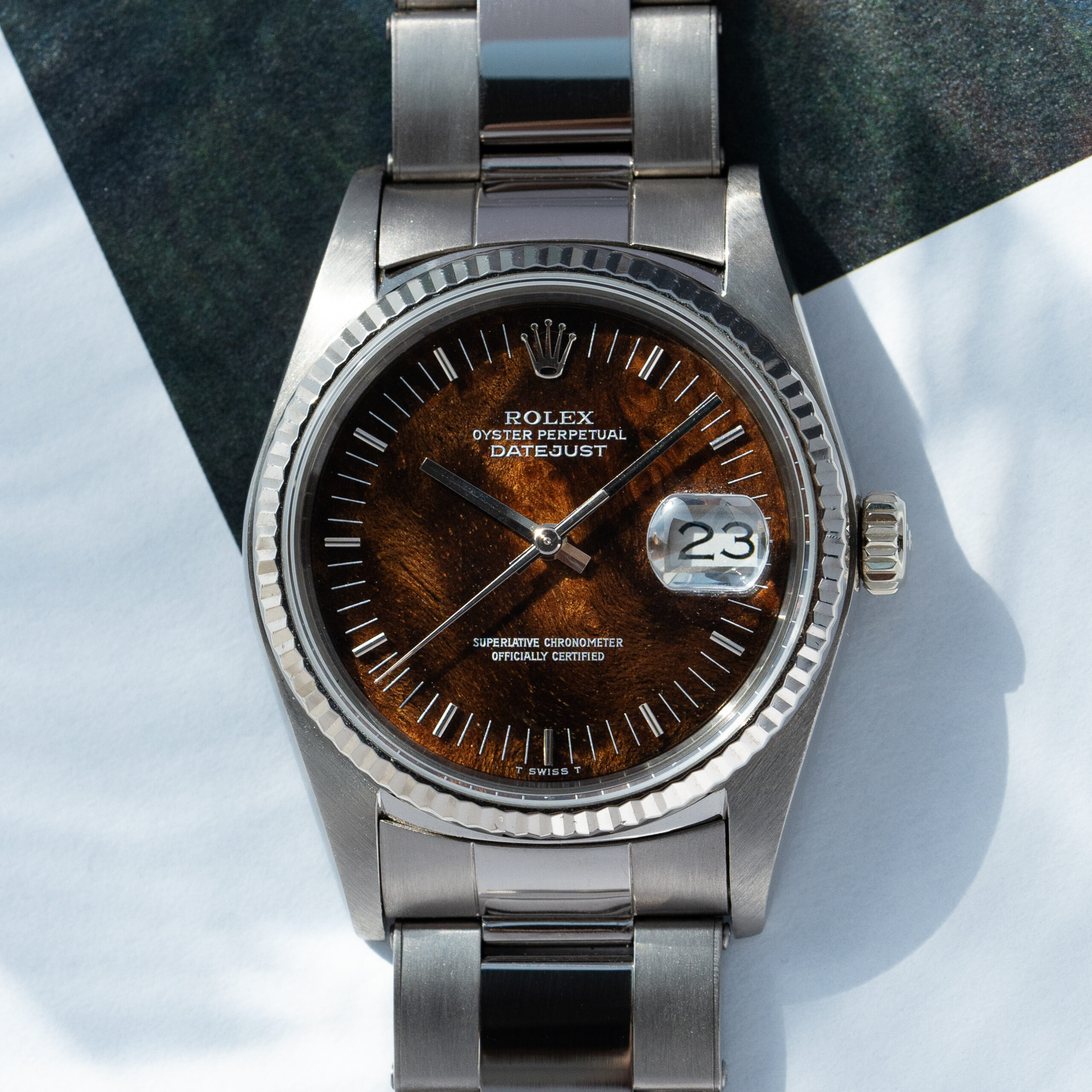
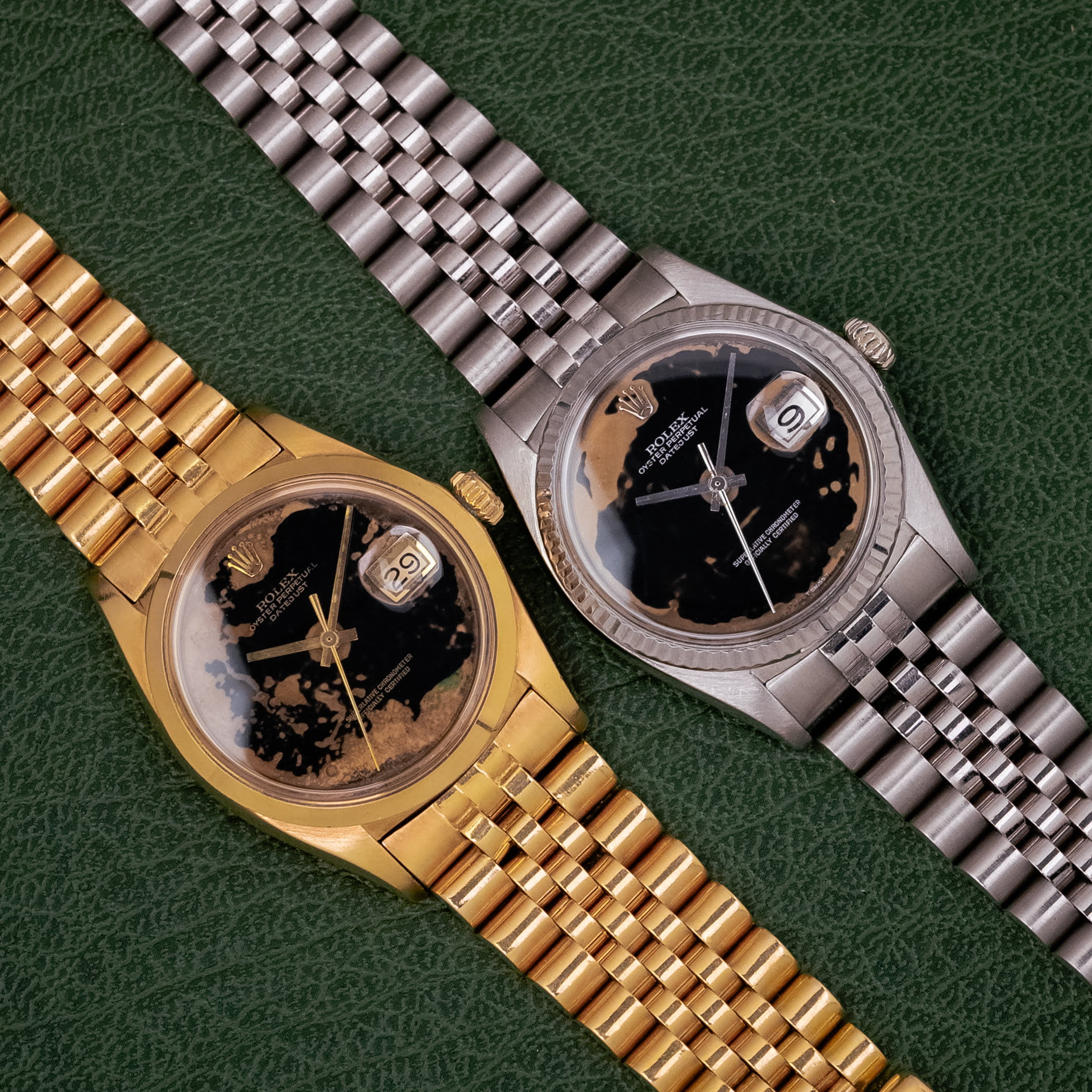
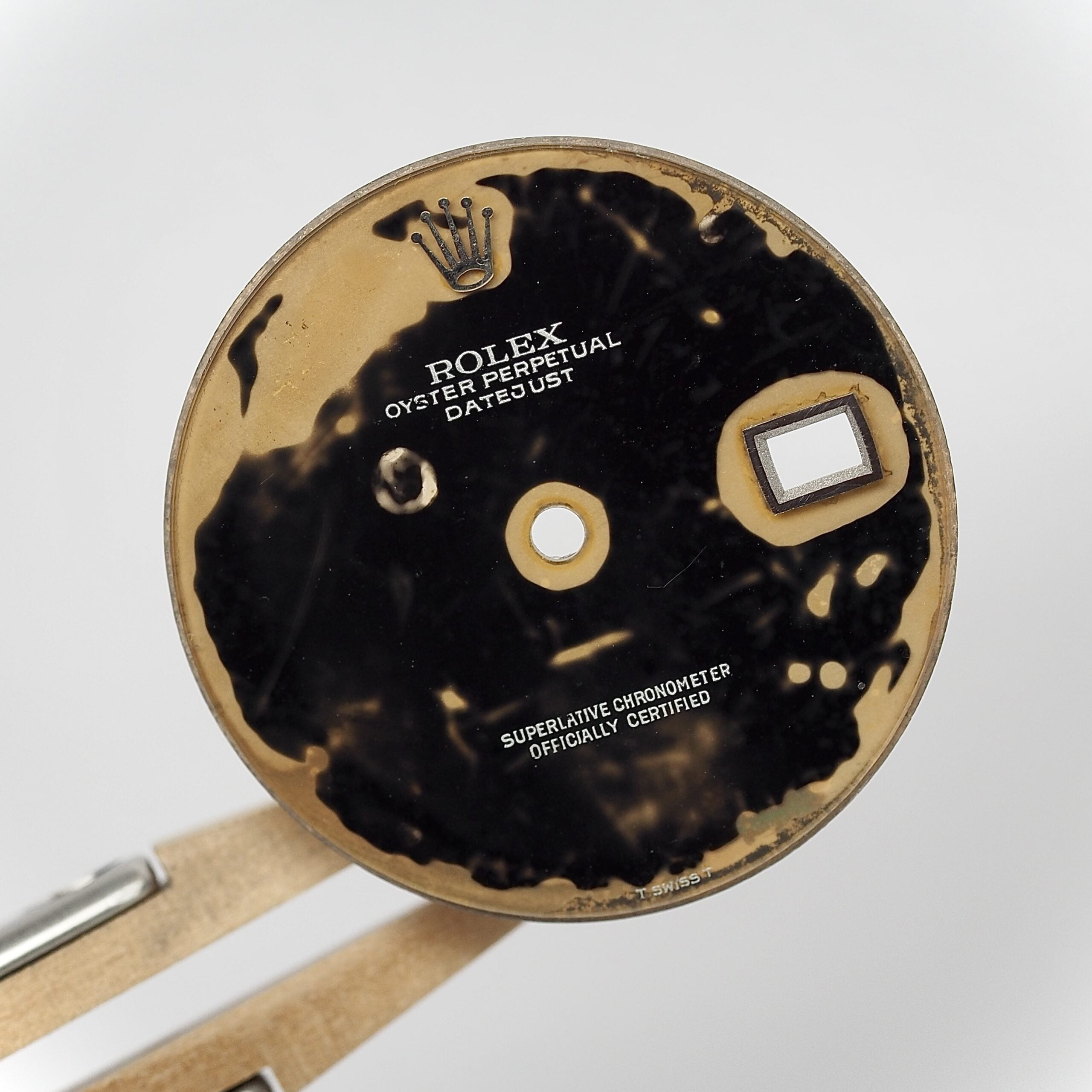
As mentioned earlier, the exact nature of the stone dial Rolex refers to as Obsidian remains debatable. This uncertainty led to another theory, which I initially put forward myself: that a very different dial found on certain four-digit Datejusts might in fact be the true Obsidian. As the theory gained traction, these dials became widely known and traded as “Obsidian.” However, after further research and careful examination of multiple examples, I no longer believe this identification is correct. The evidence strongly suggests that these are in fact Onyx dials that have discolored over time as the result of a chemical reaction, creating the distinctive brown and translucent patches previously mistaken for the natural structure of Obsidian.
Pyrite
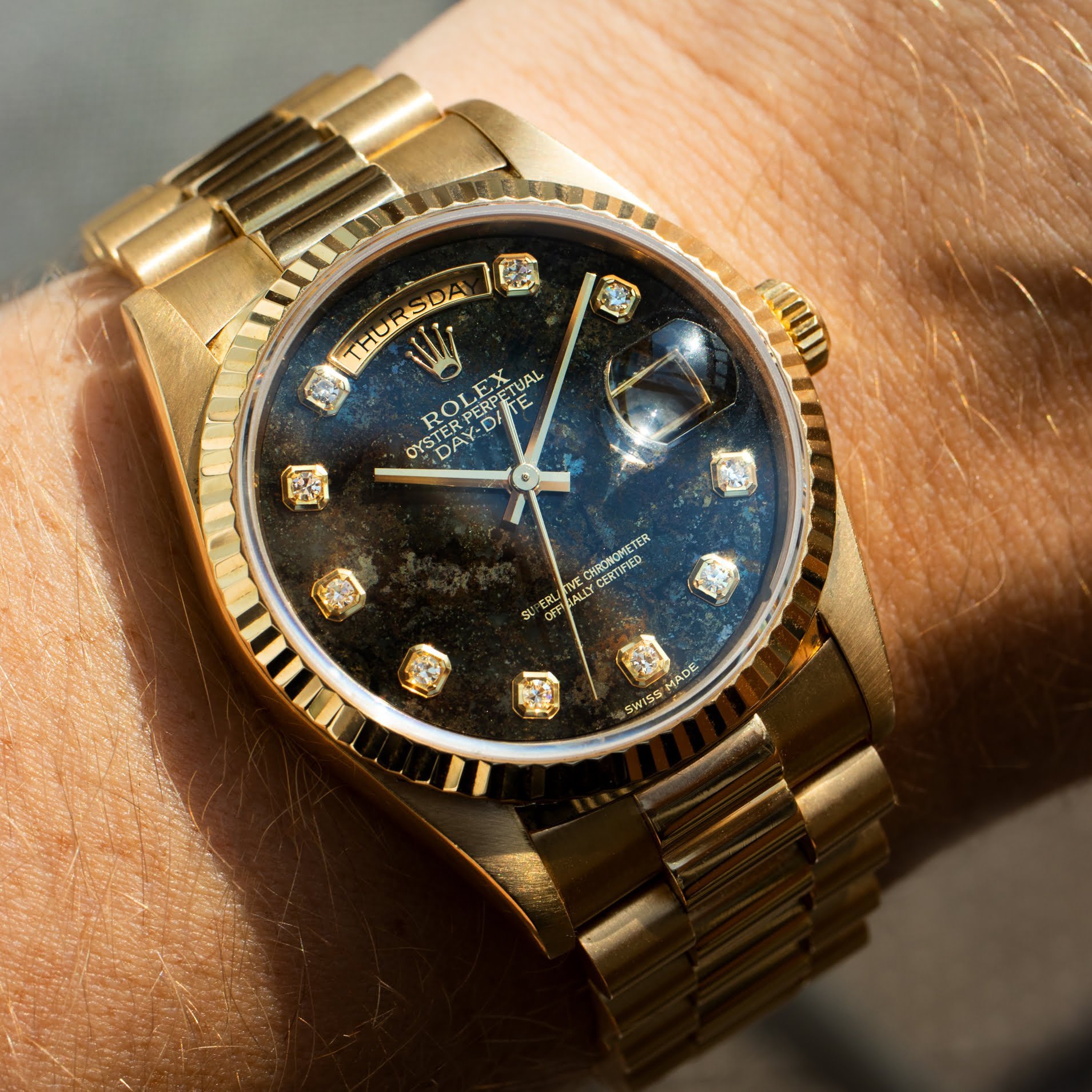
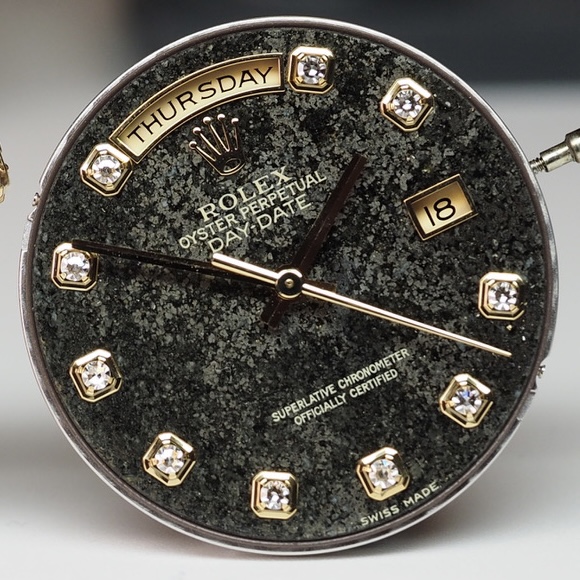
An iron sulfide mineral instantly recognizable by its metallic golden appearance, earning it the nickname “fool’s gold”. Its crystalline structure creates a highly reflective, naturally textured surface that can range from bright gold to darker brass tones.
Rubelite
Rubellite is the name given to the most intensely pink to red varieties of tourmaline. Its color can range from vivid raspberry and magenta to deep ruby red, often with subtle variations and inclusions running through the stone. Unlike ruby, which belongs to the corundum family, rubellite is a completely different mineral and derives its distinctive coloration primarily from manganese. When cut into the extremely thin slices required for a dial, these natural variations become particularly visible, giving each example its own character.
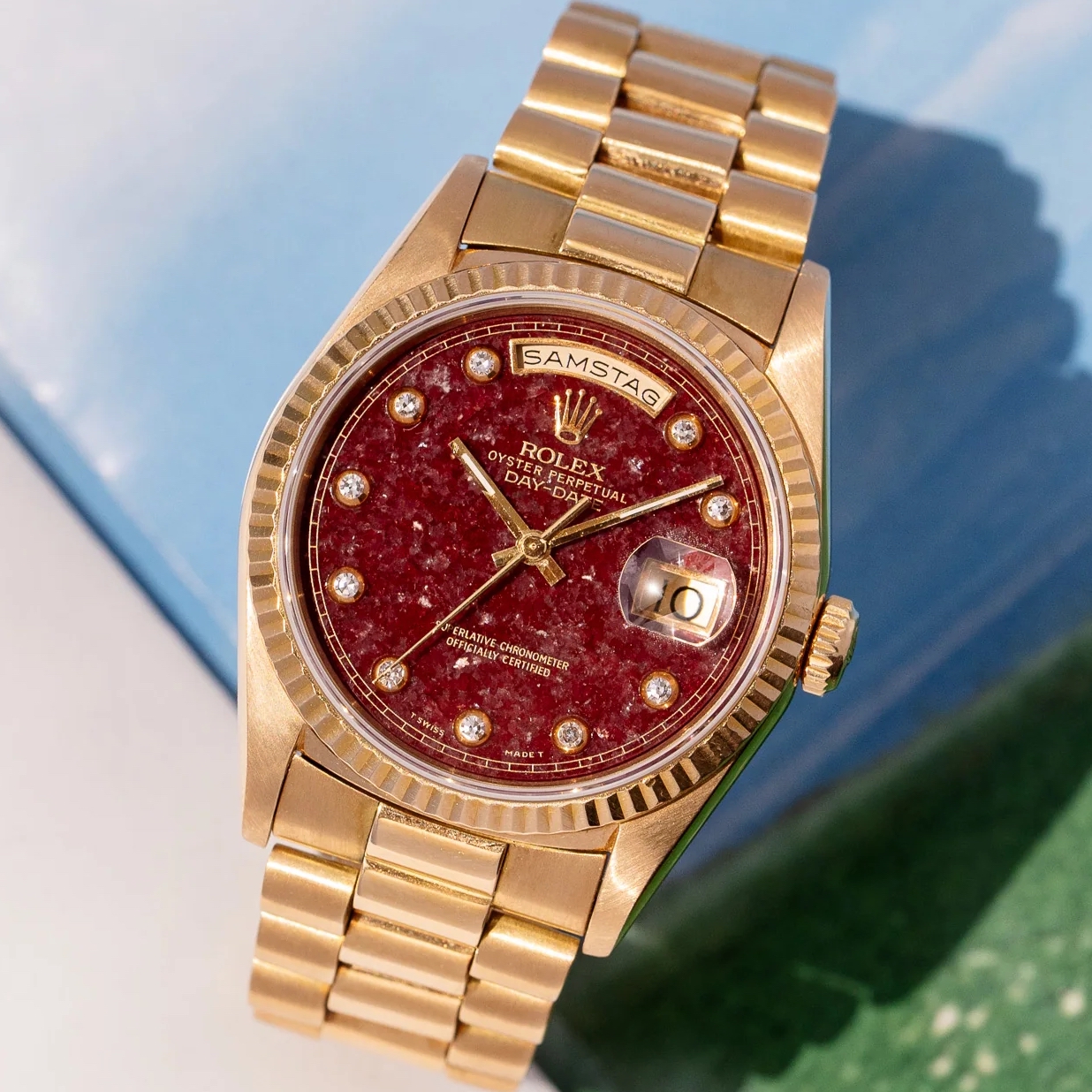
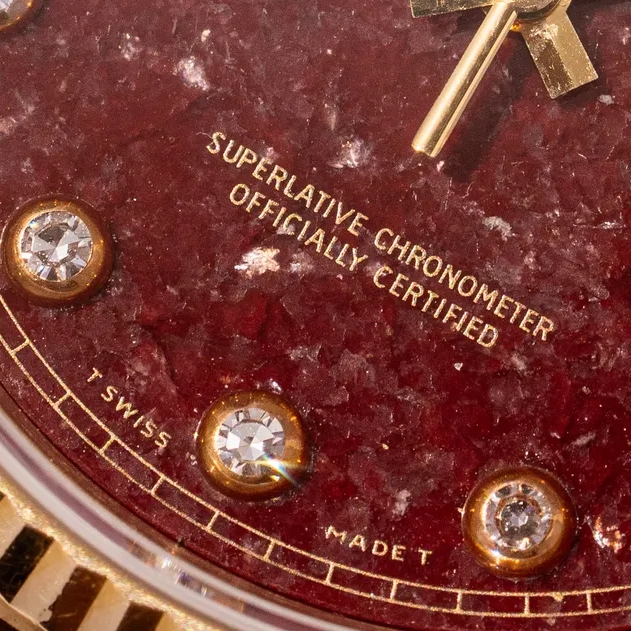
Sodalite
A rich blue mineral commonly interspersed with irregular white calcite veins. Compared with lapis lazuli, it generally has a softer blue appearance and lacks the characteristic golden pyrite inclusions.

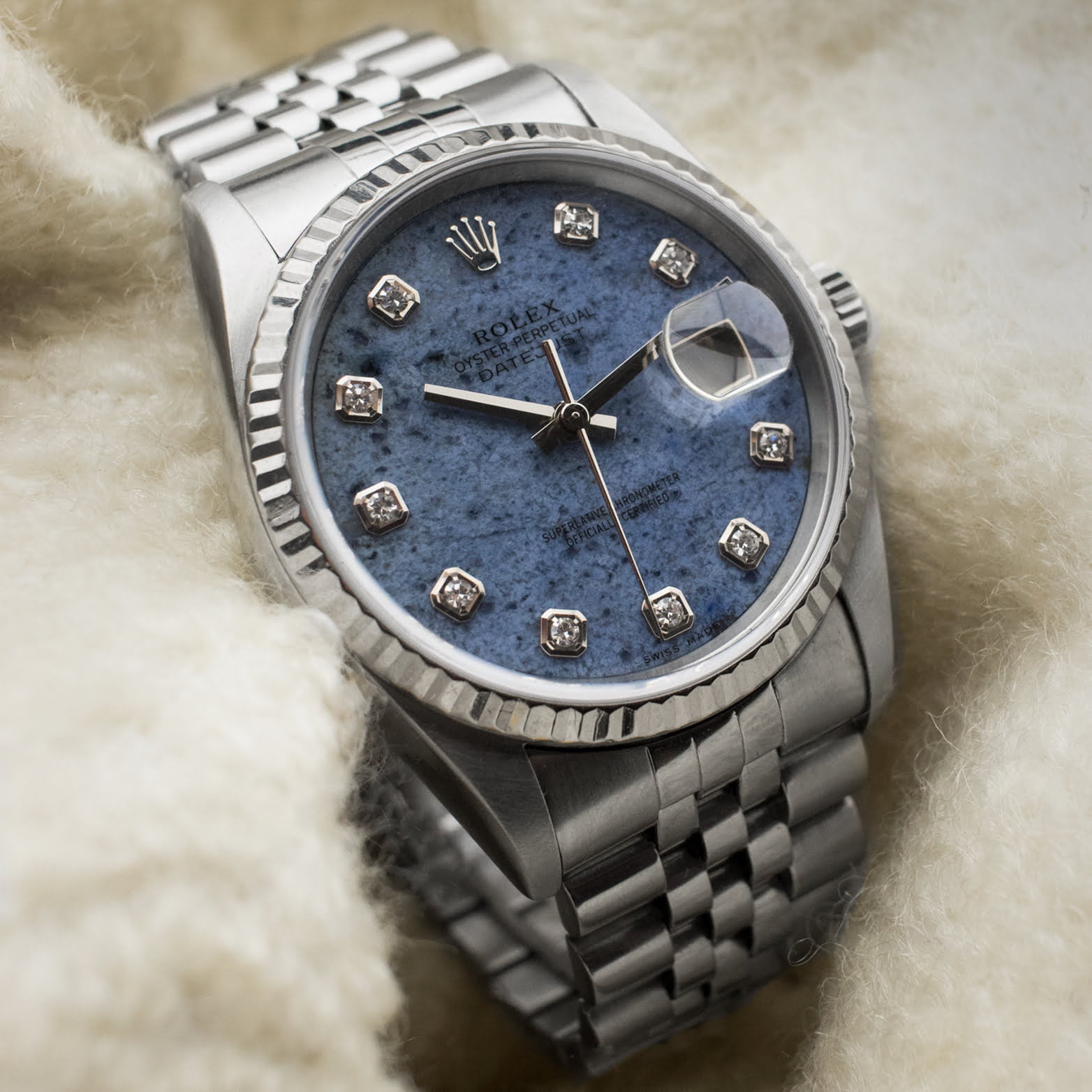
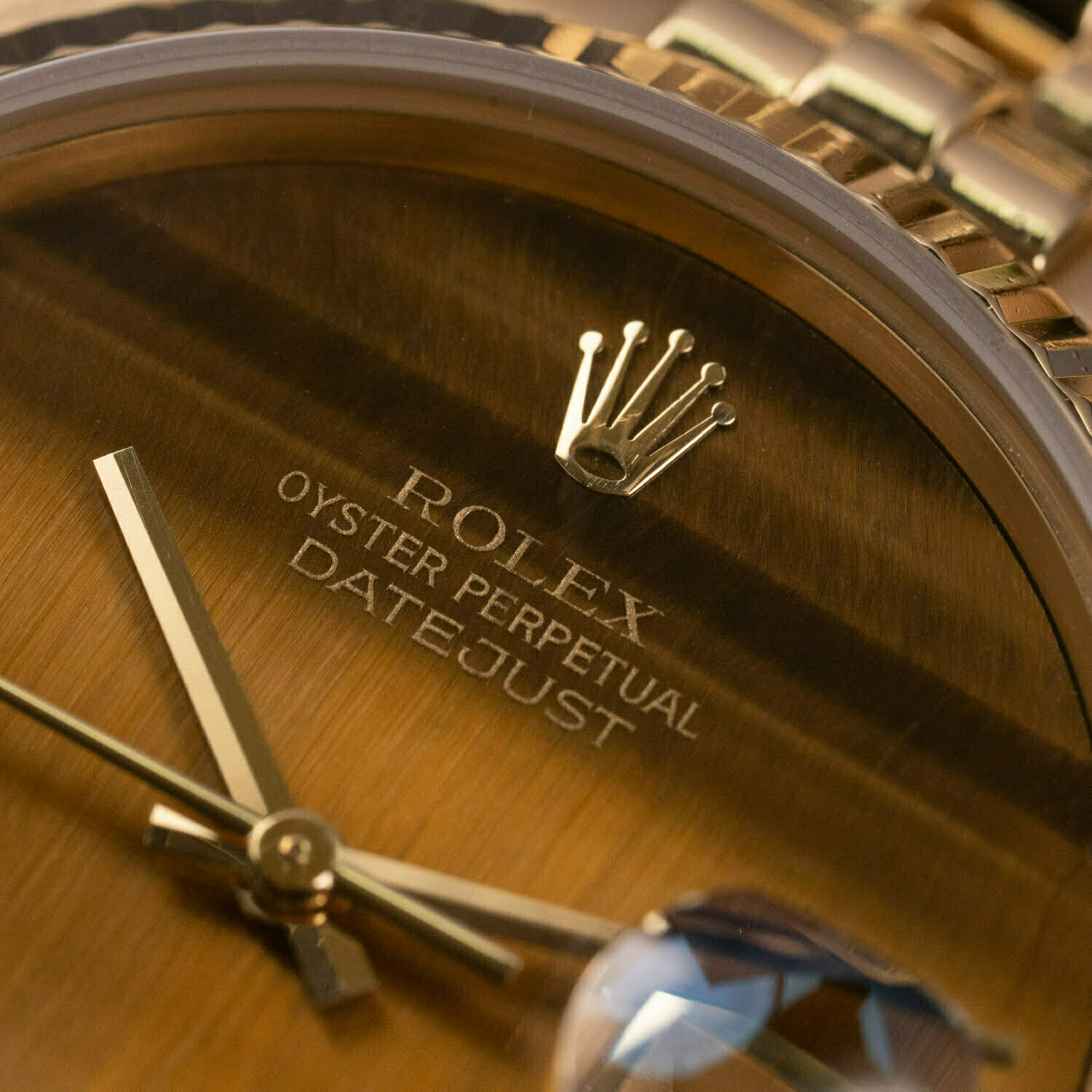
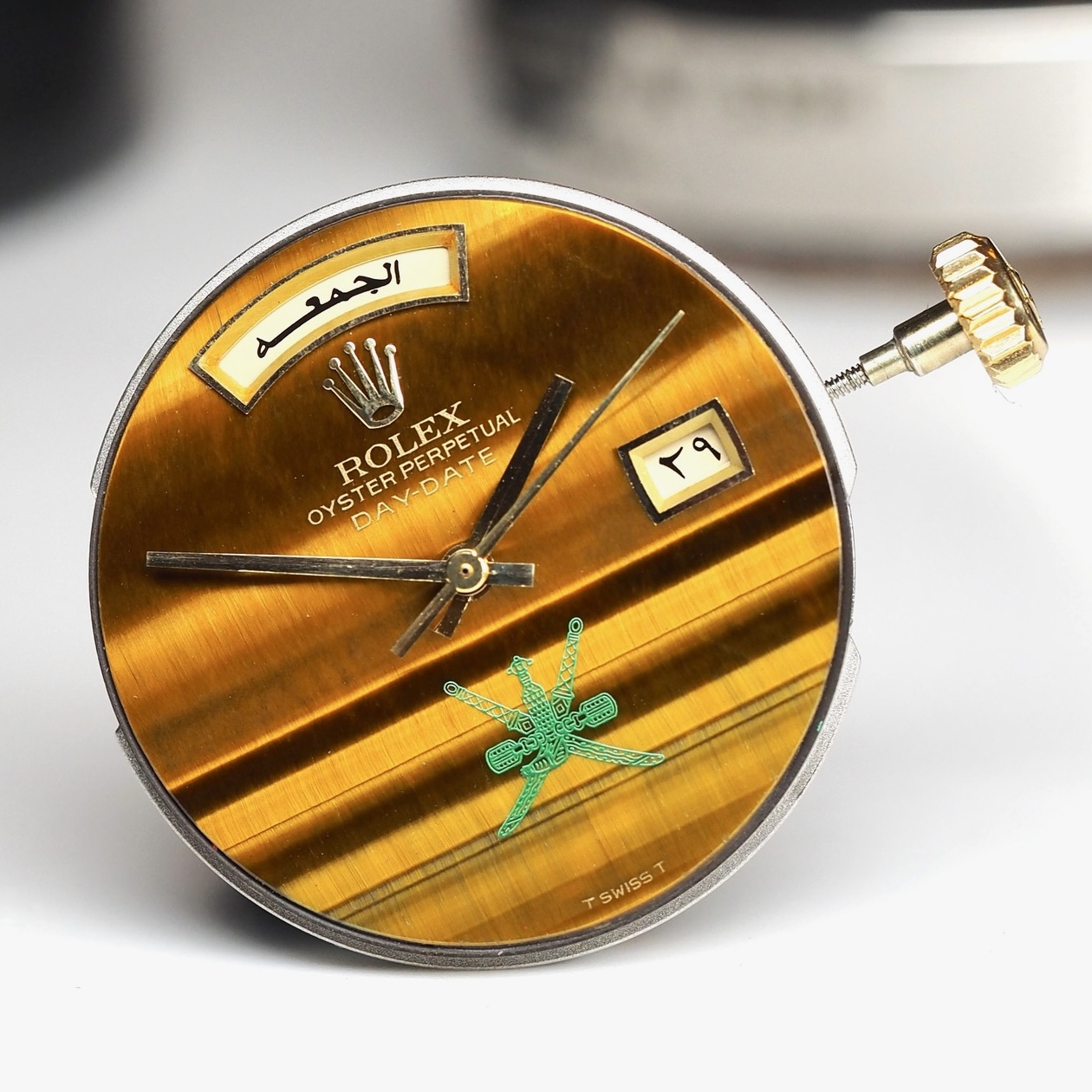
Tiger Eye
A chatoyant variety of quartz characterized by parallel fibrous structures. These produce the famous moving band of light across its golden-brown surface, creating an appearance that changes dramatically with the viewing angle.
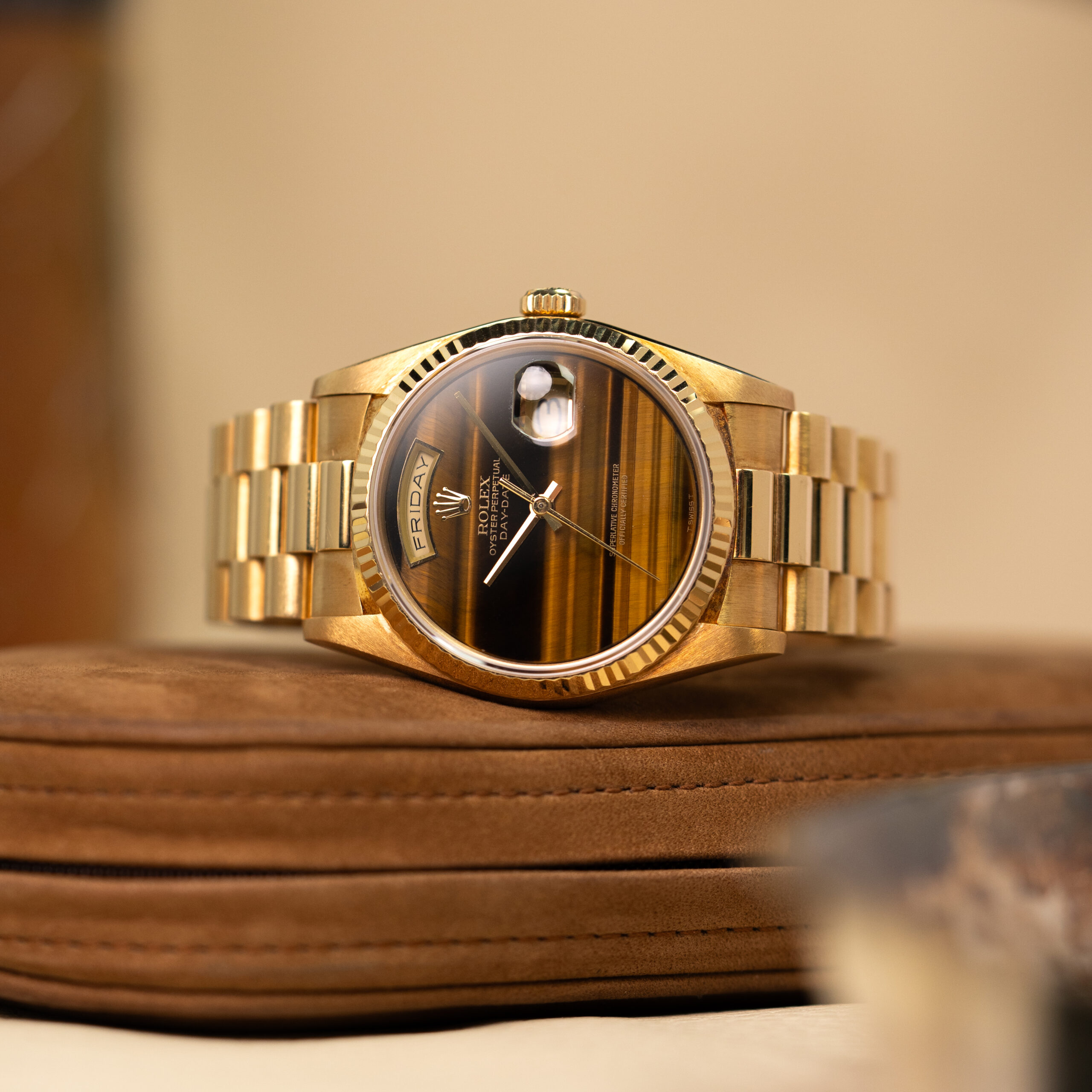

Not mentioned as not available in 36mm:
Azzurite, Chrysophrase, Opal, Siberite, Sugilite, Turquoise
Not mentioned as they are prototypes:
Hawks eye, Labradorite
Configurations
This table provides an overview of the configurations that I have personally encountered and verified. It is by no means complete, so if you are aware of a configuration that is missing, please do reach out so I can examine it and update the table accordingly.
The overview covers the period from the four-digit Datejust references through to the end of the five-digit era around 2000. Importantly, it is based on the production period of the dial rather than simply the reference in which it is found. Dials produced after 2000 but subsequently fitted to five-digit cases are therefore not included.

Outro:
I hope you enjoyed this guide and that it proves useful in your own journey of collecting, enjoying or researching Rolex stone dials. Above all, I created it to share my own passion for these extraordinary dials, hopefully spark some enthusiasm among fellow collectors, and provide a useful educational resource on a subject that remains surprisingly poorly documented.
The information presented here is the result of more than a decade of collecting, dealing and researching these watches. Unless stated otherwise, the watches pictured throughout this guide have all passed through our hands during that period. Even so, the images shown represent only a fraction of the tens of thousands of photographs I have collected and studied over the years.
This extensive photographic archive, combined with my own experience and that of other knowledgeable collectors and dealers, forms an important basis for how I study and authenticate stone dials. Unfortunately, I cannot share every detail of that process. As discussed earlier, counterfeiters closely follow published research and have become increasingly sophisticated in reproducing these dials. Revealing every characteristic used to distinguish an original from a counterfeit would ultimately help them improve the next generation of fakes.
Finally, while I am always interested in new discoveries, unusual configurations and information that can further this research, we do not offer authentication services. Please therefore refrain from contacting us with individual authentication requests.
Millions of years in the making, and only a few millimetres thick. Made by nature, shaped by Rolex.