Rolex Daytona 16528
€ 35.000



Rolex Daytona 16528
€ 35.000- Free worldwide delivery
Your accountant might disagree, but we think this stunning 1995 Daytona is a gold medal in its own right, ready to be worn on the wrist.
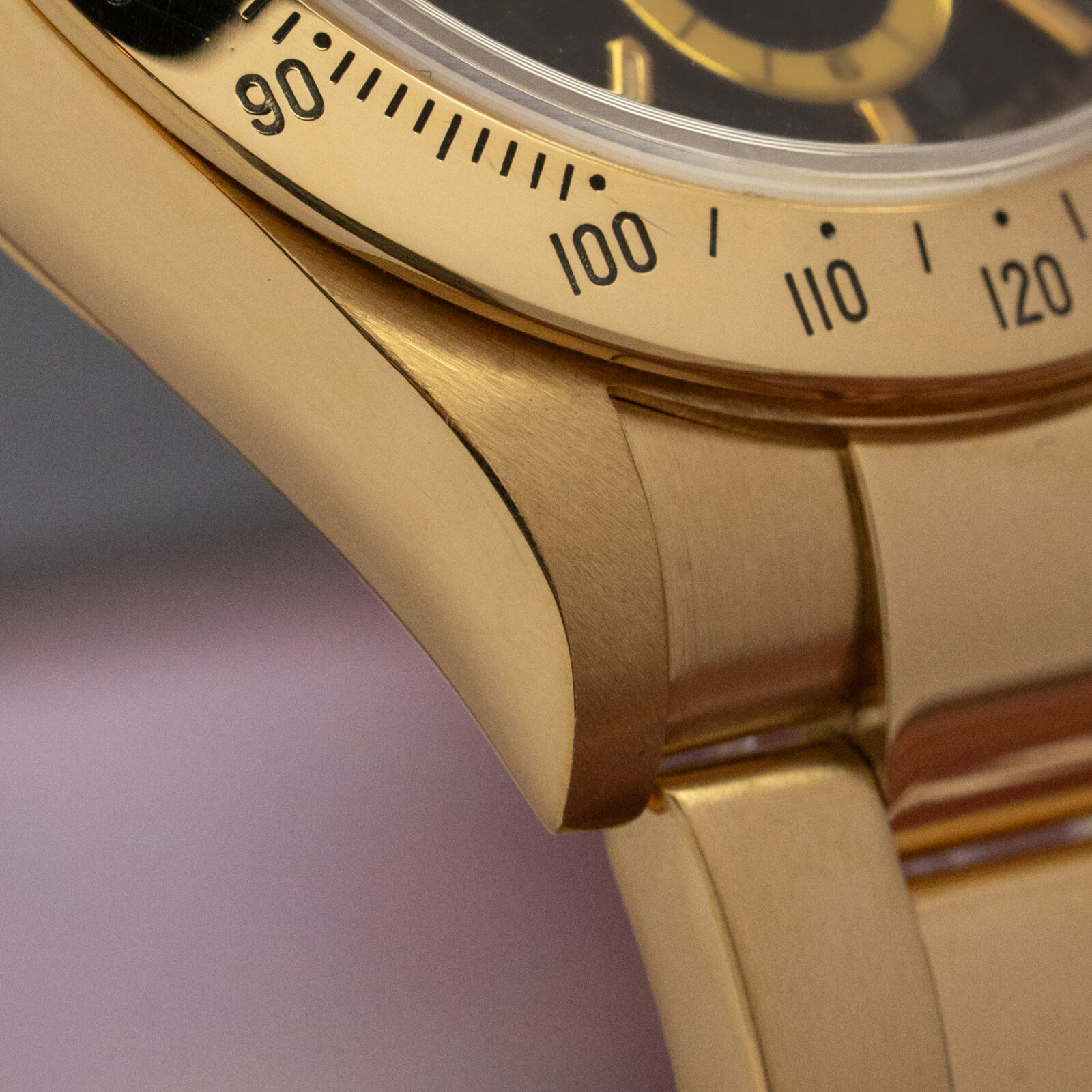
The black dial works so well against the warm 18k yellow gold. The dial has developed a slight patina over time, which, combined with the matching tritium in the hands, adds to its vintage charm. The three contrasting chronograph counters give the dial its iconic layout. The tachymeter bezel, executed in the same alloy, frames the dial beautifully. Whether you are timing a lap or simply measuring your boiled egg, this legendary Daytona is an elegant yet sporty way to keep time.
The case remains in beautiful condition, showing sharp, thick lugs with very little wear. Looking at the case back, all hallmarks remain very crisp. It also bears a rather uncommon original Rolex French import hallmark, a stamp that was required on gold items sold in France. A small detail that adds so much to the charm of a 1990s Rolex. The 18k yellow gold Oyster bracelet is in equally good condition, showing hardly any stretch. With clasp code W11, dating back to 1995, the bracelet is period-correct.
When Rolex introduced the ref. 16520 in 1988, it marked a major change for the Daytona. After decades of manually wound chronographs, Rolex finally introduced an automatic movement. The source of this new calibre was rather interesting, too. Zenith had developed the legendary El Primero, one of the best-known automatic chronograph movements, and Rolex decided to use it as a starting point. The original El Primero ran at 36,000 vibrations per hour, allowing it to measure time to a tenth of a second. Rolex reduced the frequency to 28,800 vibrations per hour and extensively reworked the movement to meet its own standards for reliability and serviceability. The result was the calibre 4030, which powered the Zenith-based Daytona range until the arrival of Rolex's first in-house automatic chronograph calibre, the 4130, in 2000.
For us, this Daytona is the perfect combination of mechanical history and a spectacular black and gold appearance. The Zenith-based movement makes it an important chapter in Rolex history. Your accountant may not agree, but we certainly do. Also because this piece will serve you for years to come.
Introduction
Rolex DaytonaRolex started making chronographs in the 1930s, but it was only in 1963 that a named product line was introduced: the Cosmograph. In some early advertisements, Rolex referred to the watch as the ‘Le Mans’ after the famous race track in France, although the name never appeared on the dial. After a few years, the line was officially renamed Cosmograph Daytona, after the racetrack in Florida.The most noticeable difference between these Cosmograph (Daytona) models and earlier Rolex chronographs, was the tachymeter scale (used for measuring distance and speed) that was moved from its traditional placement on the dial to the bezel. Furthermore, the dial was updated with the introduction of contrasting sub-dials.It’s hard to imagine now, but Daytonas received little love after their release. Most Daytonas languished in dealer displays for years and were only started to get noticed by Italian collectors and dealers in the late 1980s. Nowadays, Daytonas are among the most sought after Rolex models, fetching prices from $15,000 for modern ones to many millions for rare vintage references. A big contrast with the $210 list price when it was first released!
Specifications
- SKU 8273
- Bezel material
- Bracelet
- Caliber
- Case Dimensions
- Case Material
- Clasp
- Dial
- Glass
- Index
- Model
- Movement
-
Reference
16528
- Year